Gustavo Arellano: Noma's $1,500 meal is the antithesis of LA and the way we eat
Published in Op Eds


LOS ANGELES — Ulises Menchaca idled in his pickup truck on a steep street in Silver Lake, late for work.
In front of him, activists were emerging from a tour bus to gather in front of the historic Paramour Estate.
Menchaca, a landscaper, had landed in the middle of a traffic jam sparked by Los Angeles' latest referendum on itself.
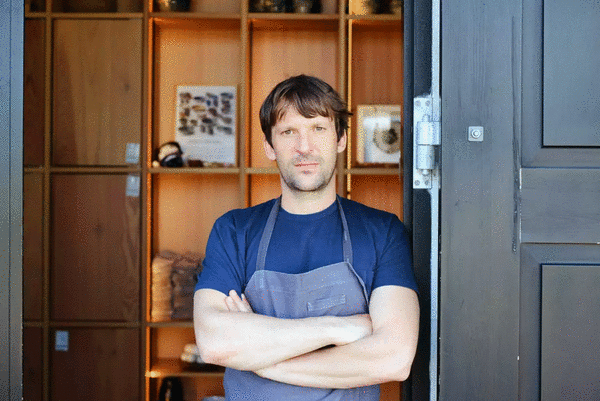
It was opening day for Noma L.A., a dinner series by Danish chef René Redzepi. For the next 16 weeks, the man behind one of the most famous restaurants in the world was going to work with his 130-member team at the five-acre compound to create multi-course meals costing $1,500 a seat.
"Imagine?" Menchaca, 52, said in Spanish when I explained Noma L.A.'s premise. Gardening tools weighed down the bed of his well-worn Ford Ranger. "I would have to work every day, all day, for three months to afford that. And if I had that money, why would I spend it on just one dinner?"
The price point is the least of Redzepi's sins. A recent New York Times article detailed allegations of abuse that Redzepi inflicted on his workers, from not paying interns to punching workers to jabbing them with forks to threatening their family members with deportation.
The chef, who has admitted to his "bully" past before, posted a weak-salsa apology on Instagram after the article published. On Wednesday, hours after the protest, Redzepi announced his resignation from Noma via a self-pitying video featuring forlorn crew members looking on as he urged them to "fight" for what he predicted would be "the restaurant of the decade."
"He's an a———!" cracked Jim Longeretta while waiting behind Menchaca in a luxury SUV when I asked if he knew what was going on. Would he go to a Noma dinner if someone else paid for it?
"No way," Longeretta replied. "Not with all the allegations right now."
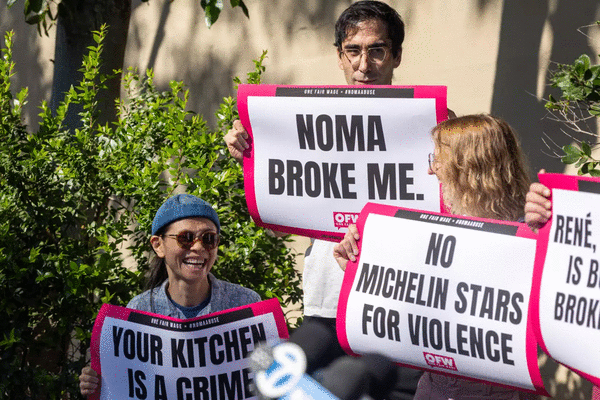
The bus finally parked down the hill. Holding signs that read "Noma Broke Me" and "Your Kitchen is a Crime Scene," about a dozen activists demanded that Redzepi meet with them and offer reparations to his victims.
L.A. is a city of reinvention, where second chances are a civic sacrament and residents often overlook the flaws of the famous. Here was a chance for Redzepi to redeem himself with true contrition.
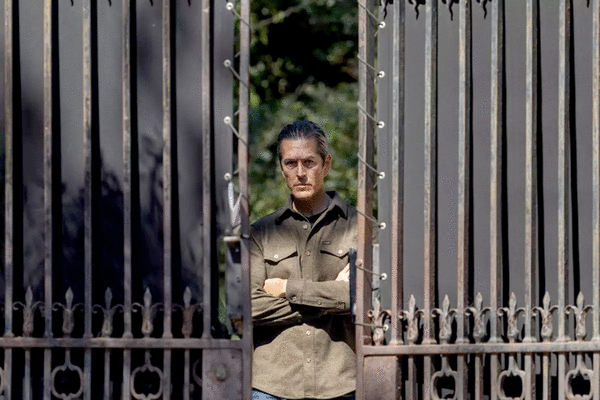
Instead, grim-faced men photographed protesters and the media. Employees peeked through a wrought-iron gate as former Noma head of fermentation Jason Ignacio White read a letter decrying Redzepi.
No one answered the intercom when White rang. A looky-loo employee refused to take the letter from him but snapped his photo as he left the letter hanging on a gate.
Security guards directed Latino workers to enter via a side entrance. When a New York Times reporter tried to interview a woman in a chef's apron and clogs carrying a flower bouquet, she ran back to her van.
"If [Redzepi] would pay any attention to what's going on in the city, he would have taken his approach differently," White said, referring to the fires and deportations that have afflicted L.A. "He doesn't care about people. He only cares about fame."
I'm OK with people spending $1,500 on a dinner. It's their money, and too many Angelenos do love conspicuous consumption. I have no problem with chefs like Redzepi catering to the elite — chefs have done that for centuries. His abhorrent behavior is sadly too common across the restaurant industry, from the finest dining to the humblest street stalls.
My main issue is the hubris of it all — and the people who enabled it.
When Redzepi announced Noma's residency last summer, the L.A. food world largely welcomed him as a culinary god. He was viewed as someone kind enough to grace us with his aura, who would renew an economically and spiritually depressed scene with his gospel of foraging, locally sourced products, food preservation and seasonality — so-called innovations that my Mexican grandmothers practiced without widespread adulation or million-dollar budgets.
Gushing media profiles willfully ignored Redzepi's problematic past and brushed aside the cognitive dissonance of offering a $1,500 Mexican meal in a city with wild economic stratification and a Latino community under existential threat from President Trump's deportation deluge, whose restaurants have particularly suffered.
Noma L.A. nevertheless sold out in 60 seconds. Its preliminary success and subsequent meltdown is another indictment of those who think that welcoming big names and events — the World Cup, the Olympics — is the way to save us.
How do you say "Pendejos" in Danish?
Last year, Redzepi told my colleague Laurie Ochoa that he chose Los Angeles for his first Noma pop-up in the U.S. because he "truly fell in love" with the city. He should have known that L.A. is sick and tired of powerful people trying to put a gloss on indefensible actions, whether it's Mayor Karen Bass and her handling of the Palisades fire or Trump and the state of this country.
Yet that's all Redzepi has done since the damning New York Times exposé. Meanwhile, his cult is such that defenders are dismissing his alleged victims as weak-willed crybabies.
Even more pompous is Noma L.A.'s philosophy. It was one thing for Redzepi to showcase the wonders of Nordic cuisine at his rarefied Copenhagen restaurant. It's quite another to land somewhere and deign to tell the natives he can elevate their cuisine, as when he completed a successful Noma run in the Yucatán Peninsula in 2017 — the late Times food critic Jonathan Gold praised the effort while concluding that "beauty and conflict are often intertwined."
Noma's website states that its staff will spend their time in L.A. "cooking, listening, learning, and building a body of work rooted in this place." For whom? Certainly not for Angelenos, who know what defines their metropolis culinarily, from pupusas to Tommy's chili burgers, from Persian food in West L.A. to regional Chinese cuisine in the San Gabriel Valley.
While Redzepi bragged about walking Sunset Boulevard from Chinatown to Santa Monica to absorb the city, he must not have soaked in an important fact: L.A. doesn't need an outsider to tell us how great we are. We already know.
Redzepi isn't completely clueless. He's teamed up with smaller local restaurants and nonprofits to boost their bottom lines and bring them attention. His team is also planning to release a coffee table book about Los Angeles culture. I was invited to contribute an essay and declined, knowing I'd want to write a columna about Noma in L.A.
I didn't imagine I'd be writing about how L.A. defeated Redzepi.
White and the other activists finished their speeches and then began a cacerolazo — a type of Latin American protest where people clang pots and pans. Two LAPD cruisers rolled up to meet with upset Noma employees who demanded that the cops shoo people away from the driveway. Officer Manny Gomez politely asked everyone to stay on the sidewalk.
"What's all this about?" Gomez asked me as we stood in the shade of a cargo truck. He shook his head and said, "Wow, that sounds kind of expensive" when I mentioned Noma L.A.'s price tag.
He declined comment further, so I asked him a better question: "What's your favorite taco spot?" After all, cops always know the best places to eat.
"21st and San Pedro. ... Everything you need!" Gomez immediately replied while protesters shouted "Shame! Shame! Shame!" at a fleet of electric Cadillac Escalades chauffeuring Noma L.A.'s first round of diners in for lunch. White's letter to his former boss remained untouched on the gate.
Gomez's recommendation reflected an L.A. that Redzepi could never hope to channel, where we freely share what we love because we want it to succeed. Where we don't hide behind high walls, apologists and exorbitant price tags.
I left the Noma protest and drove 20 minutes to El Grullense, a taco truck with an adjoining dining room near the Santee Education Complex. I ordered a fat carne asada burrito that came with two delicious salsas and a grilled jalapeño. Add a mandarin-flavored Jarritos, and my lunch cost $15.
A hundred of those would buy me one night at Noma L.A. Give me El Grullense.
The lunchtime crowd — high schoolers, blue-collar types, the elderly — waited patiently for their orders.
Guillermo Rojas Ortega and Juan Villaseñor went with a carne asada burrito, an al pastor burrito and two tacos de cabeza. The friends scoffed when I told them where I had just been.
"$1,500?!" said Rojas Ortega, a 37-year-old truck driver from Watts. He repeated the figure in Spanish, as if saying it in another language might help him make better sense of it. "Does it at least go to charity?"
"That's bulls—," replied Villaseñor, 40, an electrician, when I said no. "There's no money for poor people in the hood, but people go to that?"
They were even more disgusted when I brought up Redzepi's alleged abuse.
"Hell, no!" Rojas Orega exclaimed. "What does he have to do with community?"
"Even though that foo sucks, they're still going for the food? That's BS," Villaseñor said.
Their burritos and tacos were ready. Before the two dug in, I asked if they had a message for Noma diners.
"Whoever sees him," Villaseñor said of Redzepi, half joking and half not, "punch him."
____
©2026 Los Angeles Times. Visit at latimes.com. Distributed by Tribune Content Agency, LLC.


















































Comments