James Stavridis: 3 targets for US boots on the ground in Iran
Published in Op Eds
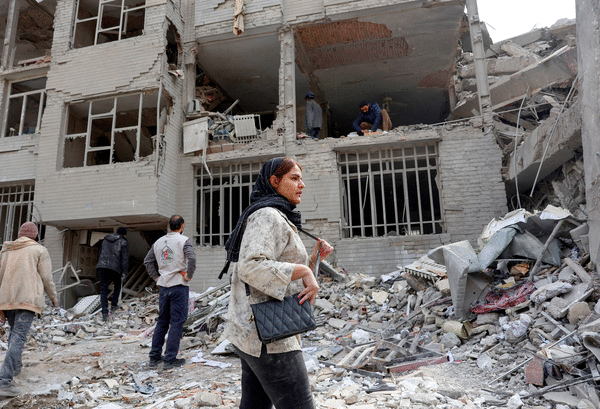
As President Donald Trump’s administration wrestles with options in the war with Iran, it continues to consider “boots on the ground.” While the Pentagon has been doing a good job with the massive air and sea assaults against Iranian targets, there are several dangerous missions that ultimately would require US troops within Iran’s territory.
“We would be completely unwise if we did not reserve the right to take any particular option,” Secretary of Defense Pete Hegseth said. “Whether it included boots on the ground or no boots on the ground.”
While a full-scale rerun of the Iraq playbook of 2003 — an all-out invasion with hundreds of thousands of troops coming ashore — seems highly unlikely, there are a handful of scenarios in which special forces could be used as the forward edge of American ground power.
I am not a Navy SEAL or Army Green Beret, far from it, but over the course of my career I have commanded them, as well as the Army’s storied 75th Ranger Regiment, in both the war in Afghanistan and counterterrorist operations in Colombia. Contrary to what many in the public (and Hollywood) may believe, special forces are not impulsive “make it up as you go along” types. They are the most meticulous planners in the military.
When Delta Force, one of the nation’s top-tier units, was assigned to me in Colombia for a delicate hostage-rescue mission, I saw firsthand the extreme level of detail that goes into special operations planning, taking into consideration every variable, including the negative ones. As the war unfolds in Iran, I am certain the armed services are thinking through several potential missions for their elite warriors.
What kinds of scenarios are being presented to President Donald Trump? And just how perilous would such missions be?
One top target would be the large amounts of enriched uranium that the Iranians may still possess. By all accounts, we don’t know exactly where it is located, and it may be buried and inaccessible after Operation Midnight Hammer back in June, which devastated Tehran’s nuclear program.
However, if the US has solid intelligence about the stockpile (perhaps in Isfahan in central Iran), locating and either destroying it or extracting it is worth exploring.
If the stockpile is accessible, it would undoubtedly be guarded by a significant Iranian force, probably the most elite units. Special technicians would have to accompany the US military teams to handle the safe extraction or destruction of the enriched uranium: Detonating it crudely would risk a “dirty bomb” situation. Alternatively, attempting to extract it is also daunting given its weight, which could approach 1,000 pounds.
Perhaps not mission impossible, but mission really, really challenging. Put this one down as unlikely in terms of near-term execution.
A second tempting target would be Kharg Island in the Persian Gulf. This is the main location for the Iranians’ oil and gas terminal transits, and depriving them of the crown jewel of their energy system would be a significant achievement. It is only 16 miles off the coast of Iran, and well northwest of the newly mined Strait of Hormuz. Simply destroying the infrastructure by bombing is a possibility, but the US hasn’t done so yet, because controlling it would be far better.
An advance force of special operators, followed by high-end conventional forces such as the Army’s 82nd Airborne Division, could take control of the island. This would send a powerful signal to the rotten theocracy in Tehran, deal a mortal blow to the Iranian hydrocarbon economy, and reduce the Iranians’ ability to control shipping in and around the northern reaches of the Gulf. It could also provide a significant foothold for further ground operations. This would require a significant commitment of troops but is likely achievable.
A third mission would be partnering with the Central Intelligence Agency and Israel’s Mossad to send small teams into Iran to connect with the political opposition to form a true resistance movement. The forerunner of the CIA, the Office of Special Services, did exactly this in World War II with the French resistance, a vital part of the war effort.
Again, the risk is high, and the decision would be dependent on the level of confidence in America’s intelligence and connections with Iranian dissidents. The Israelis appear to have deeply penetrated Iranian society, and the Iranian American diaspora has a significant pipeline into the restive civilian population. Iranian resisters need organization, money and perhaps weaponry, but involvement of special forces in support of intelligence operators could achieve it.
Putting boots on the ground is always risky. No doubt US special forces are already planning these and other daring operations with high payoff. They are the best in the business, so nothing should be left off the table.
____
Stavridis is dean emeritus of the Fletcher School of Law and Diplomacy at Tufts University. He is on the boards of Aon, Fortinet and Ankura Consulting Group.
____
This column reflects the personal views of the author and does not necessarily reflect the opinion of the editorial board or Bloomberg LP and its owners.
James Stavridis is a Bloomberg Opinion columnist, a retired US Navy admiral, former supreme allied commander of NATO, and vice chairman at Carlyle.
©2026 Bloomberg L.P. Visit bloomberg.com/opinion. Distributed by Tribune Content Agency, LLC.




















































Comments