David M. Drucker: Democrats are trying to reclaim patriotism from the right
Published in Op Eds
Democrats wouldn’t be trying so hard to embrace the American flag if they didn’t have something to prove to voters.
In the wake of the deadly coronavirus pandemic and George Floyd’s killing, many prominent figures on the political left — activists, commentators, politicians and scholars — have reexamined U.S. history, focusing on the flaws of the country’s founding and society over the past nearly 250 years. Republicans, led by President Donald Trump, have used this introspection to paint Democrats with a broad brush as reflexively anti-American, sometimes to devastating effect.
Democrats and the left have even lent the GOP a hand in this effort from time to time.
Just last August, the Democratic National Committee opened a summer meeting in Minneapolis with a “land acknowledgment” that argued: “In many ways, we still live on a system built to suppress indigenous peoples.” Years before, when protests over Floyd’s death ushered in heightened scrutiny of an American history that included slavery and racial inequality extending long past emancipation, The New York Times Magazine published “The 1619 Project.” The view of U.S. history exhibited in many of the pieces essentially declared the American founding — and thus, much of what came after it — as barbaric, which quickly gained currency among progressives.
Americans accept that the U.S. has not always honored the Declaration of Independence and the Constitution. That’s an undeniable, historical fact.
But tell voters that the land they’re living on is stolen property and that their country is inherently evil — despite all of the good, and all of the progress, the U.S. has made — and it might be hard to win competitive elections. Most Democrats active in politics know this better than anyone.
It’s why former President Joe Biden’s message in 2020 revolved around love of country; it’s why American flags were ubiquitous at then-Vice President Kamala Harris’ nominating convention in 2020. And it’s why Democrats are aggressively reclaiming the American flag, and patriotism broadly, as their own.
“Patriotism does not belong to one party,” Democratic Rep. Pat Ryan of New York, a military veteran, wrote in a dear colleague letter last year, Politico’s Adam Wren reported. “The flag, and the values it stands for, belong to every single American.”
Eight months before the midterm elections and 32 months before the next presidential election, Democrats seem aware they need a way to reclaim coveted voting blocs that shifted toward Trump in 2024. The president’s appeal with some, including working-class union members and working-class Hispanics, was to some degree cultural: He celebrated America and the American dream with an unbridled enthusiasm they didn’t see from Harris.
“America is the greatest nation in history because it’s built upon the greatest idea in history — that the circumstances of your birth should not determine the condition of your life,” U.S. Representative Jake Auchincloss, a Massachusetts Democrat, told me. “No Democrat who disagrees will become president, because Americans want their leader to love their country.”
“We have to do better at understanding how to communicate and inspire people and get them to trust us that we’re really going to step up and deliver,” added Cait Conley, a military veteran seeking the Democratic nomination in New York’s contested 17th Congressional District in the lower Hudson Valley. “Going back to being proud to be an American — absolutely. That responsibility to keep fighting for America and make it better, we should embrace that on both sides of the aisle. … I love this country and think you need to lead by example.”
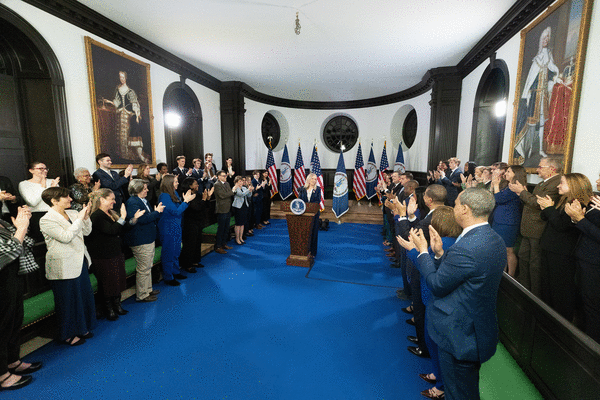
Virginia Gov. Abigail Spanberger and her well-crafted and expertly staged rebuttal to Trump’s State of the Union address is a prime example. Previous counters in Virginia to a president’s State of the Union came from the governor’s mansion (Democrat Tim Kaine in 2006) or the commonwealth’s House of Delegates chamber in Richmond (Republican Bob McDonnell in 2010). Spanberger chose to travel south to colonial Williamsburg and speak from the historic House of Burgesses. She explained why.
“In 1705, the people of the Virginia colony gathered here to take on the extraordinary task of governing themselves. Before there was a Declaration of Independence, a Constitution or a Bill of Rights, there were people in this room. The people who served here ultimately dreamed of what a new nation, unlike anything the world had ever seen, could be,” Spanberger said, flanked by American and Virginia flags. The governor linked the Democratic Party’s opposition to Trump directly to the values of the American founding and President George Washington’s farewell address.
That’s quite a U-Turn from "The 1619 Project," which posits that the true and permanently scarred American founding occurred in 1619, when the first enslaved Africans in North America arrived in none other than the colony of Virginia. Spanberger’s celebration of her state, once home to the capital of the Confederacy and the important role it played in the American founding, may irk some on the progressive left. But Democratic operatives focused on assembling a center-left coalition capable of winning national elections applauded the governor’s remarks as most welcome.
“Spanberger delivered a majority-building message of America renewal,” Andrew Bates, a former Biden adviser, told me. This surge of public patriotism from prominent Democratic officials is a promising development — politically speaking — for a party still in the process of figuring out what went wrong in 2024.
However.
The Democrats eyeing a White House bid in 2028 have more to ponder than political messaging. Yes, Trump’s sagging job approval ratings and the Democratic Party’s generic ballot lead, gauging which party voters would prefer control Congress, bode well for the party this year. But Biden was headed for defeat in the last election, and Harris lost in part because a majority of voters were unhappy with the 46th president’s record on key issues. The next Democratic nominee must not just talk better. He or she needs to convince voters they can govern better, too.
____
This column reflects the personal views of the author and does not necessarily reflect the opinion of the editorial board or Bloomberg LP and its owners.
David M. Drucker is a columnist covering politics and policy. He is also a senior writer for The Dispatch and the author of "In Trump's Shadow: The Battle for 2024 and the Future of the GOP."
©2026 Bloomberg L.P. Visit bloomberg.com/opinion. Distributed by Tribune Content Agency, LLC.

















































Comments