Editorial: Whatever his reasons, it's good Gov. JB Pritzker isn't joining other blue states on the tax-the-rich bandwagon
Published in Op Eds
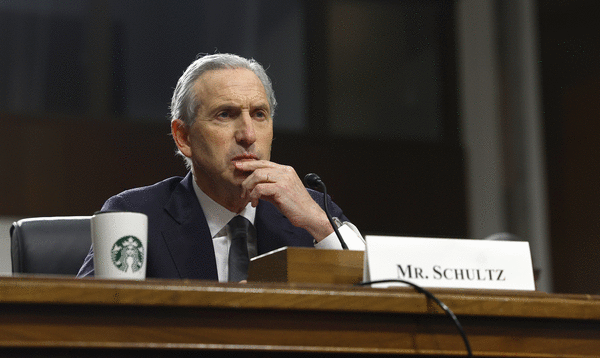
News broke earlier this week that Howard Schultz, the founder of Starbucks and a multibillionaire, is moving from his long-time home in Washington state to South Florida.
Schultz didn’t say the move was a response to Washington’s likely enactment soon of a 9.9% tax on income above $1 million, but the timing was hard to ignore. It’s become something of a theme — a theme we suspect will grow — that the uber-rich are voting with their feet as blue states increasingly look to tax their wealthiest residents.
Meta CEO Mark Zuckerberg recently closed on a $200 million mansion in the so-called “billionaire bunker” on Indian Creek Island in South Florida — a move coming as supporters gather signatures to put a one-time 5% tax on billionaires’ wealth (including unrealized gains) on the ballot in California, where Zuckerberg has lived for years. Other California billionaires already have decamped.
In New York, state legislative leaders are backing a bevy of new taxes on business and high earners. In response, New York City Mayor Zohran Mamdani, who won election last year on a soak-the-rich platform, expressed his gratitude. Mayor Brandon Johnson surely is looking from afar with envy, having begged Springfield for three years with no success to pass such taxes.
Johnson and his fellow progressives continue to beat the same drum in Springfield, but there’s no sign their fortunes will change. Why? Because Gov. JB Pritzker has stood in the way.
In Illinois — a state every bit as blue as Washington and New York — Pritzker has proposed a fiscal 2027 budget that’s mainly about belt-tightening. As he faces yet another significant budget deficit, the governor thus far has ignored calls from those on the left, including House Speaker Emanuel “Chris” Welch, for a surtax on millionaires — an initiative that would require passage of a constitutional amendment.
Whatever his motivation, we’re pleased that Pritzker to date appears to have recognized that Illinois is in no position to give its wealthiest residents more reasons to leave the state. Our economy has struggled for years; taxes already are high when taking into account income, property and sales levies; and underfunded public pensions sap confidence from would-be investors that Illinois is a good place to start or expand a business.
Pritzker took a run soon after first winning office at amending Illinois’ Constitution to allow for a graduated income tax. The Constitution currently allows only for a flat income tax, making bids to raise it for individuals politically toxic. Illinois voters handily rejected Pritzker’s proposal.
Ever since, Pritzker has pointed to that defeat when Welch and others beseech him to try again.
The worry for us and others concerned about keeping Illinois from further harming its economic competitiveness is that Pritzker’s reticence when it comes to special taxes on high earners is mainly a political calculation. Pritzker is running this year for a third term as governor and is an overwhelming favorite to retain the office. But, of course, he also is considering a 2028 presidential run, and if he takes the plunge Illinois’ story will double as his own political argument for support from the rest of the country.
Doubling down on the high-tax, low-growth narrative that unfortunately has defined Illinois for years isn’t likely to get people excited about JB in ’28.
If political calculations are what is stopping Democratic Party-dominated Illinois from sending more of its wealthy residents packing for more tax- (and weather-) friendly climes, we’ll take that. Ultimately, the only sustainable way out of Illinois’ fiscal woes is to make the state a favorable destination for new residents and growing businesses.
But we hope that Pritzker’s laudable efforts to keep his fellow Democrats from making Illinois even less competitive than it already is are based on his beliefs as to what constitutes good policy and what voters have told him they want.
Republicans and others have criticized Pritzker for running for re-election while harboring presidential ambitions that may well have him less than fully focused on Illinois’ needs during a third term. But if a presidential run means Springfield’s tax-and-spend set is kept at bay for the next few years, a little distraction from Pritzker’s day job may be a small price to pay.
___
©2026 Chicago Tribune. Visit at chicagotribune.com. Distributed by Tribune Content Agency, LLC.




















Comments