Jill Burcum: To some, Minnesota's fierce pushback against ICE was entirely predictable
Published in Op Eds
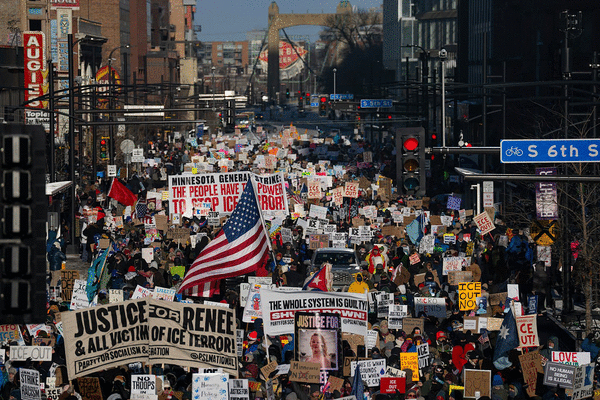
MINNEAPOLIS — U.S. Homeland Security Secretary Kristi Noem and her flunkies may have expected a population that would cow before the masked, armed agents dispatched to Minnesota. Instead, the Twin Cities refuse to break.
Individuals organized. Tens of thousands have marched. While Operation Metro Surge continues, its implementation here is a systemic failure capped by the deaths of two Minnesotans at the hands of immigration agents. President Donald Trump, who rarely admits mistakes, has had to acknowledge operational problems and has expressed that changes are needed.
The current powder keg in Minnesota was entirely predictable for those who’ve read an intriguing and provocative 2011 political science book called “American Nations.” Its author is historian Colin Woodard, a Maine native who runs the Nationhood Lab at Rhode Island’s Salve Regina University. His premise is that the United States is a lot less united than its name suggests.
Instead, he argues persuasively that there are 12 regional nations within in the continental United States whose identities were forged long ago by settlers and colonizers. With each identity came different ideas about the kind of society they were building, how society should be structured and the proper role of government, not to mention democracy itself.
Throughout U.S. history, these regional identities have not only persisted but competed for power, according to Woodard. Viewing the immigration enforcement surge through the “American Nations” lens offers fresh insights into why Minnesotans have reacted so forcefully. The Nations model may also illuminate political reverberations ahead for this fall’s pivotal midterm elections.
I spoke with Woodard recently, running by him my own application of Nations theory to Minnesota events. Our conversation is summed up below. Before you jump in, a brief backgrounder:
(To see a map of all nations, go to tinyurl.com/bdakk6st.)
One of my working theories is that our state’s Yankeedom culture is driving the fierce citizen pushback that caught federal immigration officials by surprise. I asked Woodard about this, and he agreed.
As he noted, hardwired into the extended Yankeedom cultural space is the Puritan belief that their mission was to build a better society. That legacy left a deep faith in shared institutions, local self-government, and the idea that government should be a tool for solving common problems rather than imposing authority from above. Civic participation runs deep and the nation is understood as a civic project rooted in the Declaration of Independence’s promise of equal rights.
Federal immigration operations, perceived as heavy-handed or authoritarian, collide directly with those instincts. Woodard summed it up this way: In Yankeedom, it feels like an illegitimate occupation, one foisted upon it by a polar opposite rival with an alien value system.
Is it any wonder that Minnesotans have reacted so strongly?
Woodard also noted that similarly energetic pushback emerged when ICE recently operated in Maine but less so in cities that lie within the Deep South or nations aligned with it.
November midterm elections loom. Can the Nations framework offer insights into how the fallout from Minnesota’s situation might spur elective backlash?
Woodard didn’t hesitate to sum up the political risks of an angry, energized Yankeedom for state Republicans. “It’s going to be to the benefit of Democrats because this action ... is offensive to the underlying communitarian values of the Yankee cultural space.”
That’s also likely the case in another nation similar to Yankeedom: what Woodard calls the “Left Coast.” It’s a narrow coastal strip that runs from California to Oregon to Washington. It includes San Francisco and Seattle.
But there are other nations where the enforcement actions hew more closely to culture, such as the Deep South, Greater Appalachia and the Far West, a region prioritizing individual autonomy, suspicion of government and intense conflicts over land and water. These nations are part of the broader alliance of competing nations that propelled Trump into power.
But this alliance has also included El Norte, a borderlands culture of the Southwest, shaped by centuries of indigenous and Hispanic settlement; and another large nation called the Midlands, which includes most of Iowa, some of the Dakotas and parts of Ohio, Illinois, Indiana and Pennsylvania. Settled largely by Quakers and later European immigrants, the Midlands nation values moderation, local community autonomy, social tolerance and a deep suspicion of top-down authority.
As Woodard noted, the recent immigration actions appear to be at odds with these two nations’ core values, potentially eroding Trump’s support there and threatening his party’s control of Congress. The actions may also be unpopular in southern Florida, which is part of the Spanish Caribbean nation, another location where Trump has enjoyed strong support.
If Woodard’s framework holds, Minnesota is not an outlier but a warning. The Twin Cities’ resistance is rooted deeply in its core values. Other regional nations, particularly the Midlands, El Norte and the Left Coast, are likely hardwired in similar fashion.
Continuing ICE operations strategies that are offensive to regional nations’ DNA risks fracturing the fragile coalition that brought Trump a second term in the White House, something that should give pause to his administration and his supporters.
Said Woodard: “If one is governing to win elections, this is terrible politics for Trump and for Republicans.”
___
©2026 The Minnesota Star Tribune. Visit at startribune.com. Distributed by Tribune Content Agency, LLC.









































Comments