Commentary: War for Independence was 'the people's war'
Published in Op Eds
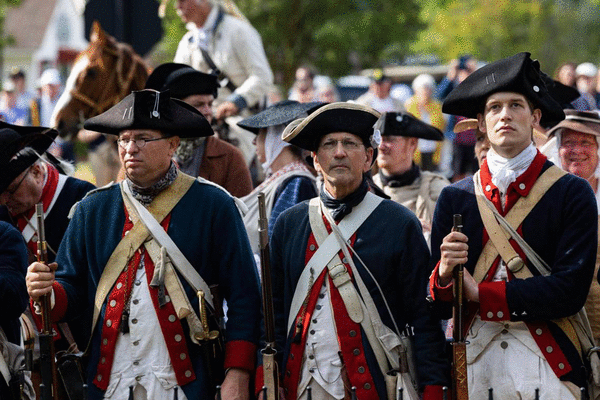
Thomas Paine’s “Common Sense” may have persuaded the American colonists of the need for independence, but it is one thing to favor independence and quite another to pick up arms to obtain it.
We tend to think of war as being won by large armies on vast fields commanded by generals. But small victories can have a big effect. One such victory, mostly forgotten, occurred 250 years ago, on Feb. 27, 1776, at Moore’s Creek in North Carolina.
At the beginning of 1776, North Carolina was deeply divided; the British considered it ripe for exploitation. They decided to raise a 10,000-man force of civilian “loyalists,” march to the coast, join up with British troops, and move north, retaking the Carolinas and opening a southern front.
It did not go as planned.
Only 1,600 loyalists volunteered for the militia. As they approached the port city of Wilmington, then the largest city in North Carolina, they found their route closed by robust defenses. Their search for another route led them to Moore’s Creek Bridge, 25 miles to the northwest. There, 1,000 patriots defeated the much larger British force. Only one patriot died, versus 50 or more loyalist casualties and 850 captured.
The Battle of Moore’s Creek Bridge interrupted British plans for a new theater of battle in the South.
Moore’s Creek was important because it galvanized the idea of independence in the minds of ordinary people. As historian David Ramsay wrote in 1789, “As the war was the people’s war … the exertions of the army would have been insufficient.” It took the brave acts of ordinary people, including the patriots who fought at Moore’s Creek — and those who voted for independence — to bring about the Revolution.
A few months later, in Halifax, N.C., members of the Fourth Provincial Congress, encouraged by Moore’s Creek, resolved that its delegates to the Second Continental Congress should declare independence from Britain. With these “Halifax Resolves,” North Carolina became the first colony officially to declare for independence. As John Adams wrote in 1818, “The Revolution was in the minds and hearts of the people.” North Carolina led the way.
The patriots who won Moore’s Creek, at the time at least, were ordinary men. They rose to the occasion in a way that is characteristically American. They were hardly alone.
During the Lexington-Concord retreat in 1775, for example, Samuel Whittemore of the Massachusetts militia held off the British regulars despite being shot and repeatedly bayoneted. He was 80 years old at the time.
Sgt. Daniel Bissell Jr. of the Continental Army spent long months alone, behind enemy lines, spying for Washington in 1781 and 1782.
And Deborah Sampson (disguised as a man, Robert Shurtliff), worked as a scout, led as many as 30 soldiers, and saw action in several battles in 1782 and 1783. Once, after being wounded, she extracted a musket ball from her own body to avoid detection.
Other countries also have heroes in their history. What distinguished America’s Revolutionary War heroes was the purpose for which their actions were carried out — not in defense of a king or a kingdom but in defense of popular sovereignty; not for a religion but for religious freedom; and not for territorial conquest but for the right to live free in the place of their choosing.
In short, the people’s revolution was a fight for ideals — not so much for themselves, but for their posterity.
The patriots saw America as a land of endless opportunity and understood that freedom was necessary to realize it. They were willing to risk life and limb for this. As John Adams famously said, “I must study politics and war, so that my sons may have liberty to study mathematics and philosophy.”
The famous Prussian general, Carl von Clausewitz, in his landmark book “On War,” wrote: “The effects of a victory cannot in any way be explained without taking into consideration the moral impressions.”
Sadly, on American streets today, we are witnessing skirmishes in which both sides seem to have lost sight of the principles our ancestors bequeathed to us.
_____
ABOUT THE WRITER
Frederic J. Fransen is the president of Amerion College in Huntington (W.Va.) and CEO of Certell Inc. He wrote this for InsideSources.com.
_____
©2026 Tribune Content Agency, LLC.











































Comments