Commentary: Nature is a powerful ally against fires and floods. So how will we save it?
Published in Op Eds
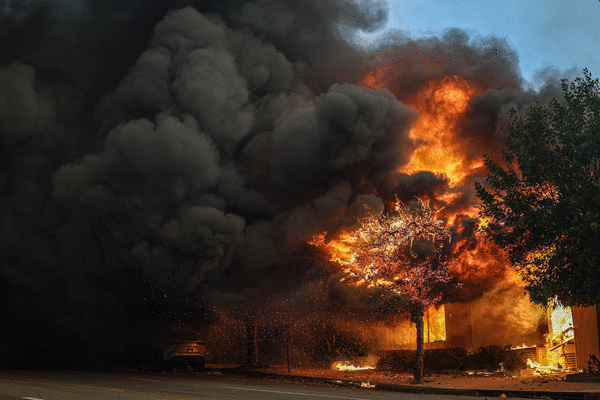
More than a year after the 2025 Los Angeles wildfires, the economic aftershocks of the disaster still permeate the lives of the people who survived it. Fewer than a dozen homes in some of the city’s hardest-hit neighborhoods have been fully rebuilt. Families remain scattered across temporary rentals, and many are still grappling with letters from their insurers announcing higher premiums, reduced coverage or no renewal at all.
Why is it getting so much harder for communities like L.A. to bounce back after disasters? Part of the answer lies in the rapid and dramatic breakdown of nature’s ability to shield communities from extreme weather, according to a new report by World Wildlife Fund.
Forests, floodplains, wetlands, reefs and other ecosystems function as green infrastructure, quietly strengthening communities’ resilience to disasters. These natural elements store and slow water during heavy rain. They retain moisture and reduce fire intensity. They stabilize coastlines and moderate heat. When these ecosystems are healthy and intact, they reduce physical damage from extreme events and the financial losses that follow. But when they erode or outright vanish, hazards become more destructive and costly.
Without vegetation, rain runs straight off the land instead of soaking into soil, causing floodwaters to rise faster and higher. Without healthy forests and wetlands, fires burn hotter and spread more rapidly — an effect that climate change is intensifying even in ecosystems that were once considered resilient. And after wildfires, stripped hillsides can no longer hold soil in place, increasing the risk of flash floods and debris flows even after relatively modest storms. As the losses multiply, insurance companies retreat, public budgets become strained and economic instability deepens.
This dynamic is on full display in Southern California. Decades of development along steep canyons and chaparral-covered hillsides, combined with prolonged drought, have left the city’s landscapes highly vulnerable. After major fires, agencies routinely warn of elevated flood and debris-flow risks during the following rainy season, as scorched slopes struggle to absorb rainfall.
Research shows that the risk of major flooding can increase by up to 700% in areas of widespread deforestation— a phenomenon that’s not unique to the U.S. In eastern Spain, severe flooding in Valencia in 2024 and 2025 caused billions in damage. Investigations by researchers at Polytechnic University of Valencia and the University of Ottawa, among others, pointed to the loss of upstream vegetation, drained wetlands and hardened waterways that funneled water directly into cities. When the rain fell, it encountered a landscape no longer able to manage it.
As extreme weather events become more intense, more frequent and more difficult to predict, insurers face much more risk, and respond by raising premiums, restricting coverage or exiting markets altogether. And when extreme weather hits places where nature is degraded, the insurance gap is wider. For example, the loss of wetlands in Florida significantly exacerbated flooding during Hurricane Irma in 2017, contributing to an estimated $430 million in insured property losses.
Between 2019 and 2024, home insurance premiums rose by an average of 38% nationwide, nearly twice the rate of inflation. These rising premiums could divert up to 4.6% of consumer spending away from other goods and services, effectively shrinking disposable income across the economy.
The result of these compounding pressures is a widening protection gap. More households go uninsured or underinsured. Recovery slows. Property values soften. Access to mortgages and business loans becomes more difficult. Economic damage persists long after the initial disaster.
In the U.S., we see the burden increasingly shifting to public budgets. Public disaster aid functions as insurance of last resort, diverting taxpayer funds from schools, healthcare and infrastructure to emergency recovery. The costs simply move from private balance sheets to public ones.
What remains striking is how little of this conversation focuses on prevention. Nature’s protective value rarely appears in financial risk models, insurance pricing or infrastructure planning. In many cases, nature-based solutions outperform traditional infrastructure at a fraction of the cost. Yet public spending continues to prioritize response over resilience. We rebuild homes, but not wetlands. We strengthen levees, but not floodplains. We pay for losses, but underinvest in the natural systems that prevent them.
Insurance markets serve as a barometer of risk, and they’re sending us a clear signal: The path to long-term resilience runs through nature.
That means we need to treat nature as core economic infrastructure, just like roads, bridges and power grids. We must account for the benefits we get from nature in risk assessments and financial planning, and direct climate and disaster funding toward restoration, not just response. Finally, we need to align insurance incentives with resilience, rewarding risk reduction and landscape protection rather than repeatedly underwriting exposure.
Prevention is cheaper than recovery. Every $1 not invested in resilience today can cost communities up to $33 in lost future economic activity— and the longer we delay, the higher the price of inaction becomes. Nature remains one of the most powerful and most neglected forms of prevention available to us. Will we save it in time to save ourselves?
____
David Kuhn serves as director for resilience partnerships for WWF US.
©2026 Los Angeles Times. Visit at latimes.com. Distributed by Tribune Content Agency, LLC.


















































Comments