Commentary: Animal testing slows medical progress. It wastes money. It's wrong
Published in Op Eds
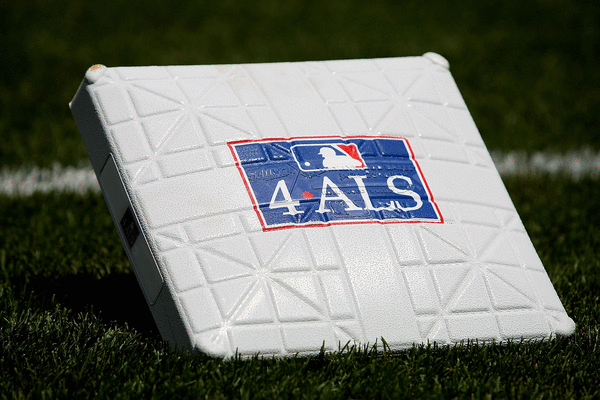
I am living with ALS, or amyotrophic lateral sclerosis, often called Lou Gehrig’s disease. The average survival time after diagnosis is two to five years. I’m in year two.
When you have a disease like ALS, you learn how slowly medical research moves, and how often it fails the people it is supposed to save. You also learn how precious time is.
For decades, the dominant pathway for developing new drugs has relied on animal testing. Most of us grew up believing this was unavoidable: that laboratories full of caged animals were simply the price of medical progress. But experts have known for a long time that data tell a very different story.
The Los Angeles Times reported in 2017: “Roughly 90% of drugs that succeed in animal tests ultimately fail in people, after hundreds of millions of dollars have already been spent.”
The Times editorial board summed it up in 2018: “Animal experiments are expensive, slow and frequently misleading— a major reason why so many drugs that appear promising in animals fail in human trials.”
Then there’s the ethical cost — confining, sickening and killing millions of animals each year for a system that fails 9 times out of 10. As Jane Goodall put it, “ We have the choice to use alternatives to animal testing that are not cruel, not unethical, and often more effective.”
Despite overwhelming evidence and well-reasoned arguments against animal-based pipelines, they remain central to U.S. medical research. Funding agencies, academic medical centers, government labs, pharmaceutical companies and even professional societies have been painfully slow to move toward human- and technology-based approaches.
Yet medical journals are filled with successes involving organoids (mini-organs grown in a lab), induced pluripotent stem cells, organ-on-a-chip systems ( tiny devices with human cells inside ), AI-driven modeling and 3D-bioprinted human tissues. These tools are already transforming how we understand disease.
In ALS research, induced pluripotent stem cells have allowed scientists to grow motor neurons in a dish, using cells derived from actual patients. Researchers have learned how ALS-linked mutations damage those neurons, identified drug candidates that never appeared in animal models and even created personalized “test beds” for individual patients’ cells.
Human-centric pipelines can be dramatically faster. Some are reported to be up to 10 times quicker than animal-based approaches. AI-driven human biology simulations and digital “twins” can test thousands of drug candidates in silico, with a simulation. Some models achieve results hundreds, even thousands, of times faster than conventional animal testing.
For the 30 million Americans living with chronic or fatal diseases, these advances are tantalizing glimpses of a future in which we might not have to suffer and die while waiting for systems that don’t work.
So why aren’t these tools delivering drugs and therapies at scale right now?
The answer is institutional resistance, a force so powerful it can feel almost god-like. As Pulitzer Prize-winning columnist Kathleen Parker wrote in 2021, drug companies and the scientific community “likely will fight … just as they have in past years, if only because they don’t want to change how they do business.”
She reminds us that we’ve seen this before. During the AIDS crisis, activists pushed regulators to move promising drugs rapidly into human testing. Those efforts helped transform AIDS from a death sentence into a chronic condition. We also saw human-centered pipelines deliver COVID vaccines in a matter of months.
Which brings me, surprisingly, to Robert F. Kennedy Jr. In December, Kennedy told Fox News that leaders across the Department of Health and Human Services are “deeply committed to ending animal experimentation.” A department spokesperson later confirmed to CBS News that the agency is “prioritizing human-based research.”
Kennedy is right.
His directive to wind down animal testing is not anti-science. It is pro-patient, pro-ethics and pro-progress. For people like me, living on borrowed time, it is not just good policy, it is hope — and a potential lifeline.
The pressure to end animal testing and let humans step up isn’t new. But it’s getting new traction. The actor Eric Dane, profiled about his personal fight with ALS, speaks for many of us when he expresses his wish to contribute as a test subject: “Not to be overly morbid, but you know, if I’m going out, I’m gonna go out helping somebody.”
If I’m going out, I’d like to go out helping somebody, too.
____
Kevin J. Morrison is a San Francisco-based writer and ALS activist.
©2026 Los Angeles Times. Visit at latimes.com. Distributed by Tribune Content Agency, LLC.










































Comments