Commentary: Nicolás Maduro is not just a corrupt leader. He's also a direct threat to US security
Published in Op Eds
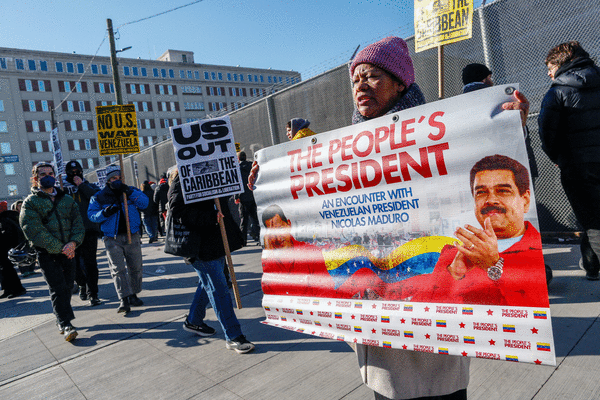
Venezuelan President Nicolás Maduro’s removal from power following his capture in a U.S. military operation rests on a mix of long-standing criminal cases against him, nonrecognition of his presidency by many democratic countries and the U.S. president’s broad, and often controversial, war powers.
Maduro had been under U.S. indictment since 2020 for narcoterrorism conspiracy, cocaine importation conspiracy and other offenses, with a reward of up to $15 million offered for information leading to his arrest. The Justice Department accused him and his allies of using the Venezuelan state as a criminal enterprise.
His elections in 2018 and 2024 were widely denounced as fraudulent or unfree by the U.S., the European Union and many Latin American governments. Under Maduro, Venezuela’s economic collapse and humanitarian crisis produced hyperinflation, food and medicine shortages, and one of the largest refugee flows in the world. United Nations-mandated investigations and Human Rights Watch and other groups have documented a pattern of crimes against humanity, including arbitrary detention, torture, sexual violence and thousands of killings by security forces in operations marked by extrajudicial executions.
Maduro also forged deep strategic ties with China, Russia and Iran, which provided loans, arms, technology and diplomatic cover. These relationships and the narcoterror indictments made Maduro not just a corrupt autocrat but a direct threat to U.S. security.
Trump’s decision to send forces into Venezuela to apprehend Maduro fits within the pattern of presidents undertaking short-term military actions without prior congressional authorization required in the War Powers Resolution. The WPR requires notification within 48 hours and allows 60 days (plus a possible 30-day extension) before explicit authorization is needed, and presidents of both parties have repeatedly used it for limited strikes and deployments while claiming compliance.
President Barack Obama went substantially further under the post-9/11 Authorization for Use of Military Force (AUMF), which empowered presidents to target individuals and groups linked to the 2001 attacks. That 2001 permission slip was invoked for years to justify drone strikes and other lethal operations against alleged terrorists in multiple countries, killing thousands — including some U.S. citizens — without fresh votes from Congress.
In 2011, Obama’s intervention in Libya went beyond the 2001 AUMF. Moammar Gadhafi was not tied to 9/11, and the administration chose to argue that an extended air campaign without U.S. ground troops did not amount to “hostilities” under the WPR, sidestepping the need for congressional authorization even as the operation helped topple Gadhafi. Many members of Congress, including Democrats, criticized this legal reasoning, but Obama was not branded a would-be king; the operation was often described in the media and by supporters as a humanitarian intervention.
By comparison, Trump’s Venezuela mission was tightly focused on capturing an indicted leader and his inner circle in a single, high-risk operation that concluded quickly and, according to initial reports, without large-scale casualties. Critics at home nonetheless called it reckless and unauthorized, while the administration pointed to the WPR and long-standing criminal indictments as sufficient legal basis.
A key element of Trump’s legal and political framing is the trial of former Panamanian dictator Manuel Noriega. In 1989, the United States invaded Panama, in part to arrest strongman Noriega on drug-trafficking and racketeering charges; U.S. courts later held that he had no entitlement to head-of-state immunity once Washington ceased to recognize him as a legitimate leader. The Trump Justice Department has revived that logic, arguing that because the U.S. and many allies no longer recognized Maduro as Venezuela’s president, he was essentially a drug dealer with a flag, not a protected head of state.
Under this view, the operation over the weekend was akin to a cross-border law-enforcement action against an indicted criminal and terrorist conspirator, not a war to overthrow a recognized foreign government — an important distinction in international and domestic law debates. Whether that argument will hold in U.S. courts and international forums remains to be seen, but it aligns with how previous administrations have blurred the line between war and policing in the name of counterterrorism and counternarcotics.
Obama’s Libya campaign, conducted without a congressional vote and contributing to regime change and Gadhafi’s death, was praised in many quarters as decisive leadership and even peacekeeping. Trump, by contrast, ordered the capture of a leader already under narcoterrorism indictment and framed it as a drug bust and accountability for crimes, yet his opponents denounce him as aspiring to kingship and dictatorship.
The pattern is familiar: When presidents from one’s own party use expansive war powers, their actions are often labeled necessary, humanitarian or decisive. When an opponent uses similar tools — especially in a high-profile operation such as Maduro’s capture — critics reach for words such as “king” or “tyrant.” Did Trump’s loudest detractors on Venezuela have anything to say when George W. Bush, Obama or Joe Biden used similar or broader powers in Iraq, Libya, Syria, Yemen or Somalia?
In Maduro’s case, Trump has acted against a leader long recognized by many democracies as illegitimate, deeply implicated in organized crime, and responsible for gross human rights abuses and a historic humanitarian disaster. Those facts do not settle every legal or moral question, and reasonable people can disagree about the risks of U.S. intervention. But they do undercut claims so far that this is simply a lawless power grab by a would-be king, rather than a hard-edged use of presidential authority in a world where his predecessors have already pushed the same boundaries — and often much further.
____
Paul Vallas is an adviser for the Illinois Policy Institute. He ran against Brandon Johnson for Chicago mayor in 2023 and was previously budget director for the city and CEO of Chicago Public Schools.
___
©2026 Chicago Tribune. Visit at chicagotribune.com. Distributed by Tribune Content Agency, LLC.

















Comments