Stephen L. Carter: Trump's lasting damage will be the steady erosion of norms
Published in Op Eds
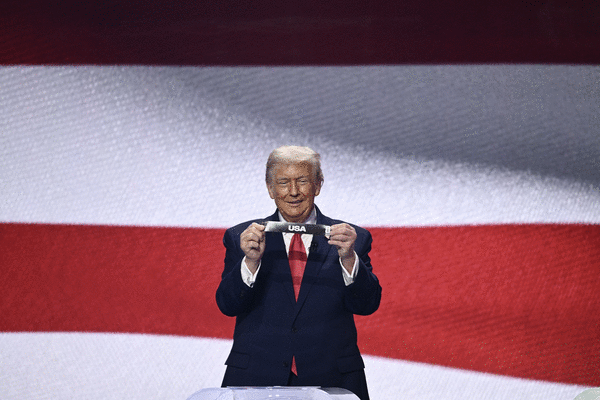
Although the first quarter of the new century has seen four presidents, it is doubtless Donald Trump who will most fascinate future historians. And with the first year of his second term nearly in the books, our stocktaking of the moment must begin with what has been most mashed and mangled since Jan. 20: the rule of law.
It’s true that Trump’s whirligig of executive orders has exposed the fragility of the concept. He has dragged us down one rarely trodden path after another. When a president so often seems to act out of impulse, it’s likely that government lawyers, far from paving the road, are in a constant struggle to catch up.
Which is relevant to the rule of law.
First, let me draw a distinction. Scholars use the phrase “rule of law” in a particular sense to refer to the structure of the laws themselves, asking, among other questions, whether they are clear and publicly understood, and whether the consequences of violating them are well defined and applied evenly. Thus, for many scholars, if the law becomes sufficiently oppressive that it can be enforced only by fear and force, the rule of law does not exist.
In our conversations about Trump, however, we generally address the question of whether he is breaking the law — that is, whether there is a formally adopted rule to which we can point that he has violated. Plainly, the answer matters, and we find out more each time a court strikes down (or upholds) one of his endless streams of orders.
And yet I think this is the wrong question. It’s undoubtedly the case that the law binds the president, as it does the government as a whole; indeed, to turn Oliver Wendell Holmes’ aphorism on its head, the government should always turn square corners when it deals with its people. But when we ask whether Trump has broken the law, we are speaking less about the rule of law than about individual instances, many of which can be debated.
The right question is whether he has challenged, or even altered, the public perception of the norms of governance — not the formal rules, but the general understanding of reasonable restraint under which the government should operate. For those restraints (one might even call the proper attitude humility) are crucial to the rule of law.
And Trump, as president, has consistently ignored them. In this sense, he has shown little respect for the rule of law, and by forcing his supporters to justify (or silently accept) ever greater violations of the norms of restraint, he is damaging the rule of law.
Consider, for example, the president’s pardon power. No one questions that the power is plenary: The occupant of the Oval Office can pardon whomever he likes for federal offenses. Thus, in issuing a blanket pardon to all who committed federal crimes during the Jan. 6, 2021, Capitol riot, he acted well within his authority. Nevertheless, by including those accused of violence, even against law enforcement officers, he crossed a normative line, an understanding of how power is exercised that helps restrain presidents from abusing authority. If everyone simply accepts such a crossing of the line, the rule of law becomes that much weaker.
Another example: I’ve long been on the “unitary executive” side of the argument over the president’s removal power, arguing during both Democratic and Republican administrations that the chief executive possesses the authority to dismiss members of most federal commissions. Should the Supreme Court rule that way, as expected, the justices will in no sense be violating the rule of law. At the same time, I’ve also assumed— wrongly, as it turns out — that a president possessed of the removal power would use it judiciously, wielding it more like a scalpel than a blunderbuss. The more the power is used, the weaker the norm that restrains it, and the weaker the rule of law.
Similarly, let’s suppose the president possesses the authority to direct the Justice Department to seek an indictment of a particular individual. That only addresses the formal legal rule. But there’s also a public norm about the way this authority is exercised: that is, rarely or never, and certainly not for petty purposes. That norm, too, should be considered part of the rule of law, in the sense that we share a popular expectation that the power will be exercised in a particular way. And that norm, too, Trump has smashed to smithereens.
The examples go on and on. Trump continues to flirt with the idea that there might be a legal way for him to serve a third term. And, indeed, scholars have long pointed out the many ways around the 22nd Amendment. But the strong public norm is that two terms means two terms; even voicing the possibility is destructive to the rule of law.
I’m not saying that law never changes; I’m not saying Trump is always in the wrong. Nor would I deny for a moment that previous occupants of the Oval Office have also acted in ways that are contrary to the public norms of how the rule of law should operate. And, usually, that’s been bad. Still, two of our greatest presidents, Abraham Lincoln and Franklin Roosevelt, spent their terms pressing the boundaries of the formal legal rules, and, in the process, transformed public understanding of the norms that should restrain the federal government.
But Trump isn’t evolutionary in that sense. He is not educating the public about new possibilities. He isn’t transforming norms; he’s ignoring them, presenting a defiant and even reckless image of what the executive looks like, unrestrained. And even if every order he issues turns out to be formally legal, that lack of restraint, all by itself, would remain an assault on the rule of law.
____
This column reflects the personal views of the author and does not necessarily reflect the opinion of the editorial board or Bloomberg LP and its owners.
Stephen L. Carter is a Bloomberg Opinion columnist, a professor of law at Yale University and author of “Invisible: The Story of the Black Woman Lawyer Who Took Down America’s Most Powerful Mobster.”
©2026 Bloomberg L.P. Visit bloomberg.com/opinion. Distributed by Tribune Content Agency, LLC.











































Comments