Noah Feldman: Snatching Maduro from Venezuela was illegal -- and damaging
Published in Op Eds
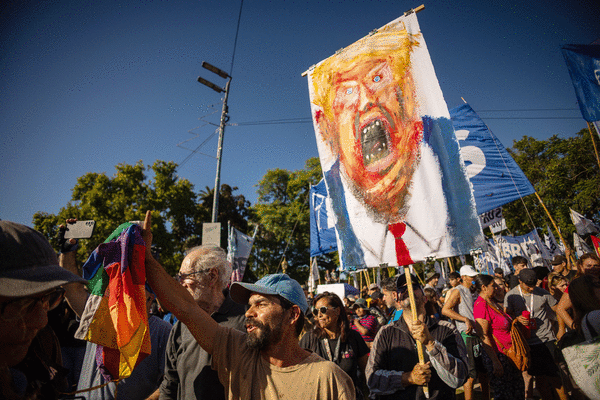
America’s incursion into Venezuela for the extraction of President Nicolás Maduro and his wife to the U.S. for trial was illegal under both international and U.S. law. Announcing that the U.S. intends to “run” Venezuela so as to benefit from its oil and mineral resources is also nakedly unlawful. The most basic building block of all international law is the principle that sovereign countries govern themselves in the interests of their own citizens.
This script should sound familiar. President Donald Trump is doing to Maduro, Venezuela and the international legal order exactly what he’s been doing to the constitutional order in the U.S. over the last year. He is openly breaking the law, with nothing resembling a credible legal justification, while assuming — correctly — that he won’t suffer any meaningful consequences.
No U.S. court is going to do anything about it, because the main treaty he violated, the UN Charter, hasn’t been made applicable in U.S. courts by an act of Congress. No international body will likely either, because the U.S. could veto any UN Security Council action, won’t consent to appear before the International Court of Justice, and isn’t a party to the International Criminal Court. As for failing to seek congressional authorization for the operation, there is no way for Congress to seek judicial enforcement for events that have already occurred, and Maduro can’t raise the illegality of his capture as a defense to criminal charges.
So why does the illegality matter? The answer is that openly violating the law without consequence is a step toward eliminating the value of law itself as a tool for creating order. That’s bad for the prospects of peace around the world. And it’s bad for America’s global influence, too.
The fundamental purpose of the international legal order that the U.S. helped create in the aftermath of World War II was to encourage peace and national sovereignty while legitimating and sustaining American power. Put more selfishly, the point of that international legal order was to make America great — not just domestically, but globally.
Now, instead of making America great again, Trump is doing the opposite. He’s sending the world back to an era in which the U.S. was merely one of several powers that felt free to order around countries within what they considered their spheres of influence. In such a world, Trump can more plausibly threaten other countries — and there is no principled basis to explain why it’s wrong for Russia to invade Ukraine, or for that matter, for China to invade Taiwan.
In the domestic sphere, the U.S. Constitution matters not only because it protects individual rights, but also because it creates a legitimate order in which the government can justifiably do what is, in fact, within its lawful authority. Violating the Constitution without consequence doesn’t just infringe on liberty; it also erodes legitimacy. It undermines the legitimacy of everything else the government does, thereby weakening the entire system.
The international legal order functions much the same way, even if its institutions — such as the United Nations and the International Court of Justice — aren’t as effective at enforcing the rule of law as our domestic legal system. When international law is respected, states can legitimately take actions that need to be taken, such as helping Ukraine defend itself against Russia. When the international legal order is degraded or destroyed, those actions lose their normative legitimacy. They become nothing more than just power politics.
That’s why it’s a mistake to think that just because international law differs from domestic law, it doesn’t have real-world consequences or that we won’t miss it when it’s gone. The international legal order, taken as a whole, strengthens actors who follow the law while weakening those who openly violate it. At this moment, the violator is the U.S.
As usual, Trump isn’t acting on a blank slate. At home, his unconstitutional uses of executive power typically build on earlier expansions of executive power that should have been stopped but weren’t. Likewise, the U.S. has never perfectly complied with the rules of the international order that it long dominated.
But when President George H.W. Bush arrested Panamanian strongman Manuel Noriega — the episode most comparable to the Maduro extraction — his administration made an effort to provide credible legal justifications for the action, including the need to protect 35,000 U.S. civilians living in Panama. Unlike Maduro, Noriega wasn’t formally a president, so he didn’t qualify for immunity from arrest under international law. Even his involvement in drugs, subsequently proved in a U.S. court, was far more significant than anything thus far alleged against Maduro.
When President George W. Bush invaded Iraq, an action that many considered a violation of international law, he nonetheless had explicit authorization from Congress and an argument, however controversial, that existing UN Security Council resolutions justified the action.
In contrast, Trump has no genuine legal arguments on his side, either international or domestic. His contempt for the law is unmistakable. That’s why he’s willing to say openly that he wants Venezuela’s oil and other natural resources. He’s explicitly declaring that he cares nothing about Venezuelan national sovereignty.
In the U.S., it’s already clear that Trump’s greatest legacy will be the profound and historic weakening of the constitutional system. Over time, that erosion was always going to reduce American capacity to act effectively in the world. But as long as Trump avoided major foreign entanglements, it was possible to imagine that the global effects of a weakened America would unfold gradually.
Now, the so-called Trump Doctrine provides an opportunity for the president to hasten the decline of America’s global authority in ways that will weaken the international order and make America less trusted, less effective, and yes, less powerful. Trump isn’t just America’s problem now. He’s everyone’s.
____
This column reflects the personal views of the author and does not necessarily reflect the opinion of the editorial board or Bloomberg LP and its owners.
Noah Feldman is a Bloomberg Opinion columnist. A professor of law at Harvard University, he is author, most recently, of “To Be a Jew Today: A New Guide to God, Israel, and the Jewish People."
©2026 Bloomberg L.P. Visit bloomberg.com/opinion. Distributed by Tribune Content Agency, LLC.






















Comments