Commentary: Encampments criminalize the unhoused
Published in Op Eds
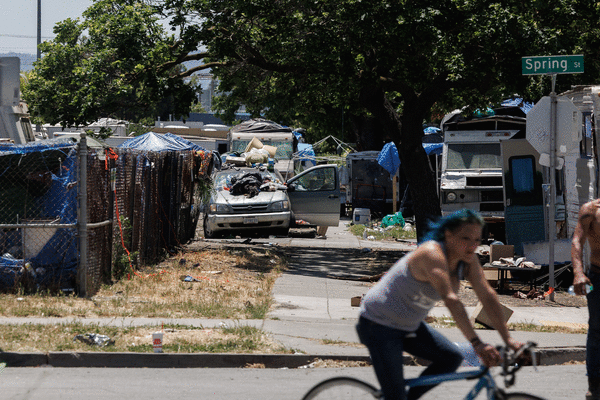
In early September, officials in Utah announced a plan to build an encampment just outside Salt Lake City where up to 1,300 people experiencing homelessness would be forced to receive treatment for mental health challenges. Unhoused people who refuse to stay in this state-run facility could instead end up in jail.
Forcing people to relocate to a facility described by its advocates as a “homeless campus” is a violation of their civil liberties. To make matters worse, this approach is generally ineffective and prone to bias. Research has shown that involuntary commitment disproportionately affects people of color and disabled people. And in many cases, the care provided to those the involuntary committed is not sufficient to meet their mental health needs.
Already, forced psychiatric hospitalizations occur at the same rate as incarceration in the United States, yet there is no evidence to suggest the health benefits of coerced treatment outweigh the harms, such as increased suicide risk after release. Pouring government dollars into this practice will perpetuate the cycle of criminalization, substance use and housing insecurity in which many survivors of involuntary “treatment” become trapped.
Construction of the facility will cost roughly $75 million, and yearly operating expenses are estimated at $34 million. It’s unclear who will oversee the encampment, who will provide the care services and what the total cost per patient might look like. However, there are similar examples of detention centers expanding in recent history. As Immigration and Customs Enforcement has ramped up its attacks on immigrants this year, for-profit businesses have stepped in to meet the demand, making billions from operating detention centers. It’s likely that private entities will do the same for this new type of detention center in Utah.
The move to build such encampments signals a renewed effort on the part of local and federal officials to disappear the unhoused. It is consistent with an executive order issued by President Donald Trump in July, which explicitly called for displacing people experiencing homelessness “into long-term institutional settings.”
As a result of the U.S. Supreme Court’s 2024 ruling in Grants Pass v. Johnson, local and state governments now have greater authority to jail, ticket or otherwise criminalize homeless people. Since then, according to the American Civil Liberties Union, more than 320 bills that criminalize homelessness have been introduced nationwide, and nearly 220 have passed into law.
Bills criminalizing homelessness on the state level often include the same components: a ban on camping with penalties of up to $5,000 and one month in jail; a diversion of all federal and state funding for homeless services from permanent housing and supportive services to short-term state-run encampments and emergency shelters; and a lowering of due process protections to involuntarily commit people to state psychiatric institutions. These policies mirror the approach taken by Utah lawmakers.
In addition to decimating the rights of people experiencing homelessness, the Trump administration has threatened federal funding for permanent supportive housing and rapid rehousing. A recent proposed change would limit the amount of federal funding that communities could invest in solutions that provide housing before treatment. The administration estimates this change would put more than 170,000 people at risk of experiencing homelessness.
At the root of these developments is an ugly truth: the widespread societal stigma toward people experiencing homelessness, mental health, and substance use influences lawmakers and the policies they enact.
Creating an entirely new carceral system for people experiencing homelessness at the state level using federal dollars would create harm instead of care. Dismantling these structures and policies will be very difficult once they are put in place. States must not invest in another form of detention.
____
All three authors work at the Center for Law and Social Policy (CLASP) in Washington, D.C. Jesse Fairbanks is a policy analyst on the Public Benefits Justice team; Kaelin Rapport is a policy analyst on the Racial Equity team; and Isha Weerasinghe is director of the Public Benefits Justice team.
This column was produced for Progressive Perspectives, a project of The Progressive magazine, and distributed by Tribune News Service.
_____
©2025 Tribune Content Agency, LLC.












































Comments