Commentary: Thoughts on 'Frankenstein,' AI and the perils of our unfinished creation
Published in Op Eds
We are nearing a tipping point with artificial intelligence. Scientists call it the singularity — the moment when machine intelligence surpasses our own. Some experts warn that it could come as soon as next year. AI already writes our code, drives our cars and designs our weapons — yet no one truly controls it.
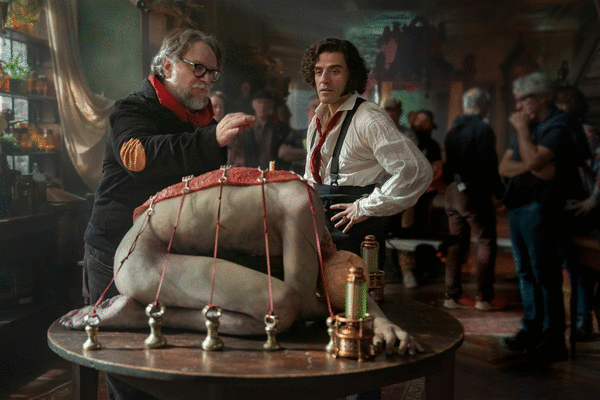
In Guillermo del Toro’s haunting “Frankenstein” film, recently released on Netflix, Dr. Victor Frankenstein’s tragedy is not that he conjures life from death. It’s that he abandons it. Horrified by what he has made, he recoils, refusing to claim responsibility for what he’s unleashed. The result is a catastrophe: a creature who, desperate for understanding and belonging, becomes a monster.
Some two centuries after British author Mary Shelley penned her dark masterpiece, we are once again standing in Dr. Frankenstein’s laboratory. Only this time, the creation isn’t a creature stitched together from corpses — it’s intelligence itself. Similar to Dr. Frankenstein, we have discovered how to animate something in our own image, and yet we refuse to own its consequences. Only government regulation, transparency and stronger safeguards can ensure that this power serves humanity rather than destroys it.
When Shelley published “Frankenstein” in 1818, she called it “The Modern Prometheus.” Her novel is not just a Gothic fantasy about a mad scientist — it is a warning about what happens when human ambition outpaces human wisdom. In the Greek myth, Prometheus steals fire from the gods to benefit humanity and suffers eternally for it. In Shelley’s story, Dr. Frankenstein captures lightning to give life — and then runs away from his own creation. Shelley’s genius was to see that the real horror is not in the creature’s deformity but in its creator’s abandonment.
That abandonment feels all too familiar today. Across the world, nations and corporations are racing to capture the promise of AI: the efficiencies, the profits, the competitive edge. Governments are pouring billions into research, while tech giants sprint to release ever more powerful models.
AI has become the new fire — the lightning that illuminates and empowers us. But amid the excitement, we are failing to confront its darker side: its capacity to deceive, displace and perhaps even destroy us.
The warnings are not speculative. AI pioneers such as Geoffrey Hinton and Yoshua Bengio caution that the technology is advancing so rapidly that it will soon spiral beyond human control. Investor Paul Tudor Jones warns that AI poses an existential threat to humanity and calls for urgent global action. Yet there is no binding international treaty or global authority on AI. Instead of a Geneva Convention for algorithms, we have an arms race.
Del Toro’s film reminds us that Shelley’s story has always been about accountability. Dr. Frankenstein’s creation, rejected and isolated, becomes the very monster its creator fears. We have built something that reflects our intelligence and ambition but also our biases, our blind spots and our hubris. If we turn away from it now — if we fail to shape its purpose and limits — it will evolve without us.
It is not too late. Humanity has faced such moments before — from nuclear weapons to atomic power — and each time, conscience caught up to capability.
AI demands the same. Two hundred years later, Shelley’s vision feels less like fiction and more like prophecy. If we fail to heed her warning — if we continue to race ahead without responsibility — then the tragedy of Dr. Frankenstein will play out in our own world, a catastrophe of our own making.
____
Kelly McKinney is vice president of emergency management and enterprise resilience at NYU Langone Health and former deputy commissioner at the New York City Office of Emergency Management.
___
©2025 Chicago Tribune. Visit at chicagotribune.com. Distributed by Tribune Content Agency, LLC.























Comments