Auto review: Subaru Trailseeker is an eOutback
Published in Business News
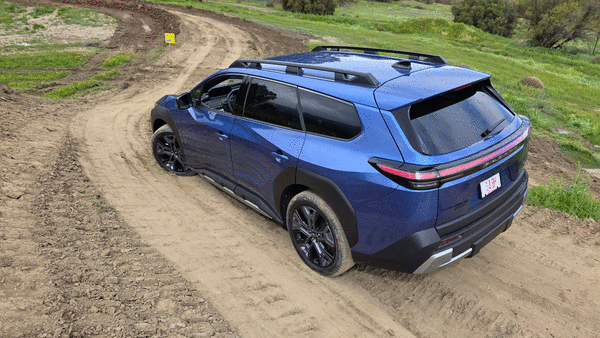
LAGUNA BEACH, California — The Subaru Outback SUV is an icon. Now it has an electric sibling.
While the 2026 Outback has zigged to a square, truck-like ute design, the 2026 Trailseeker has zagged to Outback’s traditional wagon wardrobe with a side of off-road cladding and an infusion of high tech. I slipped into the driver seat, toggled the steering wheel paddles to medium regenerative braking and nailed the throttle. Trailseeker’s twin electric motors drove like liquid silver.
Determined to satisfy the needs of 37% of its customers who would consider an EV for their next vehicle, the tree-hugging, all-wheel-drive, pet-friendly brand has birthed eSubaru triplets: subcompact Uncharted (Crosstrek brother), compact Solterra (Forester sister), and midsize Trailseeker.
The big Trailseeker is the most Subaru-like of the three.
In a U.S. market dominated by behemoths (GM, Toyota, Ford, Hyundai), Subaru has carved out a passionate tribe of customers — returning their loyalty with reliable, affordable pack horses that offer the best residual values in the U.S. market. So in sync is Subie with its budget-conscious, overlanding, wanderlust U.S. customers that 70% of its global sales are here.
But Crosstrek and Forester customers have found that affordability and wanderlust are incompatible with the limited range and expensive price tags of electrics.
The $41K-$50K Outback is a different animal.
With the average Outback price north of $40K, the midsize SUV plays to higher income households with two-car garages and a passion for the outdoors. It’s a demographic that is less budget-conscious — and more brand-conscious — than Crosstrek and Forester owners. And Subaru — like Jeep — is that rare mainstream brand that can cross premium lines.
“Should I buy a BMW, Audi, Jeep or Outback?” ask some of my affluent friends. The Jeep and Subie bring outdoor cachet that many crave, like a North Face jacket or Adidas hiking shoes.
And many Outback customers may be taking a hike from the SUV’s latest stylings. “Too boxy,” laments Mrs. Payne.
Our friends John and Mary might agree.
Their green 2020 Outback wagon has similar style to the Trailseeker and they love its roomy interior utility, green vibe and all-season capability. And, unlike the stereotypical Outback family unit, they don’t use it for road trips.
With 274 miles of range, my $49K Trailseeker Touring tester is the same price as a comparable gas-powered Outback. The Uncharted and Solterra SUVs, by contrast, are thousands of dollars more than their affordable Crosstrek and Forester siblings. If John and Mary are traveling more than 250 miles, they are flying, which means the longest-range ride Trailseeker needs to make is to, say, Metro Airport.
Install a charger in the garage, plug in every night, and Trailseeker is a treat. It’s why most electric owners are two-car garage, affluent families. EV for daily commuting, gas car for longer trips.
On the crowded two-lane roads of Southern California, the Trailseeker’s 375 horsepower and instant electric torque made driving a cinch. Subaru advertises impressive 4.4-second 0-60 launches for the big EV, the fastest Subie made (apologies to the WRX STI hellion).
Easing into a stoplight with one-pedal regenerative braking, I faced a looming merge as a four-lane funneled down to two. A Mercedes coupe sat at the light next to me. The light changed and — ZOT! — the Trailseeker surged effortlessly, merging left ahead of the German with multiple car lengths to spare.
On Interstate 5, Trailseeker was whisper quiet, fitting for an upscale cabin adorned with blue leather door inserts, comfortable seats, tech-tastic rotary shifter, twin charging pads for phones and a big digital console screen adorned with Lexus-like climate buttons.
Those buttons are one of the advantages of Subie’s partnership with Toyota to make the Trailseeker (and sibling EVs). As is the clever instrument display, which is recessed just below the windshield to offer head-up-like instrument convenience so you don’t need to take your eyes off the road.
The downside of Toyota hardware is that I often had to divert my eyes from the road to negotiate the Trailseeker’s flat adaptive cruise and radio volume buttons on the steering wheel. And Trailseeker doesn’t have access to Subaru’s hands-free highway driving tech like the new 2026 Outback.
In SPORT mode, the steering firmed and I climbed into the mountains on twisty Ortega Highway. You won’t mistake the Trailseeker for Lions running back Jahmyr Gibbs, but the big EV is noticeably lighter weight than its Hyundai EV6 (4,900 pounds) and Chevy Blazer EV (5,600 pounds) peers.
With its 75-kWh battery located low in the chassis, the Trailseeker could be hustled, not unlike the 4,000-pound gas Outback.
Hustle it on a long journey and your patience will be tested compared to the Outback and its big 18.5-gallon fuel tank. Where the Outback will travel 600 miles and then fill up to 100% in five minutes, my Trailseeker tester with 274-mile range will need to stop every 175 miles or so (because you want to fill EVs between 20% and 80% of charge) for 20 minutes.
Happily, the Subie’s charging infrastructure is robust thanks to its access to (most) Tesla Superchargers as well as other networks like EVGo and Electrify America. Plug the Trailseeker’s Tesla-style NACS plug into the Tesla charger and it will automatically bill to your credit card via the Subaru app. Slick.
“Hey, Subaru, change driver’s temperature to 70 degrees,” I barked on a chilly, 50-degree California day.
Such high-tech goodies complement signature Outback features like standard roof rack and enough rear cargo space (32 cubic feet) for the average Subie owner’s dog, cat, chicken, bird and gerbil cages.
Most Subaru customers will stop at the trail head to off-load their bikes — and dog — for long adventures, though the ‘Ru does offer a cool multi-terrain monitor so you can “see through your hood” for better tire placement at low speeds on trails, or better yet, parking in a pothole-cratered lot.
Off-roaders might pine for the Outback Wilderness model’s 9.5 inches of ground clearance and all-terrain tires. But Trailseeker doesn’t offer the latter because they would suck another 60 miles off its already limited range. This Trailseeker seeks local trails only. Which is all its two-car garage owners will ask for.
Want to travel further? Get a gas Outback. Or a Jeep.
2026 Subaru Trailseeker
Vehicle type: Battery-powered, all-wheel-drive, five-passenger SUV
Price: $41,455, including $1,450 destination fee ($48,800 GT as tested)
Powerplant: 74.7 kWh lithium-ion battery with single or dual-electric-motor drive
Power: 375 horsepower
Transmission: single-speed automatic
Performance: 0-60 mph, 4.4 seconds (mfr.); towing, 3,500 pounds
Weight: 4,565 pounds (as tested)
Fuel economy: EPA est. MPGe: 103-107; range, 273-308 miles (281 Premium standard, 274 for Touring as tested)
Report card
Highs: Ol’ Outback wagon looks, head-up instrument display with square wheel
Lows: Priced same as Outback; lacks Outback’s hands-free highway assist
Overall: 4 stars
____
©2026 www.detroitnews.com. Visit at detroitnews.com. Distributed by Tribune Content Agency, LLC.










Comments