Auto review: 2026 Mazda CX-5 gains a great new screen but loses something in the process
Published in Business News


When was it decided that buttons in a car were old-fashioned? Surely it was some young punk designer in a black turtleneck who made the call. So, he took them out. All of them. And stuffed everything onto a screen the size of a small television. Naturally, the accountants applauded. No buttons to manufacture? This saves money. High fives all round for design frugality.
But when you take away the buttons, you lose more than tactile control. You lose identity.
Designers used to have this glorious playground: chunky metal switches, aircraft-style toggles, a volume knob that felt like it was milled from the crankshaft of a P-51 Mustang. You could sit in a BMW and know it was a BMW. Sit in a Jaguar and feel like you should be wearing loafers. Sit in a Cadillac and you’d instinctively reach for the remote.
Now? You get in and it’s an iPad. The same flat glass slab whether you’re in a Hyundai or a Mercedes-Benz. Swipe up for air conditioning. Swipe down for your dignity.
Congratulations. You’ve made every interior look like an airport rental car.
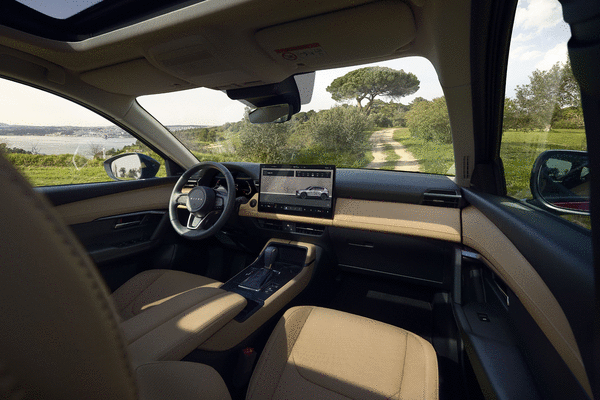
And so it goes with the 2026 Mazda CX-5, which now possesses the largest infotainment touchscreen in its class, an optional 15.6-inch affair that works quickly and boasts very intuitive software. Gone is the console-mounted control knob, along with physical buttons for the climate control. And yet, in the process of moving so much onto the screen, Mazda has also misplaced something more difficult to put on a spec sheet: that faint but important sense of understated, near-premium charm that once made its cabins feel a cut above the mainstream. So, while the new screen is better, quicker and more modern, it is also, somehow, less Mazda.
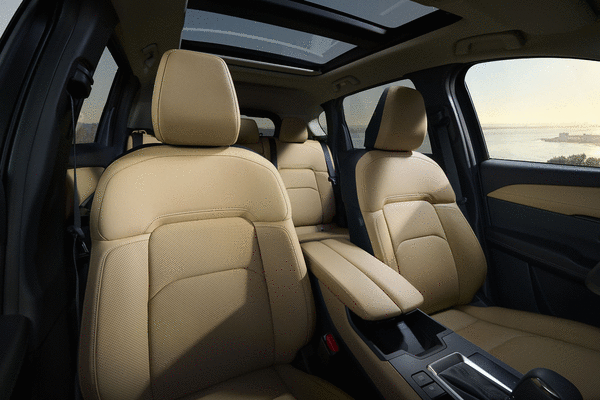
Blame the interior design, which is awash in disappointingly cut-rate plastic panels designed to impress company accountants rather than showroom shoppers. Money that should have been spent on finer finishes, the softer touchpoints and richer trim that elevated the once brand, appears instead to have been wired directly to Google. For Google Assistant. For Google Maps. For Google knows what else. Still, Google’s voice commands work brilliantly, whether it’s calling up your favorite Spotify playlist or adjusting the CX-5’s climate control. But the result is a Mazda that no longer has that certain je ne sais quoi.
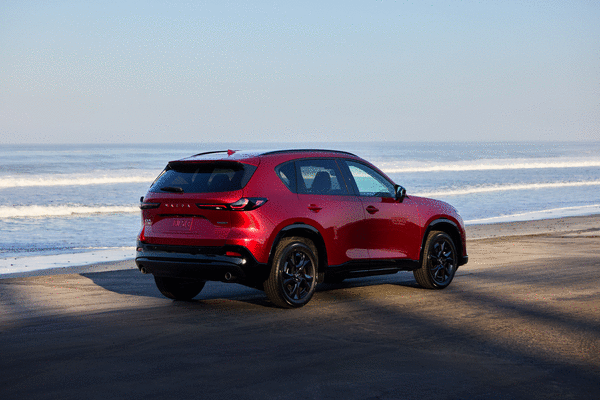
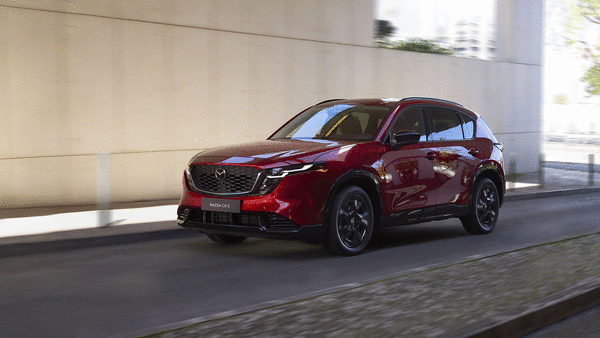
And the design misstep continues outside. Now some four inches longer and marginally taller and wider, the 2026 Mazda CX-5 attempts to borrow visual gravitas from its larger siblings, the CX-70 and CX-90. But instead of looking like a scaled-down expression of quiet confidence, it ends up resembling the Ford Escape’s Japanese cousin, the one who studied abroad for a year and came back slightly less interesting. It’s bigger. It’s broader. It’s technically improved. And yet, somehow, it feels as though something distinctive has been sanded off.
Thankfully, there’s better news when it comes time to drive. Mazda’s normally-aspirated 187-horsepower 2.5-liter four-cylinder engine is the sole powerplant for 2026, although a more powerful option is promised for 2027. On paper, that may sound like grim news delivered in a beige envelope. It isn’t. Nine-out-of-ten CX-5 buyers chose this engine anyway. It runs on regular unleaded, returns an EPA-rated 26 mpg in mixed driving, and is paired with a six-speed automatic. All-wheel drive is standard. Towing capacity is rated at 1,500 pounds, some 500 pounds fewer than before, which means your jet ski will need to start dieting.
Weighing 3,856 pounds, the 2026 Mazda CX-5 reaches 60 mph in 9.6 seconds. So, it will not rearrange your internal organs. But then it never did. And that was never really the point. What continues to distinguish the CX-5 is its driving persona. This remains a deeply satisfying vehicle to drive in a way that most rivals simply cannot be bothered to attempt. The steering actually communicates with unrestrained clarity. It’s reasonably quick, yet sufficiently polished so that passengers aren’t flung about like loose carry-on luggage. The throttle is weighted just so. The six-speed indulges you with paddle shifters, holding a gear into higher revs if you’re feeling theatrical. Body lean is kept in check. Unwanted motions are politely suppressed. It behaves like a car engineered by people who still enjoy driving.
There is some road noise. And while the seats are comfortable enough for the daily commute, their lack of meaningful side bolstering becomes apparent if you decide to treat a cloverleaf on-ramp as an event.
Practicality, at least, has improved. The cabin is more spacious, with an extra 2.3 inches of rear-seat knee room and 1.8 additional cubic feet of cargo capacity. There is even a temporary spare tire beneath the cargo floor, an increasingly rare nod to the notion that punctures still happen.
If you care more about usability than aesthetics, there is much to admire here. If design matters more, you may feel shortchanged. But the compact SUV segment is not exactly awash in beauty or brilliance. And while the 2026 Mazda CX-5 may have lost some of its former charm, it retains its dynamic edge. In a class defined largely by mediocrity, that makes it still worth a look.
2026 Mazda CX-5
Base price: $29,990-$38,990
Powertrain: 2.5-liter four-cylinder
Horsepower/Torque: 187/186 pound-feet
EPA rating (combined city/highway): 26 mpg
Fuel required: Regular
Length/Width/Height: 185/73/67 inches
Ground clearance: 8.2 inches
Cargo capacity: 34-67 cubic feet
Towing capacity: 1,500 pounds
©2026 Tribune Content Agency, LLC










Comments