Dennis Anderson: Fleeing Iran after his father was killed, he persevered and now owns a Canadian fishing resort popular with Minnesotans
Published in Outdoors
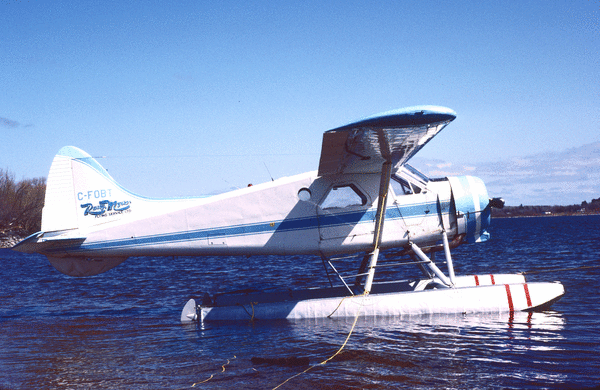
MINNEAPOLIS — Some years ago, my two sons and I were on Lake of the Woods when a friend of mine, Benny Ratuski, suggested we go flying for walleyes in his plane, a de Havilland Beaver on floats. My boys were young at the time, maybe 8 and 10, and they were all-in for the idea. On a bright, clear day, Benny put the Beaver on step, and we were off, flying north.
Our destination was Oak Lake, a wide spot on the 382-mile-long English River. A mutual friend of Benny’s and mine, Tom Ingstad, had a cabin there — an uninhabitable shack, really — and in front of it we tied the Beaver to a rickety dock. Soon we were on the water in a small boat, jigging for walleyes.
The fishing was great. But the memorable part of the trip came later, when we taxied the Beaver across the lake to say hi to John Naimian, owner of Oak Lake Lodge.
In the years since, I’ve returned to Oak Lake a couple of times, and I’ve visited John when he’s been in the Twin Cities to exhibit at sport shows.
John is from Iran and still has relatives there.
When I called John the other day to see how he’s doing, he reminded me that he was 18 when his father was executed by the Ayatollah Khomeini regime for his adherence to the Bahá’í Faith. Peaceful co-existence and the equality of men and women are among the religion’s fundamental tenets.
How John ended up in Ontario, owning a fly-in fishing lodge, is testament not only to his perseverance, but to what’s possible when people are allowed to exercise free will.
Leaving Iran soon after his father was killed, John stayed in Turkey for about two years before he emigrated to Canada. In Turkey he met his future wife, May, who followed him to Canada.
“When I was a boy in Iran, I liked fishing and hunting, but it was not readily available,” he said. “Then, when I landed in Canada and saw all of these outdoor opportunities, I was like a kid in a candy store. For our honeymoon, my wife and I rented a small cabin near Atikokan (Ontario). It was wonderful.”
Finding work in Ontario as a laborer, John grew curious about the many Minnesotans who crossed the border in summer from International Falls, Minn., to Fort Frances, Ontario.
“I was told the fishing in Canada was better than in the United States, and that’s why so many people came north,” he said.
John’s interest in tourism grew during the winter of 1998, when he hired a fishing guide to work for him.
“That fellow talked all the time about fishing and hunting, and I told him I would like to own a fishing camp someday, where I could be surrounded by nature,” John said.
Working with a real estate agent, John and May paged through listings of resorts for sale. Some they couldn’t afford. Others were either too run down or weren’t isolated enough to satisfy John’s vision of a wilderness getaway for his clients and his family, which by then included a young son and daughter.
“We put in an offer on one camp, but didn’t get it,” John said. “Then the real estate fellow took us to Oak Lake. It was really primitive and had gone through a number of owners. The buildings needed a lot of work. But the fishing was excellent. We worked out a deal and we bought it.”
In the 28 years since, by his hand, and with the help of his family, John has renovated the resort’s lodge and five cabins. Conservation-minded, he operates the resort’s fishing as catch-and-release only, except that enough walleyes are kept for shore lunches.
“Catch-and-release helps maintain the fishery to our standards,” John said. “Some people come up here and on a given day catch what they think are a lot of fish, maybe 50 walleyes. Or on an adjoining lake they might catch a hundred smallmouth bass, or a big northern or a muskie. But everything is relative. Our guides on that same day might say the fishing was just OK.”
For many years, John hired guides from Newfoundland. These were rugged, personable guys with tons of fishing experience. One I remember was Henry Belvin, who trained the lake’s bald eagles to swoop down for discarded walleye carcasses, an aerobatic display that was a main attraction at lunchtime.
“But the Newfoundland fellows grew old, and now most of my guides are younger and come from southern Ontario,” John said.
John has seen other changes, too. The grandfathers who once paid for themselves, their sons or daughters and grandchildren to come fish have passed on, and some of the younger generations no longer travel north. Money might be one reason, John said. Other entertainment options might be another.
In their places, a different clientele has emerged. Groups of American guys still come, most from Minnesota. But now more couples arrive by floatplane from the lodge’s jumping-off point in Vermilion Bay, Ontario. Some are older, but some are younger — and some bring their kids north to fish.
No one could have predicted these changes. Nor could anyone have forecast the pandemic, or Canada’s extended border closing that put some resorts out of business. Add to these the war with Iran, which causes John to worry anew about his relatives, who can no longer be reached by phone.
Yet Canada and the resort business have been good to John, whose belief in the Bahá’í Faith remains as steadfast as his father’s was so many years ago in Iran.
In May, when the ice goes out on northwest Ontario lakes, John will return to his lodge, and soon thereafter will welcome his first clients of the summer. Most are repeat visitors, and all are from the U.S.
“The truth is,” he said, “Canadians need Americans, and Americans need Canadians. We’re all human beings, and we all share the same planet.”
©2026 The Minnesota Star Tribune. Visit startribune.com. Distributed by Tribune Content Agency, LLC





Comments