Dennis Anderson: Continuing a Minnesota conservation tradition, hunters schedule Duck Summit for March
Published in Outdoors
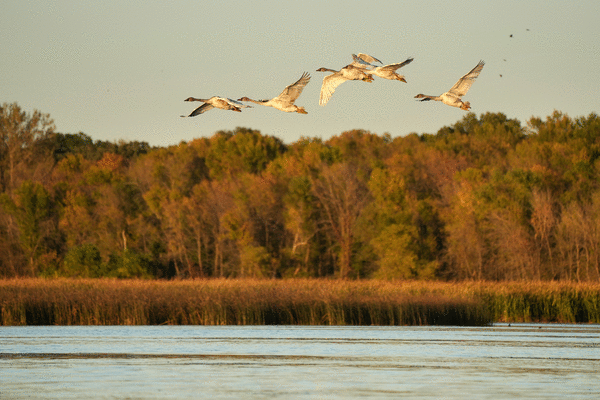
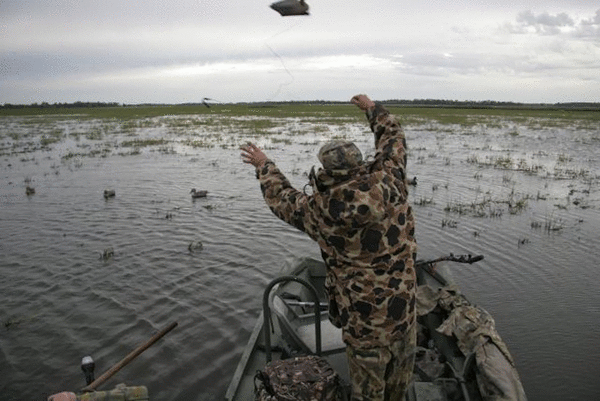
MINNEAPOLIS — Minnesota waterfowlers will hold a Duck Summit March 27-28 in Nicollet — near the shores of venerable Swan Lake, which once was one of North America’s migratory bird meccas.
The planned gathering, long overdue, is born of the frustration of Minnesota duck hunters, who in autumn are tired of seeing mostly empty skies, but who know improvements are possible.
Improvements for ducks, yes.
And also for Minnesotans, the vast majority of whom can’t tell a pintail from a bluebill, but whose futures, like those of ducks, are tied to the prevalence of healthy landscapes that include functioning wetlands and vibrant shallow lakes.
Followers of this column will recall that on Aug. 29 I wrote that Minnesota’s status as the leader among states of waterfowl conservation demanded that a meeting be held to assess the status of ducks and the resources they — and we — need to survive.
It’s no coincidence that ducks have largely disappeared from the state’s landscape at the same time wells across southern and central Minnesota yield water that is undrinkable and many of our lakes harbor fish so toxic they can’t be eaten.
In nature all things are connected, as Aldo Leopold reminded us, and it remains a mystery to duck hunters that so many Minnesotans fail to appreciate just how far we’ve allowed our water and soil, both of which we depend on for life, to degrade.
Cynics will argue duck hunters’ concerns aren’t quite so lofty; that their primary worry is the relatively few mallards and other fowl they’ve killed in recent years.
That’s true to an extent.
But true as well is that duck hunters have been at the forefront of Minnesota conservation since the first floating dredges rolled into southern Minnesota in the early 1900s to drain Murray County’s Great Oasis — 6,000 acres of connected lakes, potholes and wetlands.
No one then, and no one today, opposed farming.
But along with the haphazard ditching came spring and fall flooding and its attendant losses, including the washing of valuable topsoil into the Minnesota and Des Moines rivers and ultimately into the Mississippi River. Those losses that still resonate throughout southwest Minnesota today.
Lost as well, and considered mere collateral damage, were the red-winged blackbirds that sang in the morning, the muskrats whose mounded houses dotted the drained marshes and the canvasback ducks that in fall blackened the skies as they thundered in vast skeins toward Heron Lake.
Leopold also said, “To keep every cog and wheel is the first precaution of intelligent tinkering.”
Yet by commodifying every resource Minnesota was blessed with — water being primary — we have blinded ourselves not on only to the worth of these “cogs and wheels,” but to their connection to our own well-being.
Thanks to long mornings they’ve passed hidden in cattails, their duds muddied, with retrieving dogs by their sides, organizers of the Nicollet Duck Summit know these blessings firsthand.
As inspirational and life-affirming these experiences can be, they nevertheless are burdened by a sense of unease, of pending loss, that is assuaged only by answering conservation’s call — and in doing so, following in the footsteps of like-minded Minnesotans who have gone before them.
James Ford Bell was among these. Born in 1879, he spent a lifetime appreciating ducks and the countrysides that supported them. Arriving eight years later in tiny Kent, Minn., Jimmy Robinson was of Bell’s era, and shared his love for waterfowl, but the two couldn’t have been more different.
Bell, was studious, ambitious and curious — personality traits that live on at the James Ford Bell Museum of Natural History in St. Paul.
Robinson was more of a raconteur, a fast-talking outdoors scribe who raised millions of dollars for conservation. For years he conducted his own Canadian duck surveys for Sports Afield magazine, and shared hunting blinds in Minnesota and on Manitoba’s Delta Marsh with Regular Joes and movie stars alike, including Clark Gable.
In the footsteps of these storied conservationists now tread members of the Nicollet Conservation Club, the Fergus Falls Fish and Game Club and the Christina Ina Anka Lake Association, among others, who are organizing the 2026 Minnesota Duck Summit, scheduled for 1-5 p.m. Friday, March 27 and 9-5 p.m. March 28.
They will meet at Nicollet Public School.
Summit attendance will be limited to 350. Cost will be $30 for the conference and $50 for those who also want to attend a social hour and pork chop dinner Friday night at the Nicollet Conservation Club. Dinner attendance is limited to 200.
Organizers hope to livestream the event for those who can’t attend.
Tickets for the summit will be available in coming weeks, when payment will be available by credit card on the Fergus Falls Fish and Game Club website.
The summit’s program hasn’t been finalized, but topics will include mallard and other duck biology, waterfowl habitat quality and quantity, and bag limits and other restrictions that govern Minnesota duck hunting.
Department of Natural Resources duck and duck habitat managers will participate, as will those from the U.S. Fish and Wildlife Service and the Minnesota Board of Water and Soil Resources. Delta Waterfowl is on board, and look for Ducks Unlimited, Pheasants Forever and the staff of the Lessard-Sams Outdoor Heritage Council to join as well.
“What’s happened to Minnesota ducks?”
Often asked, that question is fairly easy to answer.
Getting enough people to care is tougher.
Stay tuned.
©2025 The Minnesota Star Tribune. Visit startribune.com. Distributed by Tribune Content Agency, LLC





Comments