Andrea Felsted: Want to keep your job? Buy yourself a blazer
Published in Op Eds
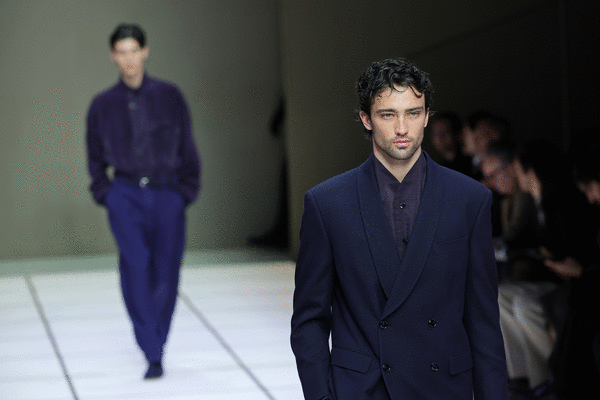
Is the headlong rush toward wearing ever more relaxed clothing over? That question has preoccupied investors since analysts at Bank of America Corp. called time on the sneaker boom this month.
The answer is yes. Evidence from catwalks, social media, retailers and sales data shows we’re wearing more sophisticated clothing and footwear again. We haven’t abandoned our sneakers and sweatpants altogether. But athletic wear in everyday life looks passe. Outside of the gym, walking or running, sports-inspired shoes are starting to lose out to dressier styles.
Companies from Nike Inc. to Adidas AG and Lululemon Athletica Inc., all winners from the athleisure wave, must adapt to the new rules of on- and off-duty dressing.
In the U.S., sales of fashion shoes — a catch-all term for smarter footwear — were about 3% lower in the period between January 2025 and November when compared with the same timeframe the year before, according to research group Circana. But this doesn’t tell the whole story. Circana saw pockets of increased demand for proper shoes: comfortable clogs and backless mules; tall boots; ballerina flats and styles with straps known as Mary Janes.
The U.S. clamor for women’s loafers was so strong that their median price rose 40% in the fall/winter season, according to retail intelligence company EDITED. The proportion of penny loafers selling out in most sizes on U.S. and UK retail websites rose 66% year-on-year. Riding boots did even better.
It’s similar for men, who began sprucing themselves up a couple of years back by indulging in “quiet luxury” — a nod to tasteful discretion — such as Loro Piana’s cashmere-trimmed desert boots. In the fall/winter season, sneakers’ share of men’s footwear newly appearing on retail websites in the U.S. and UK fell 4 percentage points from the same period in 2024, EDITED found. Formal shoes rose 7 percentage points. Boat shoes and loafers were favorites.
U.S. sneaker sales still rose 4% year-on-year between January and November 2025, Circana said. But performance items such as running shoes led the way. The larger market for athleisure styles was positive, though not as impressive.
Even the fashion sneaker, a kind of hybrid between sporty and smart, is evolving more toward the latter. The most of-the-moment variants like the sneakerina (a combination with a ballet flat) and the snoafer (a sneaker loafer hybrid) borrow from more formal footwear, Kayla Marci, a trend forecaster who writes the Haute Garbage Substack, told me.
Nor is this all about feet. A broader wardrobe refresh seems to be happening.
Sweatpants are still America’s fastest-growing clothing category, according to Circana, but that may just reflect the fact that women are dumping their old leggings and snapping up wider-legged workout pants.
For the past couple of years, catwalks have featured more structured, tailored clothing, and retailers are stocking, and selling, more of this stuff. The denim revival has contributed. Pairing jeans with boots and a blazer takes the wearer from lunch to meeting to drinks. Accessories matter, too. Tapestry Inc.’s Coach leather bags, a Gen-Z favorite, look better with a more finessed outfit.
Men, meanwhile, are swapping the once ubiquitous slim-fit silhouette for wider-legged pants and a more relaxed jacket, Peter Ruis, managing director of British department store John Lewis, told me. Heftier footwear such as boots or lace-up brogues work better with looser looks.
British retailing mainstay Marks & Spencer Group Plc is even seeing a revival of the suit, with sales up 15% in the three months to Dec. 27 compared with the same period in 2024. Sales of formal trousers were up 24%, although men are choosing more comfortable and crease-resistant versions.
Our lifestyles are playing a part as well. The pandemic and home working probably extended the athleisure trend beyond its natural life cycle. Many of us have returned to the office, and power is shifting back to our bosses as labor markets weaken, as my colleague Beth Kowitt has written. We want to not only show up, but smarten up too.
So who wins from more sophisticated dressing? Ralph Lauren Corp., is already doing well thanks to its preppy clothes playing into the sharper look. Gap Inc.’s Banana Republic could exploit the moment. Inditex SA’s Zara is the ultimate chameleon, and a move upmarket looks well timed.
Athletic brands are the losers. And it’s not just their sneaker sales at risk. Last year’s craze for quarter-zip sweaters was great for Ralph Lauren, according to Laurent Vasilescu, an analyst at BNP Paribas SA. It was less good for Nike’s fleeces — and its $13 billion of apparel sales.
Nike Chief Executive Officer Elliott Hill is doubling down on the performance footwear and clothing needed for actual sport, offering some kind of defense against changing tastes. Rapidly evolving trends on social media mean multiple, often contradictory, narratives can exist at once in modern fashion. At the same time as polishing up their office look, many people still want to walk, run or hike — and to show off a bit while doing it — hence the popularity of pricier “Gorpcore” brands such as Amer Sports Inc.’s Arc’teryx and Salomon.
Adidas looks more vulnerable given that it has been No. 1 in fashion sneakers. But CEO Bjoern Gulden is also at the forefront of more cutting-edge styles like the sneakerina. And while the Samba may be past its peak, other slimmer-soled lines are clinging on because they’re considered more put-together than chunky basketball shoes. The latest social-media style obsession is the year 2016, when Adidas’s Stan Smith reigned. Gulden is relaunching the sneaker, famously worn with tailored pants by design queen Phoebe Philo.
Of course, some of this may be seasonal. Sales of classier-looking coats, jackets and cable-knits are driven by colder temperatures, particularly in the US. Summer will show how many of us still want to dress like beach bums.
But the love of blazers looks solid, judging by a spike in mentions by social-media influencers. EDITED expects lasting interest in boat shoes and lace-up brogues. Sneakers will often be smarter or combined with more formal options. We don’t seem ready yet for constricting neckties or vertiginous heels, but we’re past peak slob. There’s more dressing up to be done.
____
This column reflects the personal views of the author and does not necessarily reflect the opinion of the editorial board or Bloomberg LP and its owners.
Andrea Felsted is a Bloomberg Opinion columnist covering consumer goods and the retail industry. Previously, she was a reporter for the Financial Times.
_____
©2026 Bloomberg L.P. Visit bloomberg.com/opinion. Distributed by Tribune Content Agency, LLC.



















































Comments