Commentary: Spending is hot. Saving is not. Something has to give
Published in Op Eds
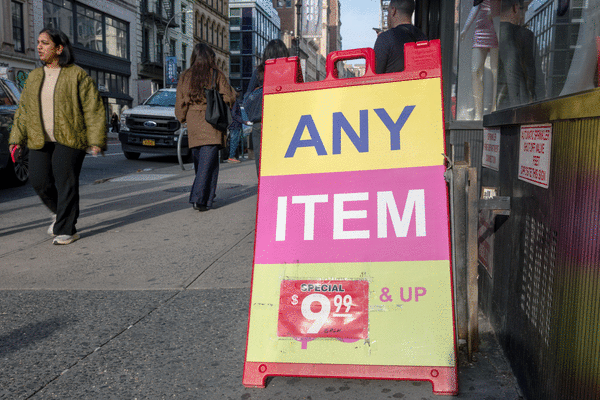
The U.S. government released some long-delayed data Thursday that seemed to prove true the cliché about never betting against American consumers.
According to the Bureau of Economic Analysis, spending increased 0.3% in both October and November when adjusted for inflation. The results were in line with the average monthly gain over the past three years, which may lead some to falsely conclude that perhaps Americans aren’t as angry and upset with the high cost of living as the surveys and polls suggest.
A close look at the data shows that households are using a greater portion of their incomes to finance consumption. That can be seen in the declining saving rate, which tumbled from 5.5% in April to 3.5% in November. Not including the wild gyrations during the COVID years, you have to go way back to 2008 to find the last time the saving rate was so low. The saving rate was near 7% just before COVID hit. Looked at another way, personal savings have dropped by a whopping $469.2 billion since April, or 37%, to $799.7 billion, BEA data show.
The “impressive strength” in spending “masks a more troubling reality,” EY-Parthenon Senior Economist Lydia Boussour wrote in a research note. “Beneath the surface, many families are grappling with depleted savings and the challenges of fewer job opportunities and slower income growth, which is eroding their purchasing power.”
This can’t go on much longer; consumers will eventually pull back on their spending, probably sooner rather than later. This is no small matter for the economy, given that consumption accounts for two-thirds of gross domestic product.
The Conference Board reported in late December that its gauge of consumer confidence fell for a fifth straight month. “Consumers’ write-in responses on factors affecting the economy continued to be led by references to prices and inflation, tariffs and trade, and politics,” Dana Peterson, chief economist at the Conference Board, said in a statement accompanying the results. “However, December saw increases in mentions of immigration, war, and topics related to personal finances — including interest rates, taxes and income, banks, and insurance.”
Despite the White House calling concerns about the lack of affordability “a hoax,” the government is scrambling to come up with solutions ranging from a cap on credit card rates to allowing Americans to tap their 401(k) accounts to help with the down payment on a home purchase. Any measures that would make a real difference need to be signed into law by Congress, which is unlikely during a midterm-election year and with Republicans holding just a razor-thin majority in both the House and Senate.
Although some Trump administration officials such as Treasury secretary Scott Bessent has been talking up the prospect of “gigantic” refunds this tax season, the reality is more nuanced. The economists at Morgan Stanley expect individual tax refunds to be $40 billion to $70 billion higher in 2026 than in 2025, or around an average of $3,500, but it will be “middle- to high-income and older consumers” that will “benefit most.”
That’s a shame, because those are not the cohorts pinched by the higher cost of living. The Federal Reserve Bank of New York’s latest Quarterly Report on Household Debt and Credit showed that around 4.5% of debt was at least 30 days delinquent in the July-to-September period, the most since the first quarter of 2020. As Bloomberg News noted at the time, the figures suggest U.S. households — especially younger ones — continue to grapple with financial challenges resulting from high interest rates, weak hiring trends and ongoing inflation. Transitions into serious delinquency were most elevated for consumers in their 20s and 30s, the report showed.
One of the biggest questions in economics has been how U.S. consumption has remained stronger than most anyone predicted in the face of elevated debt levels, faster inflation and weak job growth. The BEA data Thursday showing a rapidly declining saving rate may be a big part of the answer — just not one that foreshadows continued strength in the months ahead.
____
This column reflects the personal views of the author and does not necessarily reflect the opinion of the editorial board or Bloomberg LP and its owners.
Robert Burgess is the executive editor of Bloomberg Opinion. Previously, he was the global executive editor in charge of financial markets for Bloomberg News.
©2026 Bloomberg L.P. Visit bloomberg.com/opinion. Distributed by Tribune Content Agency, LLC.

















































Comments