Commentary: Humoring Donald Trump is appeasement, and appeasement is surrender
Published in Op Eds
Most of us learned this lesson in grade school: Appeasement doesn’t stop a bully. It invites only more bullying. The only thing that works is standing up for yourself. It isn’t a guaranteed win. You might still get a bloody nose. But if you don’t fight back, you are certain to lose, again and again.
Europe learned this lesson in 1938, when Adolf Hitler threatened war on Europe unless Czechoslovakia surrendered its border region of Sudetenland. British Prime Minister Neville Chamberlain infamously led Europe’s negotiations, on behalf of the United Kingdom, France and Italy. He ultimately capitulated, pressuring Czechoslovakia to cede Sudetenland to Germany in return for the promise of peace. That appeasement only emboldened Hitler, and the rest is history.
Europe faces a similar choice today, and the continent needs to admit it. Threatening broad financial punishment or military force if Denmark, a close and reliable NATO ally, doesn’t hand Greenland to President Donald Trump, is not something Europe can negotiate with, even if Trump later walked it back. There is no middle ground here. If Europe does not stand up now, it surrenders.
China understands this lesson. By April of last year, Trump’s tariffs on China reached 145%, but China consistently counterpunched. China not only escalated tariffs on U.S. goods to nearly the same prohibitive amount, but it also introduced export restrictions on rare earth minerals — something the United States cannot live without or effectively substitute from elsewhere. The Trump administration backed down each time within weeks, amid no Chinese concessions. The two major powers have since continued a cycle of trade escalations and truces. Trump keeps blinking and tries to cover his tracks, as things returned more or less to the status quo. One year into Trump’s trade war, his administration is worse off vis-à-vis China than it was before.
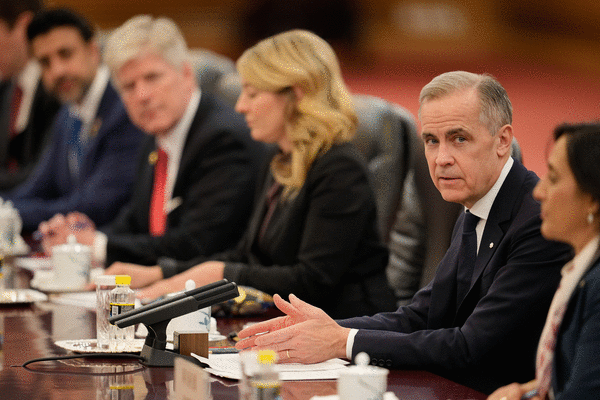
Other countries can punch back too. As Canadian Prime Minister Mark Carney explained during his powerful and on-point speech at the World Economic Forum: “Other countries, particularly middle powers like Canada, are not powerless. … The power of the less powerful begins with honesty.” He added that sovereignty “that was once grounded in rules … will be increasingly anchored in the ability to withstand pressure.”
When Trump claimed he would make Canada the 51st state, Canada didn’t respond by trying to determine how it could make him happier with less. It responded by diversifying and preparing for a world that no longer depended on a southern neighbor it couldn’t count on anyway. Canada has since signed 13 trade and security deals across four continents. Carney’s message is simple: Other countries might not be strong enough to withstand a great power’s bullying on its own, but they are together. “Middle powers must act together because if we’re not at the table, we’re on the menu,” Carney said. It’s a lesson that U.S. law firms and universities should have internalized too.
Europe needs to relay to Trump that his threats are unacceptable, not negotiable, and it has the tools to do so. Some European leaders called for the use of Europe’s Anti-Coercion Instrument, known as the European Union’s “trade bazooka,” a legal tool established in 2023 specifically to counter the use of economic tools as blackmail. This tool allows the EU to impose or increase customs duties, restrict exports or imports with quotas or licenses, restrict trade in services, and curb public procurement access, foreign direct investment, intellectual property rights and access to EU financial markets.
Europe could also finally impose the tariffs on the more than $100 billion in U.S. goods that it designated after Trump’s “Liberation Day” in April but froze for six months based on negotiations with the Trump administration. That freeze is set to expire in February.
The EU collectively — across public and private sectors — also owns about$8 trillion in U.S. stocks and debt, which is “twice as much of the rest of the world combined,” according to Deutsche Bank’s head of foreign exchange research. This matters, since dumping a chunk of this debt would undoubtedly trigger a financial crisis in the United States — something Trump couldn’t ignore. That would mean significant financial losses in Europe too, but if it were sufficient to scare the Trump administration straight, the continent’s sovereignty would remain intact, and ultimately that’s the whole ballgame.
Some European leaders are still hoping to avoid the worst by offering concessions and buying time. NATO officials are reportedly considering rewarding Trump’s aggression with sovereignty over the land where it houses its foreign military bases. This is a fool’s errand that will only embolden a president who continues relentlessly to storm past the limits of laws and reason precisely because people keep letting him do so.
Some European leaders understand this reality and steadfastly oppose compromising with wrong. Polish Prime Minister Donald Tusk said on X, “ Appeasement is always a sign of weakness. … Appeasement means no results, only humiliation. European assertiveness and self-confidence have become the need of the moment.”
Admittedly, this is not an easy path, but it’s the only choice to preserve sovereignty in Europe. Europeans, more than anyone, should understand that this is no time for Chamberlains.
____
Elizabeth Shackelford is a senior adviser with the Institute for Global Affairs at Eurasia Group and a foreign affairs columnist for the Chicago Tribune. She is also a distinguished lecturer with the Dickey Center at Dartmouth College. She was previously a U.S. diplomat and is the author of“The Dissent Channel: American Diplomacy in a Dishonest Age.”
___
©2026 Chicago Tribune. Visit at chicagotribune.com. Distributed by Tribune Content Agency, LLC.








































Comments