Ronald Brownstein: 2025 turned Trump's biggest strength against him
Published in Op Eds
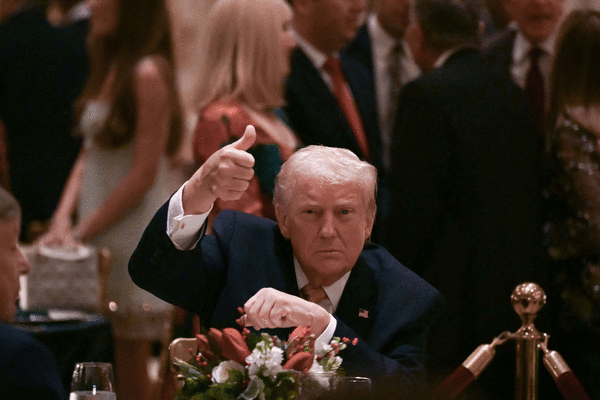
As usual when Donald Trump occupies the White House, 2025 condensed a decade’s worth of political upheaval into a single year. Identifying the most important of those developments is like picking through the wreckage to find a few family heirlooms after a tornado has torn through the neighborhood.
But in the swarm of conflicts, controversies, personnel changes, policy reversals, legal battles, feuds and shifting alliances, several dynamics emerged this year that are most likely to shape the electoral landscape in 2026, 2028 and beyond.
Of those key developments, the most significant was the collapse of faith in Trump’s ability to manage the economy. In virtually every survey during Trump’s first term, more people approved than disapproved of his handling of the economy. Moreover, his approval rating on the economy almost always exceeded his overall job performance rating, which meant that confidence in his economic agenda was a floor bolstering his support no matter which other controversies engulfed him.
Now, that equation has reversed. Recent surveys routinely show that fewer people approve of Trump’s management of the economy than at any point during his first four years; most national surveys this month have shown that 40% or fewer Americans give him positive marks on the economy, and even fewer give him good grades on the cost of living — the problem that tops every survey as Americans’ biggest concern. It’s a complete inversion from his first term: The economy is now dragging down overall assessments of his performance.
To some extent, Trump is simply suffering from proximity: presidents’ approval ratings always sag when voters are unhappy with the economy, as they are today. (Like other presidents, he’s found that efforts to blame his predecessor for current conditions fall flat after a few months.) But Trump’s problems extend beyond that. Polls consistently find that most Americans believe he has not focused enough on their cost of living. Even more damaging, more voters say his agenda has hurt than helped their finances, often by a crushing margin of two or three to one. Voters particularly dislike his tariffs.
The bottom line: Trump’s greatest asset during his first term — confidence in his economic mastery — has become his biggest albatross in his second. “Unless there’s a fix to inflation … I think the economy is going to continue to drag him down,” says Democratic pollster Jay Campbell, part of the bipartisan polling team that surveys attitudes about the economy and politics for CNBC.
The crumbling of confidence in Trump’s economic performance largely explains 2025’s second key electoral dynamic: the reversal of the president’s beachheads among the new voter groups central to his reelection. In 2024, Trump notably improved his previous performance among several big constituencies—Latinos, young men and non-White voters without a college degree. Republican strategists dreamed of realignment.
But Trump’s standing with those groups has rapidly deteriorated. Recent surveys that extensively examined attitudes among Latinos and young people, both with much larger samples than typical public polls, found his approval rating with each group has plummeted below 30%.
Frustration over the economy explains much, but not all, of that decline. In the Pew Research Center’s massive recent Latino survey, for instance, more than 7 in 10 said the administration is doing too much to deport immigrants; nearly 8 in 10 said his overall agenda was hurting the Latino community. (Even a third of his 2024 Latino voters said his policies were harming the community.) Former Republican Representative Carlos Curbelo, who represented a heavily Latino South Florida district, told me that Trump “had a lot of rope” with Latinos, but has squandered that opportunity with his militarized deportation offensive. “They have gone way too far,” Curbelo added. “It’s going to be hard for Republicans to recover some of this support.”
Which brings us to the third important development of 2025: In the normal hydraulic fashion of American politics, Trump’s fall allowed Democrats to run well in this year’s major elections. But the Democratic Party’s overall public image remains weak.
That may not matter much next year, because midterm elections are predominantly a referendum on the incumbent president’s performance. But “in 2028, the question of who we nominate matters enormously,” says Simon Bazelon, an adviser at Welcome, a new centrist Democratic group. Even if Democrats win “a referendum on Trump’s unpopularity in 2026,” he adds, it would be a mistake to conclude “voters are happy with us again, when in fact they may still be angry at us.”
The heated argument between progressives and centrists over the party’s direction will play out next year in Senate primaries in Maine, Michigan, Minnesota, Iowa and Texas among other places. But the real battle will come in the 2028 presidential primary. And that race may turn less on ideology than on disposition — who Democratic voters believe is the candidate most committed to fight, and most likely to beat, Trump’s Make America Great Again movement.
At home and abroad, Trump is governing as if he feels himself completely unbound. But while other Republican officials, with the rarest exceptions, have bowed to his excesses, he’s provoked a clear recoil among voters beyond his core coalition.
In that way, 2025 reaffirmed the most important political trend over roughly the past 60 years. The rapid erosion of Trump’s 2024 breakthroughs underscored that we continue to live through the longest period in American history when neither party has been able to establish a durable advantage over the other.
The last five times a president has gone into a midterm election with unified control of the federal government (the White House, House and Senate) voters have revoked it — the longest such streak in American history. Nothing that happened in 2025 suggests Trump can stop that wheel from turning again in 2026.
_____
This column reflects the personal views of the author and does not necessarily reflect the opinion of the editorial board or Bloomberg LP and its owners.
Ronald Brownstein is a Bloomberg Opinion columnist covering politics and policy. He is a CNN analyst and the author or editor of seven books.
_____
©2025 Bloomberg News. Visit at bloomberg.com. Distributed by Tribune Content Agency, LLC.

















































Comments