Parmy Olson: Google's chess master is working on AI's killer app
Published in Op Eds
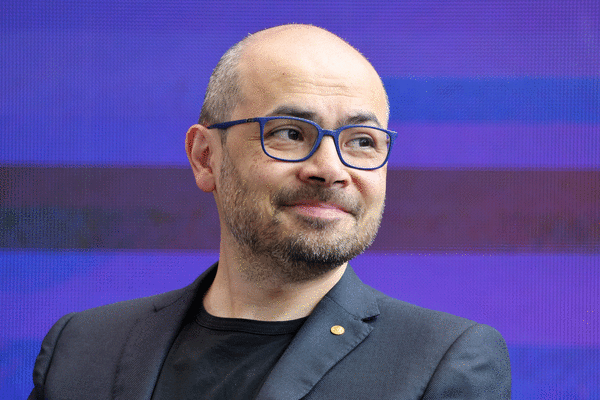
You may have only recently heard about Demis Hassabis. He’s been named one of Time magazine’s “AI architects,” won a Nobel Prize for using the technology to predict protein folding and runs Google’s AI efforts. When the search giant acquired his company DeepMind in 2014, he embraced his new employer’s vast resources to build machines that surpassed human brainpower, so-called artificial general intelligence.
His biggest achievements since then have been to give Google the glow of scientific prestige, with AI systems that beat the world’s top Go players and that Nobel Prize for chemistry. A product breakthrough has long eluded Hassabis, but that could change in 2026 if his unconventional ideas make their way into Google’s second attempt at smart glasses, the kind of development that could mark a full turnaround for a company that was caught on the back foot three years ago by ChatGPT.
Google plans to launch AI-powered smart glasses next year to compete with similar products from Meta Platforms Inc. It’ll partner with Samsung Electronics Co. to make the devices, one of which will come with a small, in-lens display for things like navigation or translation. They could offer redemption to Hassabis’ company in two ways. First, the original Google Glasses looked so absurd and worked so badly that they ruined the reputation of smart glasses for several years. Stylish, useful AI specs would rehabilitate the technology.
Second, it could prove Hassabis’ long-standing belief that chatbots are not the only path to powerful, helpful AI. OpenAI’s ChatGPT sparked the generative AI boom with large language models trained on content from the web and powered by hundreds of billions of dollars’ worth of computing power. But Hassabis has held firm to the idea that “world models” trained on simulations and the physical world around us will lead to the next leap forward.
Meta’s AI chief Yann LeCun thought the same but couldn’t get Mark Zuckerberg to agree, and recently left the company. While Zuckerberg is chasing superintelligence by going all in on chatbots like OpenAI, Google is hedging its bets by betting on scientists and potential paradigm-shifting technologies too.
For a start, Sundar Pichai, the boss of Google parent Alphabet Inc., merged the company’s two AI units under the leadership of Hassabis in 2023, surprising many who thought the California-based engineering lead Jeff Dean would get the job. Hassabis refused to move to Silicon Valley or adopt his employer’s go-to-market mindset, and he obsessed over scientific discovery. Yet from his base in London, he seemed to iron out the deep, transatlantic rivalries between the two units that had stopped them progressing.
Then in August 2024, Google effectively spent $2.7 billion to rehire Noam Shazeer, an eccentric scientific genius who co-invented the Transformer — a neural-network architecture that forms the backbone of modern AI, and is effectively the T in ChatGPT. He’d quit Google in 2021 because it refused to launch his chatbot program two years before OpenAI stunned the world with the same technology. When Shazeer came back last year, he was made technical co-lead for the Gemini chatbot and reported to Hassabis, an arrangement that on paper should not have worked out. Hassabis didn’t share Shazeer’s long-time obsession with LLMs as a path to AGI.
But Hassabis is also a former chess prodigy who likes to think four moves ahead, and he navigated his differences with Shazeer by employing charm and diplomacy. The stakes had become higher. “He’s in a hyper-capitalist race that he didn’t start and now that he’s in it he’s determined to win,” says Sebastian Mallaby, author of The Infinity Machine, a forthcoming book on Hassabis and DeepMind. “Although there’s a big part of his personality that cares about the science there’s an equally significant part that cares about winning.”
He’s a long way from victory. ChatGPT is well ahead of Gemini on user numbers and has a two-year headstart on rolling out an enterprise business, the all-important route to making money from AI. (Gemini Enterprise only launched in October.)
But Google’s latest AI model was still a resounding success. Gemini 3 topped leaderboards on performance and prompted Sam Altman to call a code red at OpenAI, citing “temporary economic headwinds.” Gemini 3 now has more than 650 million monthly app users and an estimated 2 billion users via AI Overviews on Google search. The company has always taken a slow and cautious approach to AI and now the tortoise is catching up to the hare.
Shazeer deserves credit for that comeback. Silicon Valley scuttlebutt has it that he managed to track down a deep bug in Gemini, helping to make it far more efficient to train and to surpass ChatGPT on some benchmarks. Hassabis’ big moment is still to come. If he can make world models like his Project Astra work in practice, they could be the next paradigm shift after chatbots: AI that understands how physical objects move in space and relate to one another.
Imagine wearing glasses that remember where you left your keys, understand what you’re looking at in three dimensions and predict what might happen next in your environment. That’d be a leap forward from Meta’s Ray-Ban glasses, which can only describe what they see through a camera without processing the physics of what’s around you. It would herald a step change in AI assistants.
The pressure is mounting. Google must prove it can monetize AI beyond ads, and Hassabis needs one of his moonshots to finally become a viable business. His track record till now is sobering. For all the prestige of AlphaFold, the protein-structure predictor that’s accelerating the work of 3 million scientists, it has yet to produce any FDA-approved drugs.
But if Google’s new glasses work and sell thanks in part to world models, that could put the company in the lead to find a killer app for AI. It will also determine whether Hassabis remains one of Google’s most decorated scientists, or becomes the architect of its next era.
____
This column reflects the personal views of the author and does not necessarily reflect the opinion of the editorial board or Bloomberg LP and its owners.
Parmy Olson is a Bloomberg Opinion columnist covering technology. A former reporter for the Wall Street Journal and Forbes, she is author of “Supremacy: AI, ChatGPT and the Race That Will Change the World.”
©2025 Bloomberg L.P. Visit bloomberg.com/opinion. Distributed by Tribune Content Agency, LLC.
















































Comments