Patricia Lopez: How the White House lost the public on immigration
Published in Op Eds
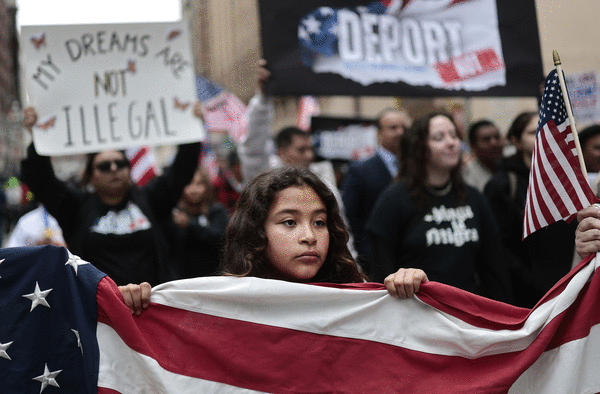
President Donald Trump spent much of 2025 squandering the public’s support on what was once his best issue: immigration. Yes, he quickly delivered on his campaign promise to secure the southern border. But as the year unfolded, his anti-immigrant agenda drove immigration policy far beyond where most Americans are willing to go.
Trump has claimed the U.S. is being “invaded” — on March 15 he invoked the Alien Enemies Act as a pretext to deport more than 200 Venezuelans to the CECOT prison in El Salvador — and that he’s only deporting violent criminals. But ICE’s own data show most have not been charged with crimes.
His approval numbers on immigration have fallen from positive by 9 percentage points in March to negative by 11 points in December, according to Reuters/Ipsos polling.
How did it happen? With four key decisions:
Imposing draconian limits on refugees
Refugee admissions had mushroomed under President Joe Biden, swamping America’s support systems. On Trump’s first day in office, he pivoted to the other extreme: issuing an executive order that shuttered the U.S. Refugee Admissions Program, leaving thousands of refugees stranded, including those with applications in process. The new admissions rate is just 7,500.
Trump has decried immigrants from what he calls “Third World” countries and has become increasingly vocal about his preference for White immigrants. What remains of his refugee program gives preference to White Afrikaners, whom Trump has said face persecution in their majority-Black country.
Despite public criticism and legal challenges, Trump is promoting his anti-refugee stance as a new standard for European countries. In November, a State Department post on X warned that “Mass migration poses an existential threat to Western civilization and undermines the stability of key American allies.”
Revoking legal status from immigrants who’ve done nothing wrong
Trump has steadily and considerably widened the pool of illegal immigrants by stripping legal status from those who entered under temporary protections — a “first you’re legal, now you’re not” approach. In the past year, he has ended or is attempting to end Temporary Protected Status for Haitians, Venezuelans, Afghans, Hondurans, Somalis, Ethiopians and others who arrived in the U.S. after being vetted.
Ultimately, more than 1.2 million immigrants who had been here legally may soon find themselves subject to deportation.
Detaining record numbers of immigrants
Over the summer, a temporary facility in Florida quickly became known for its inhumane conditions — and its callous name: Alligator Alcatraz. It was the first of several nicknamed detention centers celebrated by the administration. Backlash against the facilities — and the tasteless “merch” offered by some — has been fierce. Officials are now said to be looking at private prisons and other existing facilities to handle increased numbers of detainees.
Those held have included some legal immigrants (like graduate students here on student visas) and even some U.S. citizens. Some say they’ve been held for days or weeks without due process.
Hitting U.S. cities with militarized immigration enforcement
Under the guise of public safety, Trump began ordering National Guard troops to Los Angeles, Washington, Portland and Chicago. Federal agents from Immigration Customs and Enforcement, along with Border Patrol, also poured into those cities. ICE agents in masks and street clothes became a common sight, along with Border Patrol agents who adopted full combat kit as they engaged in dramatic raids and aggressive takedowns of immigrants who often had no criminal record.
The tactics deployed under Trump are significantly more aggressive than used under previous presidents, even though a number of those prior presidents deported more people. In Minneapolis in December, agents were videotaped dragging a woman said to be pregnant across the street as protesters threw chunks of ice. (DHS called her “a vandal.”)
The new year is likely to bring further tests of just how far Trump will go. The Supreme Court is weighing whether to repeal birthright citizenship — a change Trump considers essential. Immigration agents have begun using mobile facial recognition technology to detect potential undocumented immigrants in crowds, to the dismay of civil rights advocates. And ICE is on a hiring spree, offering $50,000 recruitment bonuses.
Trump’s agenda on immigration has become clear. He seeks more than a secure border, more than ridding the country of the “worst of the worst” criminal immigrants, more than deporting everyone in the U.S. illegally. Trump sees mass migration as a threat that could displace “American” culture, even though that culture is a mosaic made through hundreds of years of immigration.
His latest move is to set aggressive quotas of 100 to 200 a month on denaturalization, which strips immigrants of their U.S. citizenship. The process is one typically reserved for those few cases where immigration fraud is detected or other narrow circumstances, often amounting to just a handful of cases a year. The quotas represent a new way to instill terror in those who thought they had cleared every hurdle on their long road to citizenship.
2026 is a fresh chance for Americans to look deep inside and ask themselves whether this is the country and the future they want.
_____
This column reflects the personal views of the author and does not necessarily reflect the opinion of the editorial board or Bloomberg LP and its owners.
Patricia Lopez is a Bloomberg Opinion columnist covering politics and policy. She is a former member of the editorial board at the Minneapolis Star Tribune, where she also worked as a senior political editor and reporter.
_____
©2025 Bloomberg News. Visit at bloomberg.com. Distributed by Tribune Content Agency, LLC.



















































Comments