Editorial: Is it ethical for Chicago to use private debt collectors?
Published in Op Eds
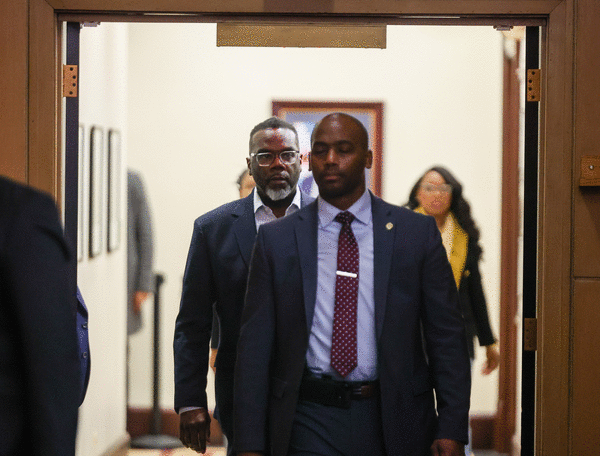
Having watched Chicago’s City Council rebel against his budget — to some extent, anyway — Mayor Brandon Johnson is now focused on the matter of how (and if) the city collects its past-due debts. It’s one of the last weapons against the alternative budget he has in his quiver.
Noting the eye-popping $8 billion currently owed to the city, the City Council-driven budget that passed this weekend included revenue projections from the sale of this debt to private entities, which likely would pursue scofflaws far more aggressively than has been the case in the past.
Johnson has said the sale of debt owed to the city is “immoral,” on the grounds that “working people and poor people are going to be harassed and berated by debt collectors.” No matter that the mayor already has some debt collection costs in his budget; what’s moral for Peter apparently can be immoral for Paul.
First, some background. The sale of debt is common practice as anyone who has heard from a collection agency is well aware; the original creditor does not get the full amount, of course, as the new owner extracts their price. But especially in the case of very old debt that is unlikely otherwise to be paid back, the debt-collection business rests on the assumption that a creditor getting some of that money is better than none.
Chicago certainly has some enforcement mechanisms: Accumulate too many parking tickets and you will find your car booted. But, in general, it has not aggressively gone after much of the money it is rightfully owed from utility bills, fees and fines, among other things.
For example, you might be surprised to know that you can be a city of Chicago employee (or contractor) who has not paid a water bill for months and it’s likely that no one garnishes your salary to motivate you to pay up. The state of Illinois, on the other hand, is far more aggressive when it comes to getting its due, especially when it comes to taxes. If you receive a regular payment from the state, that payment often is reduced by the amount you owe the Department of Revenue. And, of course, the IRS also garnishes salaries as a routine matter when it comes to those with long-standing tax debt.
Moreover, if you don’t pay your property tax debt, as billed by the Cook County treasurer, you will eventually find that your property is sold at an auction to collect that debt (and more besides, to our chagrin).
All these mechanisms create what economists call “moral hazard.” That is when those who can pay what they owe decide not to because others are being forced to pay what they owe.
Johnson’s comments make the assumption that the city is filled with “working people” who cannot pay their red-light tickets or water bills, but we know many working people, many of them far from wealthy, who make it a point of personal pride to pay what they owe. Many Chicagoans were brought up that way.
Most reasonable people would see not enforcing indebtedness as a slap in the face to those who work hard to pay their bills and adjust their expenses accordingly. Indeed, non-collection of debt hurts “working people” who do pay far more than the very wealthy, the one group of people who Johnson thinks should be subject to actual enforcement. In reality, there are many more “working people” than billionaires and if a city signals that debts are optional, more and more of those “working people” will follow this logic and pay them last, or not at all, sending the city spiraling into a yet worse financial condition.
We’ll also point out here that Johnson has greatly expanded speed cameras in the city, thus amping up the number of tickets that rapidly become debts, with heavy penalties attached. Many people have amassed those debts and if they don’t pay at all, then the penalties only have to be increased on those who do pay.
This is Johnson’s defining conundrum as mayor in so many areas; he continuously wants to represent people against the city but he also was elected to be the city. In this paradoxical case, he expands debt and then rails against its collection.
But most reasonable people understand that people have to pay their debts to the government, be it city, state or federal.
That said, there are legitimate worries about aggressive private debt collectors who might be going after debt that is not legitimate. That’s why there are laws restricting such things as the hours debt collectors can call debtors, the notice that has to be offered, and the verbiage that has to accompany written demands to collect a debt and the requirement to offer a right of appeal.
There are existing laws prohibiting threats and misrepresentation and the contacting of third parties, such as employers, and you can even demand of debt collectors that they stop calling you and, by law, they have to comply. There are laws specifying what percentage of a salary can be held back. As anyone in this business will tell you, these restrictions in Illinois are extensive. As they should be.
The existence of these protections leads to the inexorable conclusion that Johnson is utterly wrong here. Debts to Chicago should not be any different from other debts. And if the city cannot collect them, it is perfectly reasonable to send them to collection.
The other aspect here is that many of these debtors are not “poor people” but companies, such as developers, who don’t care or who know about lax enforcement and just try to run out the clock. Thankfully, the city can decide which subset of debt it sells, whether that is the age of the debt or the nature of the debtor. So, by all means, focus collection activity first on debt that does not come from individuals but from businesses, say, with ongoing contractual relationships with the city.
But, really, the only fair way to collect debt is to treat all debtors the same.
Otherwise, everyone gets hurt.
_____
©2025 Chicago Tribune. Visit at chicagotribune.com. Distributed by Tribune Content Agency, LLC.




















































Comments