Commentary: Democrats and Republicans should each support some Independents
Published in Op Eds
The Democratic Party sent a strong message to President Donald Trump and the Republican Party in the 2025 elections, but ironically one part of their overall strategy forward should be to support Independents in House and Senate races where the chances of victory for a Democratic candidate are low.
Double irony: Republicans should employ the same strategy. Triple irony: If both parties pursue this strategy, then this would both serve their self-interest and be in the best interest of the country overall.
The reason the Democrats would be wise to support Independents rather than Democrats is that it is to their advantage to have Independents elected rather than Republicans, and the reason the Republicans would be wise to vote for Independents rather than Republicans is that it is to their advantage to have Independents elected rather than Democrats.
Theoretically, we could end up with a Senate which had, say, six Independents and 94 Democrats and Republicans, suppose 47 vs 47. In the House, a similar dynamic could ensue.
States with historic traditions of substantial independent voters and states which have recently seen a rise of independent voters include New Hampshire, Vermont, Nebraska, Connecticut, Minnesota, Rhode Island, Massachusetts, Iowa, Nevada, and Arizona.
A case study would be Nebraska, where Dan Osborn, a Union Leader who became an Independent, ran for the Senate in 2024 and came fairly close to winning. He is running for the Senate again in 2026.
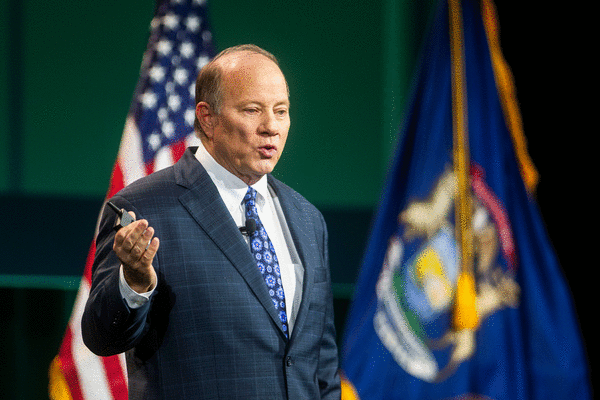
Other 2026 races where Independents have a fighting chance include the race for governor in Michigan where Detroit Mayor Mike Duggan, a Democrat, is running as an Independent, Ty Pinkins who is running for the U.S. Senate in Mississippi, and Todd Achilles who is running for the U.S. Senate in Idaho.
Having five to six Independents in the Senate would provide a bloc of members which could get them to the majority where only a majority was needed (e.g., on reconciliation bills) and to sixty votes where major policy bills required sixty votes.
There are many factors which might lead to an Independent winning a seat in the Senate or the House, with support coming from the major parties being only one of the factors. Support from an Independent PAC or Independent voters would also be important.
Apart from serving their self-interest, Republicans and Democrats, ranging from members to voters to major donors, would presumably benefit from a legislative system that was less polarized, hostile, and dysfunctional. Independents would benefit, members and voters and major donors, because they would finally get representation on Capitol Hill. The Independent bloc would not have equal power to the Republicans and Democrats, but it would possess incredible leverage.
Dartmouth economist Charles Wheelan developed "the fulcrum strategy" in The Centrist Manifesto. His important book, however, speaks for Independents as a Third Party. That approach requires that Independents, who are a diverse group, become a unified group. Centrist third parties, though they work on paper, have not been effective in electoral politics.
The approach advocated here follows the "tripartisanship" model I have developed the last few years in a series of previous columns. We need the fulcrum strategy, but it should be used to unite a diverse group of independents.
I do not imagine that they would all vote together all the time. Indeed, four or five Senators joining the majority party and several defectors from the minority party might be sufficient to get sixty votes.
I imagine, though, that the Independents would basically rotate from supporting Democratic or Republican initiatives depending on who, if either party, had majority control of the chamber in question. If the split in the Senate was 53/41/6, then five votes from Independents and two votes from the minority party would get to sixty. This Senate might have to give the minority party some bills, otherwise they might not be able to get defectors from the party line.
Thus, I don't see Independents being centrists on the ideological spectrum. I see them as a diverse group, where pragmatism would be the chief but not the only theme that motivates them. These independents would want to keep their seats having made certain ideological commitments to their voters as well as a commitment to end dysfunction on Capitol Hill.
Motivation in human life is often a complex phenomenon that is based on multiple factors. Dysfunction and hostility on Capitol Hill could ultimately be controlled if not eliminated if the two major parties helped to grow the third force in American politics both for their own sake and the sake of the country itself.
____
Dave Anderson edited "Leveraging: A Political, Economic and Societal Framework," has taught at five universities, and ran for the Democratic nomination for a Maryland congressional seat in 2016.
_____
©2025 The Fulcrum. Visit at thefulcrum.us. Distributed by Tribune Content Agency, LLC.



















































Comments