Trump unveils eased fuel economy rules, touts boost for affordability
Published in Business News
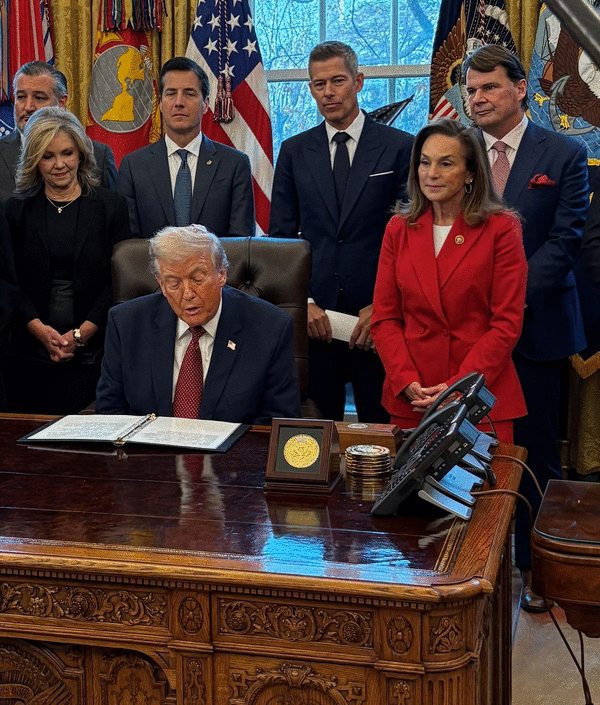
WASHINGTON — President Donald Trump gave Detroit and the U.S. auto industry center stage on Wednesday as he announced relaxed fuel economy standards for the more than 15 million new cars and trucks sold in the country every year.
The plan, if finalized, would slash fuel economy requirements through the 2031 model year, to about a fleetwide average for light-duty vehicles of roughly 34.5 miles per gallon, down from roughly 50 miles per gallon under the current rules.
Trump and other officials in attendance for an Oval Office press conference said the new standards would increase consumers' access to a wider range of affordable gas-powered vehicles and help hold down new car prices.
"They were horrible, what they were doing to the costs, and actually making the car much worse," said Trump of the current fuel economy standards. He promised consumers could eventually see savings on new cars of "at least" $1,000 due to the loosened regulations.
The president was joined in the Oval Office by Ford Motor Co. CEO Jim Farley, Stellantis NV CEO Antonio Filosa and a General Motors Co. plant manager for the company's Orion Assembly site, John Urbanic. Michigan U.S. Rep. Lisa McClain, a Republican, also attended the afternoon event.
"Today's a victory of common sense and affordability," said Farley, who was standing behind Trump next to Filosa. Filosa said the new standards had been "reconciled with real customer demand." Urbanic noted that, under Trump, the Orion plant is shifting from planned EV production to gas-powered SUVs and trucks.
GM CEO Mary Barra, who wasn't in attendance, said that if the company's EV sales hadn't materialized as expected later this decade, and if those rules weren't loosened, then GM would've needed to limit sales of gas-powered cars and maybe even pull back on production: "We were going to have to start shutting down plants," she said, indicating her support for the new loosened standards.
The White House said the current standards, if left in place, would've "compelled widespread shifts to electric vehicles that American consumers did not ask for, accompanied by significant cost-of-living increases."
Consumers have shown signs of growing unhappiness and concern over U.S. economic conditions, and the Trump administration is casting the lenient standards as a move to improve vehicle affordability at a time of stubbornly high prices, especially in the automotive sector. The average price of a new vehicle pushed past $50,000 for the first time in September, according to Cox Automotive Inc.
Despite that affordability aim, however, it is unclear how strong an impact the new rules will have on the nation's largest retail sector. The Trump administration had already worked to roll back other vehicle emission regulations throughout the year.
The auto industry is also facing cost pressures from the president's tariff policies, which will likely raise prices in the short term even if they succeed at reshoring American manufacturing in the long term.
Automakers nevertheless cheered the Wednesday announcement as one that brings forward-looking regulations in line with what they called "market realities" of a slower-than-hoped-for transition to EVs, continued cost and supply chain issues with electrified powertrains, and Americans' longstanding love for large, gas-powered trucks.
The new fuel economy rules won't go into effect right away, as they first must go through normal regulatory procedures, including a public comment period.
Secretary of Transportation Sean Duffy characterized the old standards as a "green new scam" and said that consumers had been "brainwashed" into thinking they were necessary. "All of the nonsense will be taken out of the cars," he said.
Motor City moment
The appearance of executives from all three automakers comes at a tense political time for the historic trio as they balance strong public support for the president with intense private lobbying to have tariffs reduced.
Each of the companies contributed $1 million to Trump's inauguration fund, and the group successfully advocated for a March pause of potential 25% tariffs on Canada and Mexico. Yet Trump ultimately announced 25% tariffs weeks later on all automotive goods entering the United States, albeit with numerous exceptions and bilateral trade deals added in the following months.
The auto executives at the White House didn't raise the tariff issue, but they were sure to mention big investments they were making in the United States: $5 billion from Ford, $13 billion from Stellantis. "You could do more," Trump at one point quipped to Farley, speaking of the $5 billion investment.
"They're doing it because of the tariffs," Trump said of the automakers' U.S. investments.
Ford and the Detroit-based United Auto Workers union have been especially critical of agreements reached with countries like Japan and South Korea while duty bills pile up within North America's highly integrated supply chain.
Those countries, plus the European Union, are currently subject to 15% tariffs on new vehicles. The tariff policies for Canada and Mexico are more complicated.
The United States currently charges tariffs of 25% on the non-U.S. content of vehicles imported from its neighboring nations, even if the vehicles comply with the U.S.-Mexico-Canada free trade agreement. Procedures for assessing those charges were not published until May 20, and enforcement has ramped up significantly since then.
Collectively, U.S. tariffs have cost automotive importers more than $30 billion in duties so far in 2025, according to the most recent federal data. Goods coming from Mexico and Canada account for about $8.5 billion of that.
Ford explained how the current tariff arrangement puts the company at a disadvantage in a July 30 statement: "15% tariffs on vehicles is simply not a strong enough incentive for competitors to move production to the U.S.," the company said, referring to the new announced tariff rates on autos from Japan, South Korea and the European Union.
The statement continued: "Japan and South Korea have real advantages in labor costs, materials and currency. Meanwhile, Ford is facing billions due to multiple tariffs on auto parts, steel, aluminum and more that increase our costs of building in America.
"We are committed to working with the administration to get this right. Our goals are completely aligned, and we have had constructive engagement, but we have urgent work to do to protect our domestic industry.”
Deregulatory push
The new CAFE standards announced Wednesday, which set fleetwide miles per gallon targets for automakers, were long expected from Trump. He and other Republicans have frequently bashed Biden-era standards as an “EV mandate” that would push the industry too quickly toward the new powertrain.
Trump signed an executive order on the first day of his term earlier this year pledging to “eliminate” that mandate and other burdensome regulations on the auto industry. The order also suggested that pro-EV policies rendered gas-powered vehicles “unaffordable.”
The president and Republican allies in Washington have made significant strides to slash automotive regulations over the past 10 months.
They canceled influential state-level standards that would have required 100% EV sales in California and several other states by 2035, have taken action toward removing the legal underpinning of all Environmental Protection Agency rules on tailpipe air pollution, and removed all fines for CAFE penalties.
That final policy, part of the Republicans’ One Big Beautiful Bill Act, preemptively muted the impact of Trump’s new fuel economy standards announced Wednesday.
Even if automakers fail to meet the standards, they will not be penalized.
That allows automakers like the Detroit Three — at least while Trump is in office — to sell as many of their higher-emission offerings as they want without needing to worry about paying fines or buying emission credits. Low-mpg models like the Ford F-150, Chevrolet Silverado and Ram 1500 are major profit drivers for the companies.
The White House said the new CAFE standards would save American families $109 billion in total, whereas the Biden-era standards would have raised the average cost of a new car by nearly $1,000, relative to prices under Trump's reset standards.
The White House also said that "even if far-left Democrats return to power, the current CAFE standards are sensible, so U.S. automakers are not held to infeasible standards."
Industry reactions
The Alliance for Automotive Innovation, the industry's top lobbying group in Washington, cheered Trump's CAFE rules.
“We’re reviewing NHTSA’s announcement, but we’re glad the agency has proposed new fuel economy standards," said John Bozzella, the group's president and CEO, in a statement.
“We’ve been clear and consistent: The current CAFE rules finalized under the previous administration are extremely challenging for automakers to achieve given the current marketplace for EVs.
“What’s good for consumers and the auto industry? A stable regulatory environment and balanced, reasonable, achievable standards that continue to reduce emissions and improve fuel economy. These also happen to be policies that will preserve consumer choice and keep the U.S. auto industry globally competitive.”
Toyota Motor Corp., the second-best-selling automaker in the United States in 2024, deferred to the trade group's comment.
Environmental organizations widely panned the move, while oil and gas groups hailed a policy win.
Kathy Harris, director for clean vehicles at the Natural Resources Defense Council, said in a statement that the Trump administration is "sticking drivers with higher costs at the pump, all to benefit the oil industry. That’s the last thing cash-strapped consumers can afford right now."
“Drivers will be paying hundreds of dollars more at the pump every year if these rules are put in place. That’s only good news for Big Oil, which has been given handouts time and time again by this administration.
“Gas guzzlers aren’t good for America. They are bad for our health, bad for our climate, bad for our national security — and horrible for our pocketbooks. Gutting fuel economy under the pretense of safety and affordability is a cruel joke for cash-strapped American drivers.”
Mike Sommers, CEO of the American Petroleum Institute, took an opposite stance in an emailed statement: “Today’s action is a win for American drivers. We commend President Trump and Secretary Duffy for restoring commonsense fuel-economy standards that recognize the realities of today’s marketplace and the need to preserve affordable choices for families and businesses.
"We will continue to work with the administration on durable policies that strengthen American energy leadership and preserve the full range of vehicle options families and businesses rely on every day.”
©2025 www.detroitnews.com. Visit at detroitnews.com. Distributed by Tribune Content Agency, LLC.








Comments