John Romano: The skill is still there. Now, ferocity is part of the Lightning DNA.
Published in Hockey
TAMPA, Fla. — If the game’s outcome was still in doubt, the moral of the story was not.
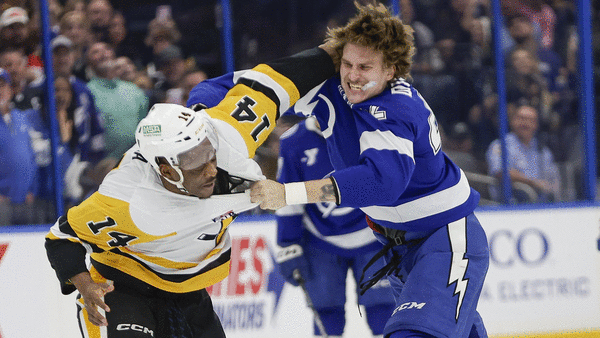
Brandon Hagel had just been thrown head first into the boards by Pittsburgh’s Connor Clifton. While everyone else was racing toward the puck behind the Penguins net, Anthony Cirelli took a sharp right turn and met Clifton with a combination of fists and fury.
In the context of the game, it was not the wisest move. Cirelli racked up 17 minutes worth of penalties in a scoreless game that had less than 17 minutes remaining in regulation. But that was not the point.
This was about something else. Call it camaraderie. Call it vengeance. Call it a message. Or, if you want to take it a step farther, call it the reason the Lightning went into the weekend with the highest points percentage in the Eastern Conference.
This team, long admired for its abundance of talent, has added a noticeable dose of spunk this season.
“You’re always looking for weaknesses in other teams,” said defenseman J.J. Moser. “If you’re playing a highly skilled team, you know skills are not going to be the weakness, so you try to get them out of their game. You try to find something they’re not good at, and maybe they’ll roll over.
“But we’re not taking s—t from anyone. Just like the other night when (Hagel) gets hit and Tony drops the gloves. And if it wasn’t him, it would have been someone else. If you have a team where every single guy is willing to step up, and you pair that with the skill we have, teams are going to stop and think, ‘Whoa.’ They start wondering, ‘Now what are we going to do? Where is their weakness?’ That can be demoralizing for another team.”
A third-period fight in a 0-0 game is not necessarily what general manager Julien BriseBois was describing when, days earlier, he said the Lightning had become a more physical team to play against this season.
BriseBois was referring more to puck battles in the corners, standing your ground in front of the opposing net, keeping forwards from parking themselves in front of your goaltender. He was basically talking about playing with an edge, and that was a priority from the moment the Lightning began training camp.
“There was a message and mandate in camp that for us to take another step forward, probably being a little harder to play against was one of the things we had to do,” head coach Jon Cooper said. “It’s not always about the big hits or fighting or anything like that. It’s about being hard to play against, like getting in the way, being on top, leaning on teams. That, for me, has really improved over, say, the last year or so.”
Not that they needed it, but the Lightning had a model in Florida. The two-time defending Stanley Cup champions are obviously loaded with talent, but they’re also among the most physical teams in the league. In consecutive seasons, they routed the Lightning in the first round of the playoffs by frustrating Tampa Bay’s stars. Nikita Kucherov has zero goals in his past 10 postseason games against the Panthers.
“They’re a hard team to play against. You know you’re going to get that kind of game against the Panthers,” said Lightning forward Gage Goncalves. “I thought we physically matched up with them but, you know, no excuses. We got banged up.”
The Lightning have been methodically moving in this direction for a couple of years. Bringing in someone like Yanni Gourde with his in-your-face style. Bringing in Moser, who added a more physical presence on the blue line. Bringing in Curtis Douglas as an enforcer.
It’s undoubtedly skewed a little because of some over-the-top battles with the Panthers already in the regular season, but the Lightning lead the NHL in major penalties, as well as penalties per 60 minutes. Tampa Bay is averaging 13:57 in penalty minutes per game which, if it holds up the rest of the season, would be the most in the NHL since 2013-14.
It might seem reckless, but it’s more strategic than anything. It’s wearing teams down. It’s protecting your stars. It’s letting opponents know that the Lightning are not going to be pushed around.
“It all came from Coop, but it also came from the players. I think we all agreed that it was pretty obvious that was something we had to do better if we wanted to go deep (in the playoffs),” Moser said. “It’s a little more demanding, but this is the only way to do it. I don’t think you can just come into the playoffs and flip a switch in the first game and say, ‘Now, we’re going to be this (tough) team.’
“It has to be part of the process, part of your identity and you burn that into your identity over the course of a season so that in the playoffs you don’t have to change a thing.”
____
©2026 Tampa Bay Times. Visit tampabay.com. Distributed by Tribune Content Agency, LLC.





Comments