How the NHL will protect the ice for Lightning's Stadium Series game
Published in Hockey
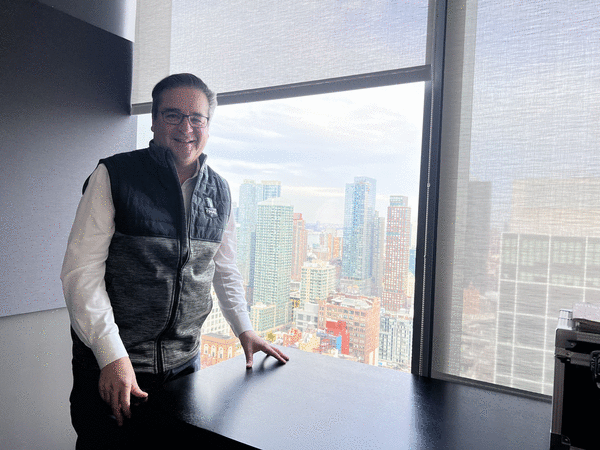
TAMPA, Fla. — Earlier this month, Steve Mayer, the NHL’s president of content and events, made a presentation at the league’s Board of Governors meeting, providing an update on what the Lightning’s Stadium Series outdoor game will look like.
A room full of bigwigs were floored, Mayer said, when he showed them an illustration of how the tented temperature-controlled structure built atop the rink on the Raymond James Stadium playing surface to protect the ice ... and then deconstructed in the hours leading up to the Lightning’s first home outdoor game on Feb. 1.
“I got so many comments after we showed that like ‘oh my goodness’ because it’s so different,” Mayer said in an interview with the Tampa Bay Times at the NHL offices in New York. “Essentially, we’re building a rink under a controlled environment that will be air conditioned so that it’s really cold underneath the tent, and the day of the game — in the 6 1/2 hours it’s going to take to take the tent down — deconstruct it.”
The Lightning’s game against the Bruins will be the league’s 45th outdoor game, and Mayer said it will be the most challenging. Weather issues have been routine, but Tampa’s sun, humidity and even air salinity being close to the water offer a unique set of challenges. The tented structure will cover nearly the entire Raymond James Stadium playing surface.
“What makes this different is the model of how it has to be done,” Mayer said. “We are building essentially a roof. For lack of better terms, we’re building a roof on a stadium that doesn’t have a roof. It’s a tent, but that’s what we need to do in order to protect our precious entity, which is the ice.
“We could never do this game without a roof. Impossible. Would not happen. So we had to figure out the engineering of it all. And I think that’s the marvel, and that’s what everybody and their brother is going to talk about.”
In 2025, the high temperature in Tampa on Feb. 1 was 73 degrees and the low was 41, according to AccuWeather. According to Weather Spark, the average high temperature on Feb. 1 in Tampa is 71 degrees with a low of 53.
Over the years, the NHL has seen its share of obstacles playing outdoors. During the pandemic season’s game at Lake Tahoe, a beautiful day under the sun was an incredible backdrop but it made the ice mush, prompting an eight-hour delay in the game between the Golden Knights and Avalanche until the sun went down.
Eight years ago, before a Stadium Series game between the Capitals and Leafs in Annapolis, high winds from a winter storm damaged the setup, and there was a 15-minute delay during the game because of a power outage.
And the ability to make NHL-quality ice hold up has improved by leaps and bounds since Wayne Gretzky slopped around in the league’s first outdoor game, held in the Caesar’s Palace parking lot 34 years ago when the Kings and Rangers played in mid-90s temperatures but low humidity in Las Vegas.
“We’ve faced a lot, you know, and we’ve learned how to overcome it,” Mayer said. “So over the years, we’ve just become smarter. The technology has just become better than it’s ever been. Making ice, which sounds so simple, it’s not, and we have the best team in the world doing it, but the technology over the years has gotten better. So all these factors have helped us to get to this point. We’ve been talking (about an outdoor game in Tampa) for a long time.
Mayer mentioned the “Next time, let’s go outside the box” billboard put up by the Tampa Bay Sports Commission after Tampa hosted the 2018 All-Star Game as getting the gears turning for an outdoor game at Raymond James Stadium.
“We knew we wanted to do an All-Star Game in Tampa, but then the second the All-Star Game was over, it was ‘what’s next?’ ” he said. “So we’re now at 2025, seven years later, and I am not kidding you, there’s been seven years of conversation.”
Since then, rounds of testing outdoor rinks in Tampa didn’t work. For the league to pull a game off, they’d need to build a structure that would keep the ice cool and limit outside interferences. A test structure was built in Texas, and they’ve done three test runs to determine how to deconstruct the structure as quickly as possible and limit the exposure to the elements and start play in a 45-minute window from 6:30 to 7:15 p.m. after the sun sets.
When fans walk into RayJay before the game, they’ll see the latter stages of the deconstruction still in progress.
“Part of the deconstruction of the tent, some of the elements of the trussing will be part of our field design, which is really cool,” Mayer said. “When people walk in the stadium, there’ll still be cranes on the field. There’ll still be work being done, because we need to get as close to game time as possible, because we want to limit the exposure of the rink to the elements. We certainly don’t want to put it out there in the sunlight.
“There’s risk — through the roof,” Mayer said. “If it’s a really warm day in Tampa, if it’s pouring down rain, there’s little things that we’re all aware of. But we’ve thought it out. We looked at the weather, and we looked at every scenario, and we’re very confident. But the process is so unique to anything we’ve ever done.”
Stadium Series tickets
A limited number of tickets are available for the Feb. 1 game at Raymond James Stadium between the Lightning and Bruins. Purchase tickets via Ticketmaster.
Road to the Stadium Series
A series of short-form, behind-the-scenes videos of the making of the first NHL outdoor game in Tampa, “Road to the Navy Federal Credit Union NHL Stadium Series, presented by Fastenal,” will be available on the NHL’s YouTube channel and on ESPN’s The Point NHL studio show. Episode 1, which focuses on how the Lightning and Tampa were awarded an outdoor game, premieres Jan. 6. Episode 2, premiering Jan. 10 on ABC’s pregame show before the network’s 1 p.m. Rangers-Bruins broadcast, will preview the tent setup and ice-making process.
©2025 Tampa Bay Times. Visit tampabay.com. Distributed by Tribune Content Agency, LLC.






Comments