Paul Sullivan: Baseball returns after a long, hard winter, and we're grateful to welcome it home
Published in Baseball
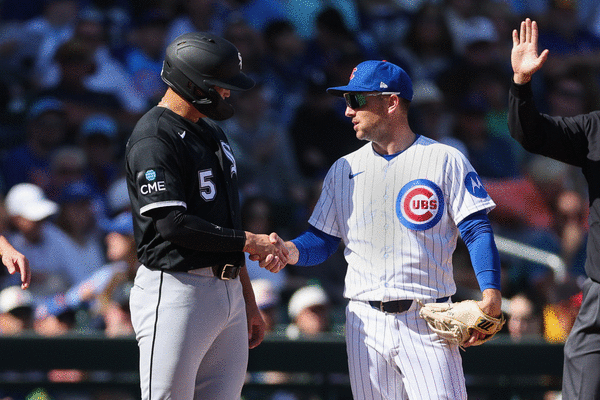
CHICAGO — The 2026 baseball season begins this week, and for that we’re eternally grateful.
Sure, it starts too early and ends too late, leading to cold-weather games every spring and World Series games into November.
But for much of the next seven months, a three-hour game provides a temporary respite from spiking gas prices, growing airport lines, conflicts abroad and madness at home. Any chance to ignore the real world and immerse ourselves into a fantasy world, even one with nonstop gambling ads, is most welcome.
No, the game is not as good as it used to be. Just ask your parents.
Starting pitchers come out of games too early, hitters rarely move along runners and outfielders have cheat sheets on index cards to properly position themselves. Ghost runners and pitch counts and walk-up music that turns into an earworm are all modern-day aggravations that won’t soon go away.
But the time-honored chess game between pitcher and batter remains as intriguing as ever, and no rules change or marketing ploy can ruin that.
The umpires, naturally, are as fallible as they were a century ago, as we witnessed once again on the final pitch of the U.S. win over the Dominican Republic in the World Baseball Classic semifinals, when an obvious ball was called a strike and ended a potential game-tying DR rally.
But MLB decided to alter the game forever this year with the addition of the “robo-ump.” The Automated Ball-Strike System (ABS) that allows two challenges per team — losing them only when incorrect — at least holds the plate umpire accountable when his eyes deceive him. It’s too late for the Angel Hernandez era, but better late than never.
Managers, as always, are the game’s primary spokesmen, meeting with the media before and after every game. Over the last decade or so, they’ve become as bland a group as baseball has ever seen, with video challenges removing the need for any on-field rants against umpires and televised news conferences removing any personality that might seep out when he’s sitting in his office going on and off the record with his beat writers about baseball and life.
The slightest managerial misspeak might be internet fodder for days or weeks, so the Earl Weavers, Billy Martins, Lou Piniellas and Ozzie Guilléns of the world are gone, and generic-sounding managers who avoid speaking truthfully dominate the landscape. Yet they’re smarter than ever and much more analytically proficient than their predecessors, and their bosses clearly prefer clichés over transparency.
The players as a whole are as talented as past generations, if not more so. Pitchers throw harder. Great fielders are more valued than ever. Power hitters can be found anywhere in the lineup. They are also, in my opinion, less colorful than the old days, when a Mark Fidrych or a Carlos Zambrano or a Turk Wendell could be themselves. When was the last time you saw a player talk to a baseball, throw out an umpire or brush his teeth in the dugout?
The nonconformists of the game have disappeared slowly, and many players seem to be more concerned about promoting their brands, improving their social-media followings or auditioning for a post-career job as a baseball analyst. Conformity pays.
They should know that perhaps the biggest nonconformist of all time was Jimmy Piersall, who was fortunate to work in Chicago after his career. Piersall became a broadcasting legend on White Sox telecasts alongside Harry Caray, before Sox Chairman Jerry Reinsdorf fired him and let Caray leave for the Cubs. At least Guillén still speaks his mind on the Sox’s pre- and postgame shows, so maybe there’s hope for nonconformists after all.
Owners are richer than ever and also threatening to flush away the 2027 season if the MLB players union doesn’t agree to a salary cap, putting a dark cloud over the game before the season begins. Players are also richer than ever but rightfully argue they only make as much as the owners are willing to pay. Kyle Tucker got a ridiculous four-year, $240 million deal from the Los Angeles Dodgers, but that’s not their fault.
No matter which side you’re on, the end result would be the same. A lost baseball season would lead to a mass exodus of fans and take years for the sport to recover. Hopefully cooler heads will prevail. Does anyone expect that?
Baseball coverage is more in-depth than ever, with hundreds of blogs competing with team-owned websites and the ever-shrinking legacy media, including this 178-year-old newspaper that has covered the Chicago Cubs for its entire 150-year history and the White Sox for its 125 years.
Ring Lardner is dead, but we’re still cranking out baseball coverage from both sides of town.
Some baseball writers focus on analytics, some on features and some on opinions. You can read the company line in some team-approved media or an old-school “gamer” in other places. But whatever you want, you can usually find it, read it and then inform the writer how wrong they got it, just like writing a letter to Lardner 100 years ago.
Technology has drastically changed how we consume the game, but at least there will always be a way to follow your team. Beat writers with the “inside dope” or bloggers with aggregated dope. Your choice.
Radio is still the best medium for following a baseball game, and we’re lucky in Chicago to have two fine broadcast teams in the Cubs’ Pat Hughes and Ron Coomer and the White Sox’s Len Kasper and Darrin Jackson. I could go without the adult-diaper sponsorship after every walk by opposing pitchers on Cubs games, but the bills must be paid, I suppose, and at least listening to a ballgame on the radio is still free.
Most fans understandably prefer watching on TV, which is fine. But it’s becoming more expensive ($20 per month for a DTC subscription) and gimmicky, with pseudo-celebrities or team presidents or general managers visiting the booth to promote themselves. The seventh-inning stretch at Wrigley hit an all-time low last year with a “look at me” celebrity podcaster who embarrassed herself and was booed by the crowd. In-game interviews in which managers or mic’d-up players say nothing of interest are also becoming more prevalent.
God invented the mute button for a reason, but it would be nice to let baseball broadcasters just call a game.
Despite all its warts, the game remains “the” game, and its fans are still fans. Pleasing the customers is the goal of every team, and every fan base is different, as evidenced by the two in Chicago.
Open the gates at Wrigley Field and Cubs fans usually come, no matter the weather or the product on the field. This year the Cubs begin as consensus favorites to win the National League Central and have a personable, young star in Pete Crow-Armstrong to help keep the place packed, like Sammy Sosa in the late-’90s and early 2000s.
But if you want to get fans in the seats at Sox Park, you had better provide good food, cool giveaways and lots of fireworks. Fortunately for Sox fans, food and giveaways are what they do best. Add in an improved team on the field and a bonafide slugger in Japanese star Munetaka Murakami and it should make for a more interesting summer.
Either way, spring is here, and baseball is just around the corner.
No, it’s not the game we grew up with, when the stars seemed bigger and the days and nights seemed to last longer.
But it’s still baseball, and we’re grateful to welcome it home.
____
©2026 Chicago Tribune. Visit chicagotribune.com. Distributed by Tribune Content Agency, LLC.




Comments