In bid for voter data, Trump's DOJ lays groundwork to undermine confidence in midterms
Published in Political News
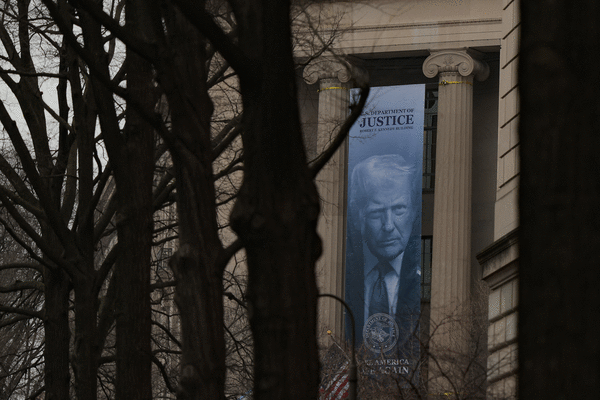
The U.S. Department of Justice has begun connecting its push to obtain sensitive personal data on millions of voters to whether the upcoming midterm elections will be fair and secure, laying the groundwork for the Trump administration to potentially cast doubt on the results.
The Justice Department has sued 29 states and the District of Columbia over their refusal to provide unredacted voter rolls that include the driver’s license and partial Social Security numbers of voters. The department has lost three of those lawsuits so far this year.
But as the Justice Department begins appealing the losses, it has filed emergency motions warning the “security and sanctity of elections” would be questioned in those states — California, Michigan and Oregon — without immediate rulings.
Election experts told Stateline that federal appellate courts are unlikely to move quickly for the Justice Department. Instead, the department’s court filings suggest that without the data, the Trump administration may question the validity of the midterm elections in November.
“Absent a final Court determination on this matter there is no other process to ensure a fair election in 2026,” the Trump administration’s motions say.
President Donald Trump has made identifying noncitizen voting, an extremely rare occurrence, a priority of his administration, and the Justice Department has said the detailed personal data is necessary to ensure states are properly maintaining their voter rolls. At least a dozen Republican-led states have provided the information.
Democratic election officials, and some Republicans, have condemned the demands as an invasion of voters’ privacy and have voiced concerns the Trump administration plans to use the information to target political opponents or create a national voter list. Other Republican election officials and the Trump administration and have downplayed privacy concerns and said the data will help ensure only eligible voters cast ballots.
The DOJ’s sense of urgency comes after the department spent months sending letters to state officials demanding voter data, followed by successive rounds of lawsuits against states that refused to comply — all in what department officials said was the pursuit of noncitizen voters.
“We know this isn’t a big problem nationwide,” said David Becker, executive director of the nonpartisan Center for Election Innovation & Research and a former senior trial attorney in the Justice Department’s Voting Section during the Clinton and George W. Bush administrations.
“We know the states have adequate safeguards,” Becker said. “We see Republicans — Republicans — coming out and saying this repeatedly. So there is no problem that urgently needs to be solved in advance of the election.”
But the Trump administration has increased its attention on elections in recent weeks. In early February, Trump voiced a desire to “nationalize” elections. He demanded Congress pass a proof of citizenship voter registration requirement and strict voter ID rules. The U.S. Senate is expected to debate the bill next week, but it is unlikely to have enough votes to advance.
The FBI has also seized ballots from the 2020 election in Fulton County, Georgia, and the Arizona Senate complied with a federal grand jury subpoena for records related to its 2020 audit of that year’s election results in Maricopa County, Arizona.
Michigan responded to the Justice Department in a March 6 court filing by asserting that its case involves no emergency. Lawyers representing Michigan Secretary of State Jocelyn Benson, a Democrat, wrote that the appeal doesn’t challenge any state election law or rule and that the outcome of the case would have little to no effect on the 2026 election.
In response to an interview request, Benson’s office referred Stateline to a news release that quoted the secretary as urging election officials across the country “to stand up to the federal government’s overreach and to safeguard citizens’ private voting information we’ve been entrusted to protect.”
Oregon Democratic Secretary of State Tobias Read said in an emailed statement to Stateline that he’s “confident in our case, and trust the courts will continue to uphold the Constitution and the privacy rights of all Oregonians.”
California Democratic Secretary of State Shirley Weber didn’t respond to an interview request.
Race against time
Federal judges have so far ruled that even though states must perform maintenance on their voter rolls, federal law doesn’t give the Justice Department authority to obtain full voter lists.
While the Justice Department now claims the security and sanctity of upcoming elections necessitates the need for speed, the department hasn’t alleged any states are violating federal voter list maintenance requirements, said Derek Clinger, senior counsel and director of partnerships at the State Democracy Research Initiative at the University of Wisconsin Law School.
“This is the first time in all the litigation that DOJ has claimed that there’s an urgent need to resolve the cases,” said Clinger, who is tracking the voter data lawsuits.
Even if courts ultimately determine that states must provide the voter data, it’s not clear that the Justice Department could make effective use of it before the midterms.
Federal law generally prohibits states from conducting significant purges of registered voters less than 90 days before primary and general elections. For example, that period will begin in Michigan on May 6 ahead of the state’s Aug. 4 primary election.
The Justice Department has asked for all court documents in its Michigan appeal to be filed by April 1. Even if the appellate court immediately ruled in the department’s favor, only 35 days would be left until the pre-primary blackout period.
Lawyers for Michigan wrote in its court filing that it is “dubious” that any serious assessment of the state’s 7.3 million voters could occur in that time frame.
Still, Rosario Palacios, a naturalized U.S. citizen who leads the good-government group Common Cause Georgia, said she’s worried the federal government could wrongly flag her or others like her as noncitizens if the Justice Department eventually obtains her state’s unredacted voter roll.
The U.S. Department of Homeland Security operates a powerful online program called SAVE (Systematic Alien Verification for Entitlements) that it uses to verify citizenship. It has previously invited states to run their voter rolls through the program, and the Trump administration in September confirmed the Justice Department is sharing state voter roll data with Homeland Security. But SAVE has faced criticism from some election officials for mistakenly flagging U.S. citizens for review.
After the department sued Georgia for refusing to turn over its data, Palacios and Common Cause intervened in the lawsuit to oppose the demand.
Palacios said in an interview she’s worried some may choose not to participate in the election. “The fear alone of this is going to make people withdraw.”
Some GOP states share voter data
The Justice Department has offered few details about how it intends to analyze the voter data it obtains. The agency didn’t answer questions from Stateline and declined to comment.
Idaho Republican Secretary of State Phil McGrane last month said he wouldn’t turn over voter data. McGrane declined an interview request, but in a Feb. 26 letter to the Justice Department he raised concerns about data security.
“While I appreciate the Department’s representations that Idaho’s data will be safeguarded, I cannot take that now-apparent risk in the absence of clear legal duty to do so,” McGrane wrote.
Some Republican election officials have decided to share their state’s data, however.
Eric Neff, the acting chief of the Justice Department’s Voting Section, wrote in a March 2 court filing that 18 states had either shared voter data or planned to do so soon. He didn’t name those states.
The Brennan Center for Justice at New York University, which tracks the voter data requests, has identified at least a dozen states that have provided the data: Alaska, Arkansas, Indiana, Kansas, Louisiana, Mississippi, Nebraska, Ohio, South Dakota, Tennessee, Texas and Wyoming.
Two of those states — Alaska and Texas — provided their voter rolls after signing a memorandum of understanding, or MOU, with the Justice Department.
The document, marked confidential, says that after the state provides its voter roll, the department agrees to test, analyze and assess the information. Each state agrees to “clean” its voter roll within 45 days by removing any ineligible voters. States would then resubmit their list.
Tennessee Elections Coordinator Mark Goins, who works under Tennessee Republican Secretary of State Tre Hargett, said in an interview that the state had shared its voter data after concluding that DOJ was entitled to it as part of its authority to enforce federal voting law. But Goins said Tennessee had decided against signing the memorandum of understanding because of concerns that the agreement conflicted with the National Voter Registration Act, which sets rules on when election officials can remove voters from their lists.
“When you’re dealing with this much data, and we have 4 million registered voters here, there could be a false flag and you certainly don’t remove anyone improperly,” Goins said.
In Texas, it’s unclear when the Justice Department will provide feedback on the state’s voter list. The state is currently in the preelection blackout period on sweeping changes to its voter registration list ahead of a May 26 primary runoff election, a spokesperson for Texas Republican Secretary of State Jane Nelson told Stateline.
Texas already ran its voter roll of more than 18 million voters through Homeland Security’s SAVE program last year, identifying 2,724 potential noncitizens registered to vote. County election officials were then left to investigate the flagged voters.
Christopher McGinn, executive director of the Texas Association of County Election Officials, said he’s unsure what would happen now, given that the state’s voter roll was recently examined by SAVE.
“Especially since those noncitizens were, in theory, cleaned up,” McGinn said.
In Alaska, the decision to share voter data has produced blowback from some state lawmakers. The state constitution guarantees a right to privacy that “shall not be infringed.”
Alaska Director of Elections Carol Beecher faced skeptical lawmakers during hearings last week that probed her refusal to waive attorney-client privilege to divulge the legal advice she received before providing the voter roll. In response to questions from Stateline, Beecher’s office referred back to her remarks to lawmakers.
“At this point, I am not willing to waive that privilege,” Beecher said at an Alaska Senate hearing.
Alaska state Sen. Bill Wielechowski, a Democrat who was among those who questioned Beecher, in an interview predicted the state will soon face lawsuits challenging the data sharing. He also said lawmakers are looking into pursuing legislation that would direct state officials to seek the return of the information from the Justice Department.
“I just think there’s a total lack of trust in what the federal government will do with this information,” Wielechowski said.
©2026 States Newsroom. Visit at stateline.org. Distributed by Tribune Content Agency, LLC.



















































Comments