White House rejects Democrats' DHS demands to unlock funding bill
Published in Political News
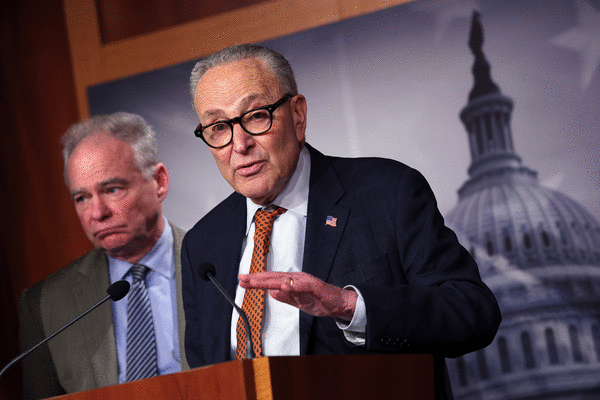
WASHINGTON — The White House promptly rejected a Senate Democratic proposal for restraints on federal immigration agents Wednesday, saying those talks should occur on a separate track from negotiations on a $1.3 trillion fiscal 2026 spending package hung up in the Senate.
The administration’s stance throws a wrench into bipartisan talks to try to get the huge appropriations bill unstuck before Friday night’s deadline when stopgap funding for several Cabinet departments, including Homeland Security, runs out.
“The White House is committed to avoiding a shutdown, and to productive dialogue with the Congress,” a White House official said Wednesday afternoon. “A demand for agreement on legislative reforms as a condition of funding the Department of Homeland Security with a government funding deadline just 48 hours away is a demand for a partial government shutdown.”
After his caucus’s Wednesday policy lunch, Senate Minority Leader Charles E. Schumer, D-N.Y., said his party has coalesced around three demands:
—Further restrictions on federal agent patrols, including tighter warrant requirements and collaboration with state and local law enforcement.
—Accountability through a uniform code of conduct and review including independent investigations.
—A ban on masked agents that also requires officers to carry identification and wear body cameras.
“Congress has the authority and the moral obligation to act,” Schumer said at a news conference where he announced Democrats’ policy priorities. “What’s missing is Republican will to act.”
With only two days left remaining before current funding for many federal agencies runs out, senators of both parties were working behind the scenes on a plan for addressing how the Homeland Security Department is conducting an immigration crackdown that has led to two fatal shootings in Minneapolis.
Talks between the Trump administration and Democrats likely hold the key to breaking the logjam, Senate Majority Leader John Thune, R-S.D., told reporters Wednesday morning.
“I think right now the conversation should be between the White House and Democrats,” he said. “I think the White House obviously is open to negotiation.”
But Thune continued to press for finding a solution that doesn’t require amending the House-passed, six-bill spending package that would head off a shutdown and provide most of the discretionary spending for the current fiscal year.
If another House vote is required, Thune said, “You’re injecting a lot of uncertainty into the equation here.”
The White House official echoed Thune’s view, saying now is not the time to undo a DHS appropriations bill that was all set to clear the Senate this week prior to the death of 37-year-old nurse Alex Pretti in Minneapolis over the weekend.
“This bipartisan appropriations package, which the Democrats agreed to and have now walked away from, has been under negotiation for more than a month,” the official said.
Top Democrats, however, continued to press for stripping out the House-passed Homeland Security appropriations bill from the larger package.
Senators of both parties “are talking and sharing ideas,” Schumer said in a floor speech. “But given how little time we have left before the funding deadline, the first, right step for the Senate is for Leader Thune to split the funding bills and put the five bills on the floor, 96% of federal funding, that can pass. It’s the right and expedient thing to do.”
Split package?
A pair of senior Republican appropriators said Wednesday that they would be willing to break up the package to allow for passage of the other five less controversial bills and a continuing resolution for the Homeland Security Department.
“At this juncture, the smart play is to carve out the Homeland Security bill, and we can fight over that,” said Sen. John Kennedy, R-La., while emphasizing that he could change his mind on the best path forward. “But in the meantime, try to do a CR and pass the other ones.”
That position isn’t uncommon within the GOP ranks, according to Kennedy, who said “a bunch” of Republicans are open to breaking off the DHS bill. “Sen. Thune can’t admit it, because he’s got to act like a tough guy,” he added.
GOP Sen. Lisa Murkowski of Alaska, who chairs the Interior-Environment Appropriations Subcommittee, also said Wednesday that she would be open to removing the Homeland Security bill from the package.
Some lawmakers are considering approving a short-term stopgap bill for DHS to buy time for both sides to negotiate potential restraints on the department, as public scrutiny mounts over the administration’s immigration enforcement operations.
The other five bills in the package — Defense, Labor-HHS-Education, Financial Services, National Security-State and Transportation-HUD — could be passed as a package, providing funding for affected agencies through September. But removing the Homeland Security measure would require another vote in the House.
“If we get five of the six across the finish line with House cooperation, that’s funding … in excess of 90% of government, with basically only Homeland left,” said Sen. Mike Rounds, R-S.D.
Rounds also pointed out DHS already has funding available through last year’s reconciliation law that could help fund the agency during a shutdown. That measure provided an extra $170 billion for the department outside the annual appropriations process, although it wasn’t clear how much of that sum was still unspent.
However, the plan would likely meet pushback from some conservatives, who strongly oppose breaking off DHS funding from the pack. That means efforts to fast-track the potential plan could face procedural delays, increasing the chances of a temporary partial government shutdown.
Sen. Brian Schatz, D-Hawaii, a senior appropriator and member of Democratic leadership, said Wednesday that there’s “a will to get some reforms on a bipartisan basis” as lawmakers in both parties look to chart a path forward.
“Republican senators have indicated that they also want some changes to the way that things are going on,” Schatz said.
Democrats are digging in on the stance that any policy changes would need to be codified via legislation rather than implemented through executive action. The Trump administration’s efforts to impose its influence over Congress have left them with little trust that the administration would stick to any kind of deal, they say.
Sidecar option
Also under consideration by senators is an approach that would allow the spending package to advance as-is, with a separate bill including policy changes on immigration enforcement to get votes separately.
That approach would avoid some of the procedural hurdles that would cause a government shutdown, but senators are again worried about getting such stand-alone legislation across the finish line.
However, at least one moderate-minded member of the Democratic conference, Sen. Angus King, I-Maine, is pouring some cold water on that idea. When asked about the prospect of advancing the spending package and tackling policy changes in a separate bill, King told reporters he didn’t see that approach as something that would be feasible.
“I don’t think so, because I don’t think we have any assurance that our friends would take that up,” King said, referring to the House.
_____
(John T. Bennett and Savannah Behrmann contributed to this report.)
_____
©2026 CQ-Roll Call, Inc., All Rights Reserved. Visit cqrollcall.com. Distributed by Tribune Content Agency, LLC.



















































Comments