New York on track to lose 2 House seats after 2030 census
Published in Political News
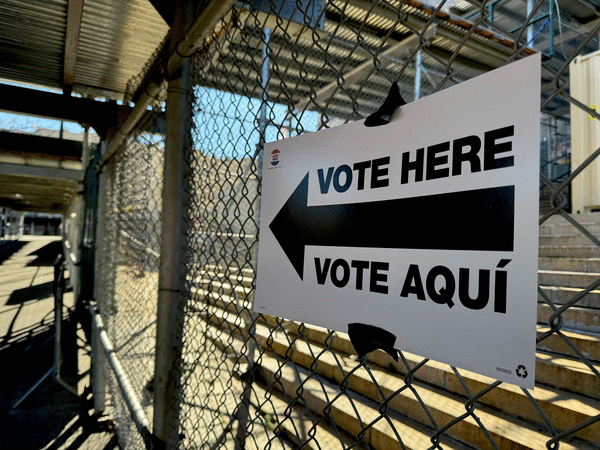
NEW YORK — New York is on track to lose two seats in the House of Representatives after the 2030 census as population growth in several Democratic-leaning states lags far behind the rest of the country, a new population report predicted on Tuesday.
The Empire State’s delegation would have just 24 seats, down from the current 26, a dip that could reduce its clout, according to the report created by the nonpartisan Redistricting Network.
California is expected to lose four seats, marking the second straight time the Golden State will have lost at least one seat after previous decades of high growth. Illinois could lose two.
The big winners among the states are expected to be Texas and Florida, which could add four seats apiece if current trends play out until the start of the next decade.
Other high-growth Sunbelt states like Arizona, Georgia and North Carolina are expected to pick up one seat each in a reshuffle of the 435 House seats that are divvied up each decade among the 50 states, based on their relative populations.
The shifts are widely considered to be a major political boon for Republicans because they hold firm control of most states that would pick up seats, while Democrats are in charge in states that will lose out, including New York.
The GOP advantage in Congress is likely to be exacerbated by the increasingly bare-knuckled gerrymandering strategies employed by both parties after President Donald Trump launched an unprecedented mid-decade redistricting push.
The new allocation of House seats will in turn will dramatically affect the states presidential candidates would need to win to gain 270 electoral votes and win the White House.
Notably, the recent Democratic strategy of seeking to sweep the so-called Blue Wall states of Pennsylvania, Wisconsin and Michigan would likely not be enough to score a win over a Republican candidate in 2032 and beyond if other red and blue states stay in line. Democrats would likely also have to win one or more Sun Belt states, like perhaps Georgia and North Carolina.
Trump has suggested he may seek to hold a census earlier than 2030, but it’s not clear if that would pass legal muster. He also wants to limit the count to U.S. citizens, which could shake up the state-by-state predictions.
The changes are not directly related to the nationwide mid-decade redistricting war that involves red and blue states redrawing the lines of existing districts, not adding or losing seats.
_____
©2026 New York Daily News. Visit nydailynews.com. Distributed by Tribune Content Agency, LLC.



















































Comments