Analysis: 6 key questions about the 2026 midterm elections
Published in Political News
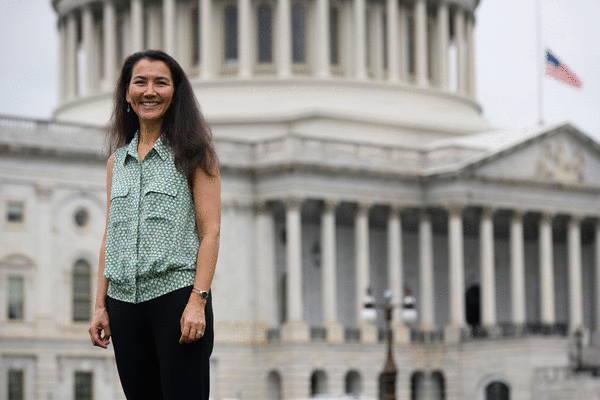
WASHINGTON — Both parties are preparing for a hard-fought midterm election year that, if the first full week of 2026 is any indication, will bring along some surprises.
Primary contests begin in March and will help answer key questions about what’s driving voters in both parties and set up the critical battleground races to watch in the general election. Republicans are defending a threadbare majority in the House and a more comfortable one in the Senate, where Democrats have to contend with a challenging map.
The candidate fields are still being set. On Monday, former Alaska Rep. Mary Peltola announced she would challenge Republican Sen. Dan Sullivan, giving Democrats their best chance to flip an otherwise difficult seat. In Maine, GOP Sen. Susan Collins has yet to officially announce her bid for a sixth term, although she has indicated she’s running again.
Here are a few key questions we’ll be checking on throughout the year.
Does anything top affordability in messaging?
The cost of living seems likely to be the top campaign issue in 2026, but the first week of the year underscored that both parties will have to balance efforts to lower costs with responding to the Trump administration’s foreign policy ventures and headline-grabbing events across the country. While 17 House Republicans sided with Democrats to extend enhanced health insurance tax credits that had expired at the end of last year, lawmakers were also grappling with shootings by federal agents involved in immigration enforcement and the U.S. military and law enforcement operation in Venezuela that culminated with the capture and arrest of the country’s leader, Nicolás Maduro.
Democrats appear determined to keep their campaign messaging fixated on affordability, an approach that helped them win big in the off-year elections last fall.
Senate Republicans late last week traveled to the South Texas city of McAllen to highlight border security provisions that were included in the tax and spending package the GOP enacted last year. Border security was seen as a winning issue for Republicans in 2024, and the party is touting the current decrease in illegal border crossings compared with during the Biden administration.
What do Democratic primary voters want?
While House Democrats have their sights on winning the majority this year, several incumbents are facing primary challenges they need to take seriously.
They include longtime stalwarts such as Mississippi’s Bennie Thompson, Connecticut’s John B. Larson, Tennessee’s Steve Cohen and California’s Doris Matsui. These primaries could test how Democratic voters feel about aging lawmakers, as well as if they feel like their members are doing enough to push back on the Trump administration.
In several states, such as New York and Illinois, there are crowded Democratic primaries for safe blue seats, which could also offer clues about what voters are prioritizing in terms of political experience and approach. The rise of New York City Mayor Zohran Mamdani, a self-described democratic socialist, has inspired a wave of younger, more progressive candidates across the country, and those primaries will test whether Democrats at large are ready to embrace an unabashedly left-leaning platform.
Will more states redistrict?
The second half of 2025 saw mid-decade redistricting efforts succeed in several states. Trump’s call for Republicans to redraw the congressional lines in states they control to help them keep their House majority prompted Democratic-leaning California to respond with its own map redraw. But as of January, neither party holds a major map-making advantage in the fight for the House this year.
Still, more states could see new maps before their 2026 primaries begin. Florida Gov. Ron DeSantis has called for an April special session of the state legislature to focus on drawing a new map that could help them flip a handful of Democratic-held seats. Virginia Democrats, meanwhile, appear poised to try to amend the commonwealth’s constitution in an attempt to redraw the map to target as many as four Republicans.
Litigation over newly enacted maps in Missouri and Utah could also dictate which boundaries those states use for the 2026 elections.
But the Supreme Court remains a wild card in the redistricting fight as both parties await a decision in a high-profile case that threatens to overturn Section 2 of the Voting Rights Act. Depending on when, over the next six months, the court issues that ruling, several Republican-led Southern states could seek to quickly reconsider their maps for 2026.
Will there be more retirements?
Congress has been hit by waves of retirements and resignations, making way for an incoming crop of ambitious newcomers.
In the Senate, four Democrats and five Republicans are not seeking reelection in 2026. In the House, 13 Democrats and seven Republicans are calling it quits. Those numbers don’t include a larger group of members from both chambers who are running for other offices.
And with filing deadlines in many states still months away, more veteran lawmakers could bow out before the primaries. Age is a key driver for many retiring incumbents. The list includes towering political figures such as former Senate Majority Leader Mitch McConnell, former Speaker Nancy Pelosi and former House Majority Leader Steny H. Hoyer.
But some of the intended departees, especially Republicans, have voiced disenchantment with the tone and tenor of politics these days. In the run-up to her resignation last week, Georgia’s Marjorie Taylor Greene, who built a national reputation deploying fiery rhetoric against her opponents, lamented an incendiary political climate that she blamed on former ally Trump.
How ugly will Senate primaries get?
Senate races are already being hotly contested, but several primaries could get contentious before the parties can fully pivot to November.
For Democrats, primaries for open seats in Illinois, Minnesota and Michigan, as well as the primary to take on Collins in Maine, have raised questions over the right type of candidate and the right message for the current moment.
Those contests will start soon. Texas Democrats have a competitive March 3 Senate primary between two rising stars — Rep. Jasmine Crockett and state Rep. James Talarico. The Illinois primary follows later in the month, with Reps. Raja Krishnamoorthi and Robin Kelly and Lt. Gov. Juliana Stratton vying to succeed retiring Sen. Richard J. Durbin.
Republicans are also dealing with competitive primaries in New Hampshire and Georgia — both viewed as top pickup opportunities — as well as for safer seats in Texas and Louisiana. Texas Sen. John Cornyn faces his toughest reelection fight, having drawn primary challenges from state Attorney General Ken Paxton and Rep. Wesley Hunt. Louisiana Sen. Bill Cassidy’s vote to convict Trump at his 2021 impeachment trial has earned him a host of primary challengers.
What role will Trump play in the election?
Trump won’t be on the ballot in 2026, but his presence nevertheless looms over the midterm elections. The party that occupies the White House typically loses seats in its first midterm cycle, and Trump’s sliding poll numbers suggest that could hold true this year.
But that’s not the only way the president could shape the outcome. He’s already endorsed dozens of congressional candidates, and the midterms will test whether he has the political coattails to pull other Republicans over the finish line. His political operation has played an outsize role in deciding which incumbents merit his support — or his wrath.
Presidential primary threats have already pushed Greene to resign and North Carolina Sen. Thom Tillis to forgo reelection. Trump has made good on his pledge to back a challenger to intraparty critic Rep. Thomas Massie of Kentucky, and last week, he included Collins among the five GOP senators who should “never be elected to office again” after they joined with Democrats to advance a resolution that would restrict the president’s ability to use military force in Venezuela.
_____
©2026 CQ-Roll Call, Inc., All Rights Reserved. Visit cqrollcall.com. Distributed by Tribune Content Agency, LLC.

















































Comments