Spending bills, prices, health care top 2026 agenda for Congress
Published in Political News
WASHINGTON — For congressional Republicans, the year’s big question is how aggressive should they be in trying to advance President Donald Trump’s policies as the midterm elections approach as opposed to making the sales pitch for what’s already become law.
The immediate challenge facing Congress is once again funding the government, with only three of the dozen regular fiscal 2026 appropriations bills — Agriculture, Legislative Branch and Military Construction-Veterans Affairs enacted. Stopgap funding for everything else expires on Jan. 30.
As the calendar flipped to 2026, there have been no immediate signs of another looming partial government shutdown. The House on Thursday passed the next three measures — Commerce-Justice-Science, Energy-Water and Interior-Environment — and the Senate is taking up that legislation this week.
House and Senate appropriators on Sunday unveiled compromise versions of the fiscal 2026 Financial Services and National Security-State bills but had to punt on releasing a Homeland Security measure as they sought time to resolve differences.
Texas Rep. Henry Cuellar, the top Democrat on the Homeland Security Appropriations Subcommittee, said the bill was affected by the fatal Jan. 7 shooting of a woman in Minnesota by an Immigration and Customs Enforcement officer.
Even before that shooting, many acknowledged that finding agreement on Homeland Security spending would be a heavy lift.
“Some of these bills are going to be very, very challenging,” a senior administration official said before Christmas. “It’s hard to see how you get a full-year appropriations bill for DHS at this point.”
Venezuela
Meanwhile, international affairs have drawn a renewed focus after the Trump administration opted to oust and capture Venezuelan President Nicolás Maduro during the first week of the year, with the president hinting at possible moves to gain control over Greenland and Cuba as well.
On Thursday, the Senate advanced a joint resolution aiming to bar Trump from further military action against Venezuela, setting up a potential flashpoint between the president and the handful of Republican senators who backed the move to take up the measure as the year begins.
Trump, meanwhile, also continues to push the Senate GOP to get rid of the legislative filibuster, though there’s been no sign of any groundswell of support for such a move. That means the path to getting any additional partisan agenda items into law in 2026 would likely run through the budget reconciliation process, which only requires simple majority support.
Speaker Mike Johnson of Louisiana, Senate Budget Chairman Lindsey Graham of South Carolina and House Budget Chairman Jodey C. Arrington of Texas are among those wanting the Republican majorities to take another bite at the reconciliation apple.
Graham said he wants to offer a package that includes “affordability” measures, for example. He also said he wants to target fraud in schemes such as the Supplemental Nutrition Assistance Program, otherwise known as food stamps.
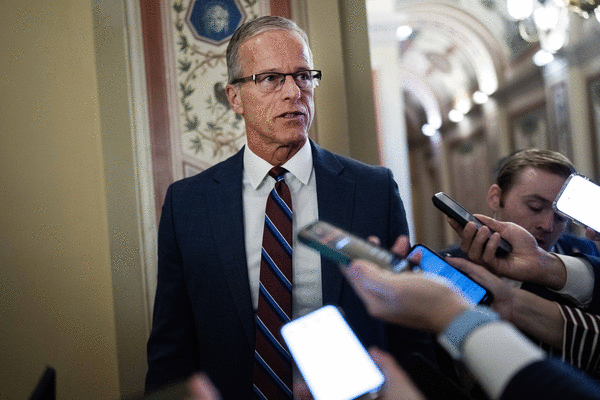
Despite the push to end the legislative filibuster, there are opportunities for bipartisanship. One of the big outstanding items is a potential deal on cryptocurrency market structure legislation, and Senate Majority Leader John Thune is also talking about wanting to move a housing package.
“There are a number of bills that I’d like the Senate to take up, including ROAD to Housing — legislation that addresses housing affordability and availability — and market structure legislation that builds on the success of the GENIUS Act and provides long-overdue clarity on digital asset regulation,” the South Dakota Republican said on the Senate floor to open 2026.
The Senate housing package was included in the chamber’s version of the National Defense Authorization Act, but it was not included in the final bill agreed upon by the House and Senate, which became law last month.
Sen. Tim Scott, the chairman of the Banking, Housing, and Urban Affairs Committee, announced last week that the panel would mark up a crypto market structure bill on Jan. 15. Advancing the measure would help ensure that 2026 is “the year of affordability,” the South Carolina Republican said.
The Senate Agriculture, Nutrition and Forestry Committee, which shares jurisdiction with the Banking panel, also plans to hold its markup on Jan. 15.
Republicans on the Banking Committee initially wanted to mark up a crypto market structure bill in September. But negotiations with Democrats on bipartisan legislation to become the foundation for a markup continued through the fall and into December.
Health care priorities
Another looming issue is how or whether to extend expired Affordable Health Care Act health insurance subsidies, and for how long to do so. The House on Thursday passed a Democrat-led bill to extend lapsed tax credits for three years. Seventeen Republicans backed the measure. The Senate tried but fell short of mustering the 60 votes necessary to advance similar legislation last month.
Meanwhile, a bipartisan group of lawmakers from both chambers hopes to reach a deal next week to extend the subsidies for a more modest two years. The enhanced credits expired Dec. 31, meaning roughly one-third of individuals who get coverage through the ACA marketplace face significantly higher costs for 2026. Open enrollment for these plans closes Jan. 15.
Democrats have signaled that the fight over the health care subsides, as with the affordability issue, will factor heavily in their midterm messaging as Republicans defend their razor-thin House majority.
A week ago, House GOP lawmakers huddled for their policy retreat at Washington’s Kennedy Center, whose building now also bears Trump’s name. They heard from the president, who discussed the 2026 agenda ahead of the November elections. Trump cited immigration, health care and paring down energy prices among his priorities, but paramount was maintaining GOP control of the House.
“You got to win the midterms, because if we don’t win the midterms,” he said, “they’ll find a reason to impeach me.”
But the House vote-counting became more difficult for Republicans last week with the resignation of Georgia’s Marjorie Taylor Greene becoming official just before the passing of California Republican Doug LaMalfa.
Other matters
There’s plenty of other work to look ahead to in 2026 — including some recurring classics.
For instance, lawmakers are expected to grapple again this year over the reauthorization of a powerful but contentious surveillance authority, an issue that bitterly divided privacy hawks and intelligence-focused members last Congress.
Section 702 of the Foreign Intelligence Surveillance Act, which allows the U.S. government to collect digital communications of foreigners located outside the country, is set to expire in April. This time, that will likely not align with a funding deadline.
One debate that will line up with a big funding deadline? The highway bill. The 2021 surface transportation law expires on Sept. 30, giving lawmakers until the end of fiscal 2026 to pass a new reauthorization or extend the current one.
House Transportation and Infrastructure Chairman Sam Graves plans to introduce a surface transportation reauthorization bill in the first few months of 2026, the Missouri Republican said in a December interview.
Graves and Senate Environment and Public Works Chair Shelley Moore Capito, R-W.Va., have both indicated a willingness to move some discretionary funds in the 2021 law to formula grants for states. And it’s not clear whether they will keep the funding levels. Graves voted against the 2021 law; Capito voted for it but criticized the Biden administration’s implementation.
The expiration of farm programs will also align with the end of the fiscal year, though funding for many of the programs won’t dry up until the end of December.
_____
John T. Bennett, Olivia M. Bridges, Paul M. Krawzak, Mark Schoeff Jr,. Ryan Tarinelli and Valerie Yurk contributed to this report.
_____
©2026 CQ-Roll Call, Inc., All Rights Reserved. Visit cqrollcall.com. Distributed by Tribune Content Agency, LLC.




















































Comments