Senate advances Venezuela war powers measure
Published in Political News
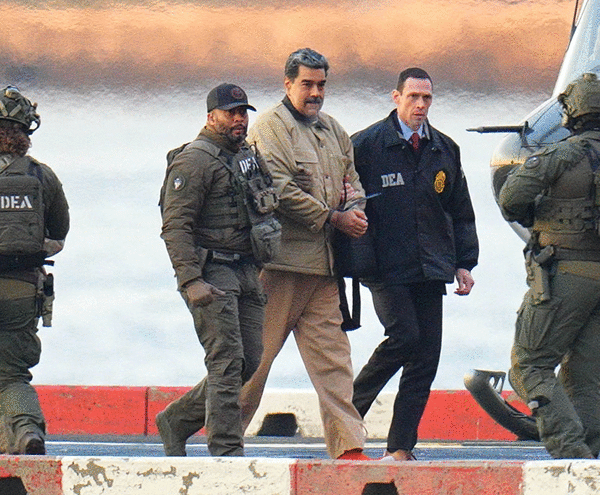
WASHINGTON — The Senate on Thursday voted to advance a resolution aimed at preventing President Donald Trump from taking more military action against Venezuela days after U.S. forces bombed Caracas and captured Venezuelan President Nicolás Maduro.
Senators voted 52-47 to discharge a war powers resolution from the Senate Foreign Relations Committee that would bar military action “within or against” Venezuela absent a specific congressional authorization. The Senate will now need to vote in the coming days on whether to pass the resolution; the initial procedural tally bodes well though final passage isn’t a lock.
The outcome represents a reversal from just a couple of months ago, when the Senate voted against advancing a nearly identical resolution.
“I believe invoking the War Powers act at this moment is necessary, given the President’s comments about the possibility of ‘boots on the ground’ and a sustained engagement ‘running’ Venezuela, with which I do not agree,” Sen. Susan Collins, R-Maine, said in a statement announcing her “yes” vote Thursday.
In addition to Collins, Sens. Todd Young, R-Ind., and Josh Hawley, R-Mo., also voted in support of the resolution Thursday after previously voting against it. GOP Sens. Rand Paul of Kentucky, who co-sponsored the resolution, and Lisa Murkowski of Alaska also voted in favor of the resolution, as they did previously.
Meanwhile, Sen. John Fetterman, D-Pa., who had suggested Wednesday he may not support the resolution despite voting for it in November, maintained his “yes” vote Thursday along with every other Democrat.
In a statement afterward, Fetterman said his vote was meant to “continue this important debate on the floor of the Senate,” leaving himself wiggle room to vote against the resolution on final passage.
The Senate’s vote came days after U.S. forces conducted an overnight raid in Caracas and captured Maduro, who has been indicted in the United States on cocaine trafficking-related charges.
Maduro and his wife, who was also apprehended in the operation, pleaded not guilty in federal court in Manhattan on Monday as Maduro told the judge he had been “kidnapped” from his home.
After the attack, Trump told reporters the United States would now “run” Venezuela, raising questions about whether he was planning a long-term military occupation in the country.
Administration officials have since sought to reassure lawmakers that Trump’s vision of running Venezuela means exerting pressure on the new interim president, Maduro’s Vice President Delcy Rodriguez, to act in U.S. interests, including allowing U.S. control of Venezuela’s oil, rather than further military action. Secretary of State Marco Rubio, Defense Secretary Pete Hegseth and other administration officials briefed lawmakers on the plans Thursday.
While those reassurances appeared to keep in line a couple Republicans who had been on the fence about the resolution, others remained concerned about the prospect of continued U.S. military intervention.
“The president and members of his team have stated that the United States now ‘runs’ Venezuela,” Young said in a statement. “It is unclear if that means that an American military presence will be required to stabilize the country. I — along with what I believe to be the vast majority of Hoosiers — am not prepared to commit American troops to that mission. Although I remain open to persuasion, any future commitment of U.S. forces in Venezuela must be subject to debate and authorization in Congress.”
White House response
After Thursday’s vote, Trump lashed out at the Republicans who supported the resolution.
“Susan Collins, Lisa Murkowski, Rand Paul, Josh Hawley, and Todd Young should never be elected to office again,” he posted on the social media site he owns, Truth Social. “This Vote greatly hampers American Self Defense and National Security, impeding the President’s Authority as Commander in Chief.”
Still, he also attempted to brush off the vote, saying that “nevertheless” a “more important” vote on the issue is still to come, presumably a reference to the vote on final passage.
Vice President JD Vance also told reporters that administration officials were in touch with defectors and that “much of their argument was based more on legal technicality than any disagreement of policy.”
“If you look at the people who actually voted, every single one of them have supported the administration’s plan,” said Vance, who also argued the 1973 War Powers Resolution (PL 93 – 184) is “fake and unconstitutional” and so the vote is “not going to change anything about how we conduct foreign policy over the next couple of weeks or the next couple of months.”
Sen. Thom Tillis, R-N.C., who was one of the Republicans who voted against the resolution after suggesting they were on the fence, told reporters a “long-term investment” is needed to revitalize Venezuela. But, he added, “if we start seeing a pattern of behavior that does involve the use of force or the threat of force, then we have to revisit the war powers resolution.”
House action
As the Senate moves forward on the resolution, the House Democrats are also preparing for a similar push.
Rep. Jim McGovern, D-Mass., is expected to introduce a Venezuela war powers resolution Thursday afternoon that mirrors the one he previously sponsored that the House rejected in December.
“We are all pleased by the results in the Senate,” McGovern said at a news conference announcing his resolution. “Maduro was a horrible tyrant and terrible human being. Nobody here disputes that. But when it comes to putting American troops in harm’s way, Congress is in charge. And that’s not me saying that, it’s the Constitution.”
Due to the unusual structure of the War Powers act and constitutional issues, however, even if there’s majority support in both chambers it’s not clear such resolutions would be binding.
McGovern’s proposal is drafted as a concurrent resolution, as that’s the only format that enjoys expedited procedures in the House under the War Powers act. A joint resolution like Kaine’s measure only has such protections in the Senate — not the House, according to a June 2025 report from the Congressional Research Service.
However, concurrent resolutions are not subject to presidential signatures and do not have the force of law, based on most legal analysts’ view of a 1983 Supreme Court ruling in INS v. Chadha. The high court in that case determined that a “legislative veto,” where one or both chambers adopts a resolution but it is not presented to the president, is unconstitutional and therefore nonbinding on the executive branch.
Later that year, Congress enacted a separate statute creating expedited procedures for the withdrawal of troops using a bill or joint resolution, which does have the force of law. But while that law limited debate in the Senate, House consideration was left up to that chamber’s leadership.
So House GOP leaders could ignore the Kaine resolution if it passes the Senate, unless backers found some other way like via discharge petition, which would require 218 signatures.
Then of course there’s the issue of a presidential veto, which seems very unlikely given the two-thirds bar in both chambers.
Still, there’s a legal school of thought that says even a concurrent resolution, typically nonbinding after the Chadha decision, in this case is different. “Some legal analysts contend, nevertheless, that the War Powers Resolution is in a unique category which differs from statutes containing a legislative veto over delegated authorities,” the CRS wrote.
_____
Savannah Behrmann, Mark Satter, Hunter Savery and Daniel Hillburn contributed to this report.
_____
©2026 CQ-Roll Call, Inc. Visit at rollcall.com. Distributed by Tribune Content Agency, LLC.




















































Comments