December brings reelection reflection -- and safety fears
Published in Political News
As members of Congress get ready to spend more time with their families over the winter holidays, they often have big decisions about reelection or retirement on the brain.
This year, it’s becoming harder to separate those from another concern: fear for their personal safety.
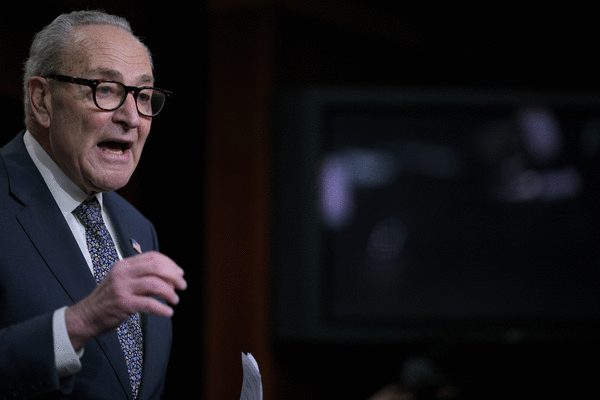
A drumbeat of recent threats has kept member security top of mind, with Senate Minority Leader Charles E. Schumer announcing this week that some of his New York offices received bomb threat emails with the subject line “MAGA.”
It caps off a year that also included the murders of Minnesota House Democratic leader Melissa Hortman and conservative political activist Charlie Kirk. And December can be a particularly tense month for threats aimed at lawmakers’ homes, with multiple swatting attempts reported on Christmas Day in 2023.
“It’s not just a fear, it’s a reality,” said Rep. Hillary Scholten, D-Mich. “I think you’re seeing a lot of members who are realizing that the stakes of doing this job — and this is on both sides of the aisle — are not just necessarily worth it. And that’s a shame.”
When Rep. Jared Golden, D-Maine, explained why he wouldn’t seek reelection next year, he cited “incivility and plain nastiness,” along with arson at the Pennsylvania governor’s residence over Passover and last year’s assassination attempts against Donald Trump.
“These have made me reconsider the experiences of my own family, including all of us sitting in a hotel room on Thanksgiving last year after yet another threat against our home,” Golden said in an op-ed in the Bangor Daily News last month.
Rep. Marjorie Taylor Greene, R-Ga., pointed to “nonstop never ending personal attacks, death threats, lawfare, ridiculous slander and lies about me” as she declared her intention to resign come January.
Greene has spoken more openly than some about facing threats. “I was just swatted. This is like the 8th time. On Christmas with my family here,” she posted on X during the 2023 wave of hoax calls.
But whether they talk about it publicly or not, personal safety is now a major topic behind the scenes as members of Congress weigh the upsides of holding office against the downsides of fearing for their lives. Those calculations are increasingly part of the job, several said. And while some see reason for hope, thanks to the $203.5 million meant to shore up member security included in last month’s spending law, they also point to problems that money can’t solve.
New programs
Starting this week, the House sergeant-at-arms launched a mobile duress system and allotted members up to $20,000 a month to pay for personal security, building on an earlier pilot. This funding can be used to hire security personnel or companies for their protection while they’re away from the Hill.
While the Capitol features metal detectors and a heavy police presence, among other fortifications, members may have fewer protections while traveling in their home districts — a sore spot for many.
“I applaud House Admin for getting increased security for members. I still don’t think it’s enough,” Scholten said. “As a mom of two young kids, it’s something that is top of mind for me every single day.”
House Administration ranking member Joseph D. Morelle, D-N.Y., has said the work isn’t yet done and floated the idea of allowing members to directly employ armed staff members. A Republican staffer familiar with the new security programs, however, said the focus now is on educating members about the resources available to them.
On the Senate side, as of this fall, senators can now use their office funds to pay for personal security measures. The goal is flexibility, said Sen. Markwayne Mullin, R-Okla., who chairs the Legislative Branch Appropriations Subcommittee.
“People need to be aware of it themselves, so that’s why we work with Capitol Police and work with the member themselves to find the best program that works for them,” he said.
Others said there’s only so much congressional leaders can do as threats become an occupational hazard.
“We need more increased security and monitoring, but there’s going to be threats,” said Rep. Lauren Boebert, R-Colo.
Rep. Jared Moskowitz, D-Fla., said there’s “no doubt” that discussions about member safety are factoring into people’s plans about whether to run, retire or resign. He has faced a high-profile incident himself; in November 2024, a man was arrested near his Florida home over what Moskowitz described as a “potential plot” on his life.
“It’s probably the most bipartisan thing that’s going on in the chamber,” he said of security fears. “It’s unfortunate that we’re collectively unwilling to take the temperature down.”
Also no stranger to threats is Rep. Sarah McBride, D-Del., in part because she’s the first openly transgender member of Congress. For her and others, the concern is pervasive.
“I don’t know if going back for the holidays is going to have people more alarmed than usual. I think there’s a pretty significant base level of concern about the political climate,” she said.
‘Good people are not running’
It’s hard to quantify whether safety fears are driving members away from Congress, or even how many threats they receive.
Capitol Police saw an increase in threat assessment cases for the second year in a row in 2024, according to the department’s public data, reporting 9,474 cases last year, compared with 8,008 in 2023 and 7,501 in 2022. But those figures include a broad range of cases, ranging from concerning statements to direct threats against members of Congress, their families and staff. And Capitol Police don’t disclose the names of threatened members or their party affiliations.
“I generally am not so much worried about the threats,” said Sen. Mark Kelly, D-Ariz., whose wife, former Rep. Gabby Giffords, was severely injured in an assassination attempt near Tucson in 2011.
Kelly himself is now in the middle of a political firestorm, earning the ire of Trump and Defense Secretary Pete Hegseth over a video with other Democratic lawmakers urging American troops to defy illegal orders. But there’s a difference between words and actions, he said.
“I think the threats are indicative of the threat environment. But people who do things like execute on political violence, like go and try to shoot somebody — like the guy who shot my wife in the head, he never threatened her. The guy that took a shot at Donald Trump never threatened him,” he said.
Still, others point to an overwhelming sense that things have changed in recent years, with Congress becoming a riskier option for people interested in public service.
“Since Jan. 6, this security situation has been very tough on people and their families,” said Rep. Jamie Raskin, D-Md., citing the mob attack on the Capitol in 2021.
Rep. Melanie Stansbury, D-N.M., said it “feels not only dangerous but difficult to get things done.”
“I think that the toxic and violent political rhetoric that is dominating the political sphere right now is making a lot of members on both sides of the aisle reconsider their long-term goals around serving in public office,” she said.
For members with young children, it hits particularly close to home, especially as they return to Washington from the Thanksgiving holiday after some potentially tough conversations.
“Members are getting that from their spouses, and if the kids are old enough, from their kids,” Moskowitz said.
As filing deadlines for the 2026 elections approach in more and more states, it’s not just current members who could be deterred but would-be candidates eyeing their first bids for office as well.
“Good people are not running and will not run because of the risk to safety in these positions, and it’s only getting worse,” said McBride.
©2025 CQ-Roll Call, Inc., All Rights Reserved. Visit cqrollcall.com. Distributed by Tribune Content Agency, LLC.




















































Comments