US House demands records from environmental groups that opposed Twin Metals mine in Minnesota
Published in Political News
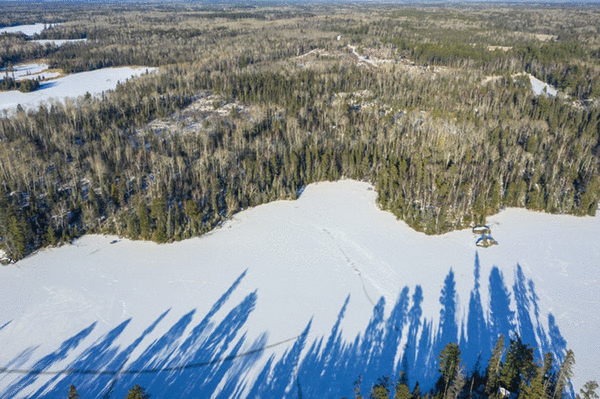
The U.S. House Natural Resources Committee sent broad requests for information to three environmental groups this week, looking for evidence that they “colluded” with Biden administration officials to stop mining in Superior National Forest.
The requests, signed by Rep. Pete Stauber, R-Minn., Rep. Bruce Westerman, R-Ark., and Rep. Paul Gosar, R-Ariz, were sent on Monday. A news release from the committee said it was “keen to discover the details of (environmental groups’) backroom roles” in the cancellation of the leases for the Twin Metals copper-nickel mine and the withdrawal of national forest land from mining.
The offices of all three congressmen did not respond to messages seeking comment.
The three groups that have been targeted all have a national profile: Earthjustice, an environmental law firm, The Center for Biological Diversity, a frequent plaintiff in lawsuits against the federal government, and The Wilderness Society, which advocates to protect public lands.
Stauber, Gosar and Westerman are alleging the three environmental groups improperly met with Biden officials in the Department of Interior in 2021, at the same time they were suing the administration over Twin Metals’ then-active mineral leases.
“At the very least, these meetings created a serious appearance of impropriety; more likely, these meetings violated ethical standards and evidence potentially improper relationships between CBD — and other similarly radical groups — and the Biden administration," read a letter sent by the committee to the Center for Biological Diversity on Monday.
Kieran Suckling, the executive director of the Center for Biological Diversity, said on Wednesday that “Stauber and Gosar are mimicking Trump, and using governmental power to persecute their opponents. That’s all this is.” He said the groups had done nothing unusual or illegal, and that discussions with the Biden administration were a normal part of their advocacy.
The other two groups did not respond to a request for comment.
The congressional request does not carry the legal power of a subpoena. It was launched amid a flurry of federal actions targeting Minnesota this week. President Donald Trump has pledged an immigration enforcement crackdown on the state’s Somali community. Treasury Secretary Scott Bessent said the administration would investigate whether money from state social programs had been funneled to terrorist groups.
The direct probe of environmental groups is an escalation in the long-running fight over Twin Metals, the most controversial mine proposal in Minnesota.
The underground mine would be in the watershed of the Boundary Waters Canoe Area Wilderness, and environmental advocates argue that toxic runoff from a mine could damage it. That argument persuaded the Biden Administration in 2023 to bar any mining across 225,000 acres in the Boundary Waters watershed. Biden had already canceled the mineral leases for the Twin Metals mine the year before.
Conversely, pro-mining interests say a new domestic supply of copper, nickel, cobalt and platinum-group metals is sorely needed, and that new jobs would help northeastern Minnesota, where the taconite mining industry has faced significant economic challenges.
Stauber has singled out environmental groups as the obstacle to the economy and way of life in his northeast Minnesota district. In a 2022 letter commenting on the proposal to bar mining in Superior, he accused the Biden administration of “appeasing radical activists who prefer Not-In-My-Backyard policies.”
The first year of Trump’s second term has proven tense for environmental nonprofit groups around the country, which in the spring were bracing for the possibility that the Trump administration could try to revoke their tax-exempt status, according to Inside Climate News. That hasn’t come to pass.
Suckling said that it’s normal for advocacy groups to talk to the government, even during a lawsuit. The House request is “fundamentally an attempt to intimidate” that will not succeed, he said.
“They don’t name a single crime to investigate, (because) there’s nothing to investigate,” he said.
_____
©2025 The Minnesota Star Tribune. Visit startribune.com. Distributed by Tribune Content Agency, LLC




















































Comments