New Trump policy puts immigration 'on hold' for Cuba, Haiti, Venezuela and others
Published in Political News
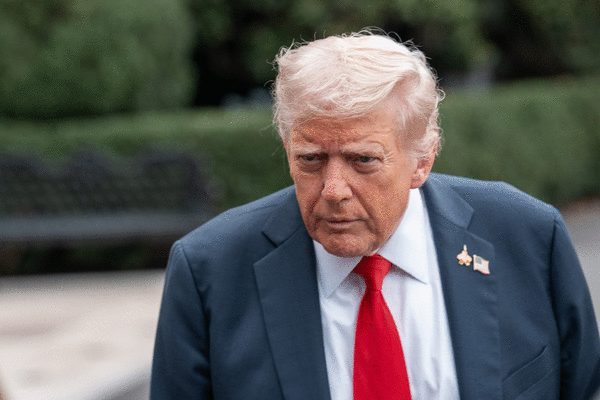
The Trump administration on Tuesday issued one of its most sweeping immigration crackdowns to date, ordering a pause of all immigration applications, including pending asylum claims, from nationals of Cuba, Haiti, Venezuela and 16 other so-called “high risk” countries.
The Department of Homeland Security directive affects everything from green card applications to work permits for individuals with pending asylum applications. In South Florida, where there are millions of immigrants from Latin America and the Caribbean, the decision carries sweeping implications.
Late Tuesday, immigration attorneys were still trying to make sense of the memo.
“What this means for our South Florida community, given who we are as a community, is this effectively stops legal migration,” said Randolph McGrorty, executive director of Catholic Legal Services.
“For our South Florida community, lawful immigration is now on hold because of the countries listed,” he said. “Everyone wants security, I am just not sure that this is providing the security we need.”
McGrorty notes that three of the 19 countries represent some of the biggest immigrant communities in South Florida.
“If you are an asylum applicant, and it’s already filed, but you’re seeking work, that work permit is going to be paused. So that’s going to impact a lawful worker who is going to have to wait for their work permit,” he said.
The new policy extends on a series of changes the administration announced last week after an Afghan national was accused of shooting two National Guard members, one of whom died.
Trump had already announced a review of green cards of individuals from the 19 countries and a pause in all asylum decisions for migrants in the U.S. In addition, he said all asylum decisions taken by the Biden administration would be reviewed, while all immigration applications filed by Afghan nationals would be indefinitely put on hold. The U.S. would also bar Afghans from entering, he announced, as he also hinted of further action.
Tuesday’s directive reaches even further into the immigration population, particularly Hispanic and Haitian communities. They were already facing deportation with the end of temporary legal protections, and are now facing immigration limbo.
In its memo, DHS said the sweeping review is necessary to ensure that individuals from high-risk countries “do not intend to harm Americans or compromise U.S. national interests.”
The 19 countries already faced varying levels of restrictions. Burundi, Cuba, Laos, Sierra Leone, Togo, Turkmenistan, and Venezuela were subject to partial bans affecting tourist, business, and student visas in June. Nationals from Afghanistan, Burma, Chad, the Republic of the Congo, Equatorial Guinea, Eritrea, Haiti, Iran, Libya, Somalia, Sudan, and Yemen faced full visa suspensions for both immigrant and non-immigrant categories.
The administration has raised the possibility that immigrants who have lived in the U.S. for decades and hold permanent residency status, known as green cards, could potentially be kicked out of the country.
The memorandum appears to mandate that all immigrants from the targeted countries would “undergo a thorough re-review process, including a potential interview and, if necessary, a re-interview, to fully assess all national security and public safety threats along with any other related grounds of inadmissibility or ineligibility.”
After reading the memo, Maureen Porras, an immigration attorney and Doral councilwoman, said her first thoughts are that it will add more burden and delay to an already flawed, backlogged system. There are currently about 1.5 million asylum applications awaiting decisions.
“If the goal is to strengthen the security of the U.S. we should be applying a more expedited review of all asylum claims and streamlining the process,” Porras said.
She also said that she thinks it’s going to be hard to challenge Trump’s decision in the courts, especially since the administration cited a national security basis.
Fear in South Florida
Tuesday’s memorandum cites two recent terrorism cases involving Afghan nationals—including a foiled Election Day 2024 attack and the deadly shooting of the two National Guard members— as evidence of gaps in prior screening and the need for heightened scrutiny.
Miami attorney Ira Kurzban, who is among a cadre of lawyers challenging the DHS decision to end Temporary Protected Status for Haitians as of Feb. 3, 2026, said the new policy was guided by the administration’s racial animus. On Tuesday, Trump referred to Somali immigrants as “garbage” during a televised cabinet meeting.
“It was the Trump administration that granted asylum to the shooter of the National Guardsman in Washington DC, so it is now using a false narrative about prior administrations to do what [Deputy White House Chief of Staff Stephen] Miller, Trump and the white supremacists have wanted to do from day one—shut down asylum in the United States,” he said. “This is just another step in their efforts to attempt to ‘cleanse’ the country of Black and brown refugees who are desperately seeking freedom from brutality, autocracy and dictatorship.”
Kurzban was far from the only critic concerned by the new policy.
Adelys Ferro, executive director of the Venezuelan American Caucus, a nonprofit organization advocating for the Venezuelan community, called the directive “a cruel and dangerous measure.”
“For Venezuelans, it entails a real risk of being returned to a regime that persecutes and tortures, amid ongoing military tensions and instability in Venezuela.”
DHS said a list of people subject to review will be “prioritized” within 90 days.
Already, immigrants from the affected countries are worrying about what this means for themselves, their families and friends.
Alberto Argüelles, who left Maracaibo, Venezuela 11 years ago, said he never imagined he would once again face the same suffocating uncertainty that he had fled.
Back home, every day carried the threat of the unknown—whether the government would imprison him, persecute him, or force him to escape overnight. In the end, he made the painful choice to leave everything behind and start over in the U.S. Today, he lives in Doral, the city with the largest Venezuelan population in the United States.
But now, the terror has returned, said Argüelles, a one-time asylum applicant who received his 10-year green card in July after his daughter sponsored him. Many of his family members, he said, remain asylum applicants after also fleeing the political persecution that continues to consume Venezuela — which Trump has threatened to target with military land strikes.
“Do people with pending asylum have to leave? Would they be considered illegal?” he asked. “I don’t feel safe in the U.S. These decisions are filled with hate against Hispanic migrants.”
The halt of asylum among other immigration process affects some of the most vulnerable people seeking protection in the U.S., including children, single mothers, survivors of domestic violence or torture, and others fleeing persecution or extreme trauma.
Paul Namphy, a Haitian community advocate who earlier Tuesday decried the decision to end TPS for Haitians, said “we are deeply concerned about efforts to roll back immigration benefits allocated to our community members over the past years and decades, which form an integral part of the immigration ladder and which have characterized the history of this country.”
Immigration, he said, “is one of the pillars of why this country has been sought out by people throughout the world as a venue of refuge and a venue to build dreams on.”
©2025 Miami Herald. Visit at miamiherald.com. Distributed by Tribune Content Agency, LLC.






























Comments