Commentary: From sandwich shops to Silicon Valley, noncompetes are holding back US workers
Published in Op Eds
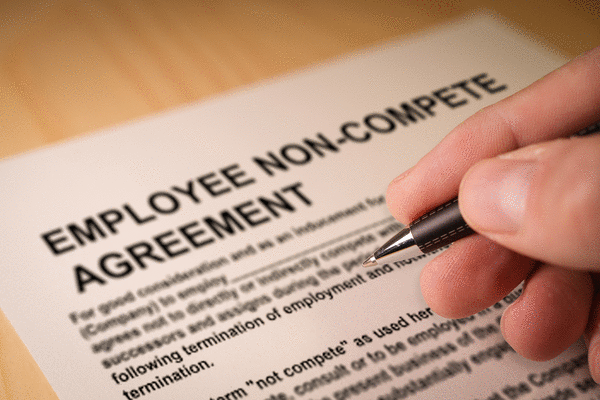
Noncompete agreements, once reserved for executives with unique access to trade secrets, have gone mainstream in America. According to the Government Accountability Office, between 18% and 20% of U.S. workers are covered by one. From artificial intelligence organizations to sandwich shops, employees have been left unable to leave for competing businesses or start one of their own for defined periods of time.
These agreements have quietly become one of the most consequential and least examined restraints on the dynamism of the American labor market, but that’s beginning to change. The Federal Trade Commission (FTC) has come to oppose many noncompetes, especially in health care. A handful of states have taken action, such as Minnesota, which in 2023 passed laws making the agreements unenforceable. My new research shows encouraging early results.
Supporters call noncompetes a natural extension of freedom of contract. If an employer and employee voluntarily agree to terms, why not expect enforcement from courts? In theory, it sounds reasonable. In practice, it’s open to question.
Workers generally do not negotiate their noncompete clauses; they are handed a stack of onboarding papers and told to sign. Only savvy workers with leverage and other options take advantage of this freedom of contract as a practical outcome.
The deeper question is whether noncompetes serve the public interest, and the evidence increasingly suggests they do not. They may even shape the economic fates of entire regions.
Consider Silicon Valley vs. Boston’s Route 128 corridor. In the 1970s, Boston had every advantage: the nation’s oldest and most elite universities, defense contractors and a dense cluster of engineering talent. Yet by the 1990s, it was Silicon Valley, the scrappy upstart, that became the global center of technology.
Why? One reason is that while both states had some rigorous regulations on wages and employment, California does not enforce noncompete agreements. This contributed to Silicon Valley’s culture of rapid job‑hopping, knowledge spillovers, and cross‑firm collaboration. Engineers could leave one company on Friday and join a competitor on Monday. Ideas moved with them, sometimes finding more traction in different environments. Startups formed faster. Innovation accelerated.
Boston, by contrast, locked down its talent. Workers stayed put not because they wanted to, but under threat of lawsuits. The result was a more hierarchical, siloed system — one that didn’t keep pace with the Valley’s dynamism.
This pattern repeats across the country, and not just in high-level tech environments. Beyond limiting mobility, noncompetes suppress workers’ bargaining power and wage growth. Studies show that when employees cannot credibly threaten to leave, employers have little incentive to raise pay or improve conditions. Someone bound by a noncompete may have to uproot their family or leave their industry entirely just to make a change.
Worse, the costs sometimes fall hardest on workers who pose no plausible threat to trade secrets. Certain hair stylists, warehouse employees, security guards and fast‑food workers have been bound by noncompetes. Jimmy John’s was once reprimanded for making sandwich makers sign them. The idea that a low-wage worker can jeopardize proprietary information by taking a better job at the deli down the block would be laughable if the consequences were not so serious.
The good news is that states are beginning to rethink these restrictions. California, Oklahoma, North Dakota and now Minnesota have already limited enforcement of noncompetes outright. The early results from Minnesota’s sweeping reform are interesting and informative.
With workers choosing to switch jobs at higher rates, many are also working more hours. My recent research with Yun taek Oh shows that Minnesota physicians are now accepting more patients relative to neighboring Wisconsin, which continues to allow noncompete agreements for doctors. Overall, the number of health care services provided increased by 6.3%.
In other words, when people are free to move, they do — and the labor market becomes healthier and more dynamic. In Minnesota’s case, patients gain more abundant access to medical care.
Noncompetes don’t create stability; they create stagnation. They don’t protect innovation; they suppress it. They undermine the very American idea that talent should rise, ideas should spread and workers should pursue opportunity wherever it leads. The question is whether more policymakers in other states will act, or if the FTC will pursue charges under its mandate.
A freer labor market works better. It helped build Silicon Valley. It’s now helping Minnesota patients. And it is essential to the country’s continued economic vitality. Surely, we can protect legitimate trade secrets without putting the burden on mid-level tech workers, sandwich makers, and ultimately, American consumers.
_____
Morris M. Kleiner is a visiting fellow at the Hoover Institution, fellow at the Archbridge Institute, professor at the Humphrey School at the University of Minnesota, and research associate at the National Bureau of Economic Research.
_____
©2026 Tribune Content Agency, LLC.


















































Comments