Juan Pablo Spinetto: Look to Latin America's oil boom for energy security
Published in Op Eds
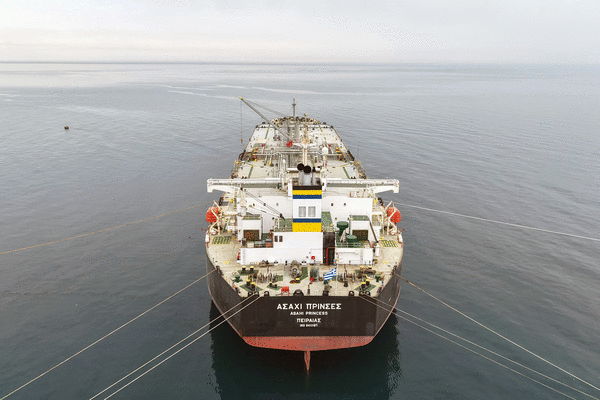
From the ultra-deep waters of Brazil’s Santos Basin to the arid shale fields of Argentina’s Patagonia, a new hydrocarbon boom is welling up across Latin America.
About 44% of global crude supply growth between 2025 and 2030 is expected to come from Brazil, Guyana, Argentina and Venezuela, according to consultancy Rystad Energy. Together, these four producers are set to add nearly 2.5 million barrels per day by the end of the decade, out of a projected global increase of 5.6 million.
This expansion could hardly come at a more sensitive moment for the oil market. Conflict in the Middle East, which has disrupted flows through the Strait of Hormuz and damaged natural gas infrastructure, is forcing the industry to rethink risk, reliability and diversification. For Latin America, that shift creates a clear opening: to position itself as a steady, resource-rich supplier in a region largely free of major interstate conflict and increasingly shaped by more pragmatic, pro-business policy trends. If the region emerges as a winner from today’s geopolitical realignment, much of that newfound weight will rest on its growing energy clout.
“Latin America does not replace the Middle East, but it meaningfully mitigates concentration risk by combining stable investment environments, visible project pipelines and scalable resource potential,” Rystad Energy analyst Radhika Bansal told me. That, she added, positions the region as “one of the most important contributors to global oil supply growth over the coming decade.”
The region should also seize this moment to push forward on energy integration, a key step to boost intra-regional trade, support the relocation of supply chains and strengthen political and economic stability. Projects such as an emerging natural gas corridor linking Argentina, Brazil and Chile, the rise of Mexico as a re-export hub for US gas to global markets and the long-discussed interconnection between Colombia, Central America and the Caribbean could lift consumption, underpin manufacturing growth and expand exports — all potential game changers.
The industry has already reached some impressive milestones. Brazil, the region’s largest oil and gas producer, is now a global leader in deepwater and ultra-deepwater production and aims to rank among the world’s top five crude producers by 2030, driven by prolific fields such as Búzios. Together with Guyana, it dominates the market for floating production, storage and offloading vessels, both in terms of active platforms and projects under development. Argentina, meanwhile, is already a leading shale oil producer and has ambitious plans to become a major supplier of liquefied natural gas. By some estimates, Latin America has recently been among the largest sources of incremental upstream capital expenditure growth.
“This is a turning point for the region from a growth, technological and resource-extraction perspective,” says Iván Sandrea, a Venezuelan geologist and chief executive of Alize Energy, an investment venture focused on opportunities in the region. “Latin America is targeting everything: oil, gas, LNG, shale, deep water, heavy oil, offshore gas. I feel extremely positive.”
As part of his portfolio, Sandrea leads the oil startup CaribX with a prospective offshore license in Honduras, where no relevant exploration has taken place since the 1970s. The company plans to begin seismic work this year. “Things are happening,” he told me.
Across the region, other interesting prospects are also emerging, from an upcoming licensing round in the Dominican Republic to offshore activity in Peru and Uruguay, alongside other frontier opportunities.
For all the momentum, the region’s realities remain uneven and vulnerable to politics. Countries such as Mexico, Colombia and Ecuador are focused less on expansion than on managing the natural decline of mature fields. The elephant in the room is Venezuela, an OPEC member with the world’s largest proven oil reserves — more than 300 billion barrels — and arguably one of the countries with the most to gain from Middle East disruptions. The removal of Nicolás Maduro earlier this year and the country’s unexpected political transition, closer to a US-backed protectorate, have put it back on the radar of major international oil companies after decades of resource nationalism and institutional decay. In the near term, output could rise by 300,000 to 400,000 barrels per day.
But sustained growth will depend on political stability, a clearer legal framework, competitive fiscal terms and the return of international operators such as ConocoPhillips and Exxon Mobil Corp. after the settlement of arbitration claims. The resources are there; whether they translate into durable production gains remains an open question.
At the other end sits Mexico. For decades Latin America’s largest producer, it has shifted from the investor-friendly reforms of a decade ago toward a more nationalist approach under the ruling Morena party. While President Claudia Sheinbaum has signaled renewed openness to private investment, including partnerships in electricity and a possible revival of fracking, her administration’s statism continues to weigh on Mexico’s appeal relative to regional peers. For private producers, other parts of the region look more compelling. Possible political swings in Colombia and Brazil’s upcoming electoral cycles could also reshape energy policy further.
In the short run the Middle East conflict has become a headache for policymakers, raising fuel and fertilizer prices and stoking inflation. Governments are responding to the external shock with subsidies and other fiscal remedies. While this may end up accelerating the long-term transition toward renewable energy in some markets, Latin America’s oil and gas expansion is gathering steam. It’s another opportunity that the region can ill afford to miss.
____
This column reflects the personal views of the author and does not necessarily reflect the opinion of the editorial board or Bloomberg LP and its owners.
JP Spinetto is a Bloomberg Opinion columnist covering Latin American business, economic affairs and politics. He was previously Bloomberg News’ managing editor for economics and government in the region.
©2026 Bloomberg L.P. Visit bloomberg.com/opinion. Distributed by Tribune Content Agency, LLC.





















































Comments