Commentary: Hungary's lessons for democracy under fire
Published in Op Eds
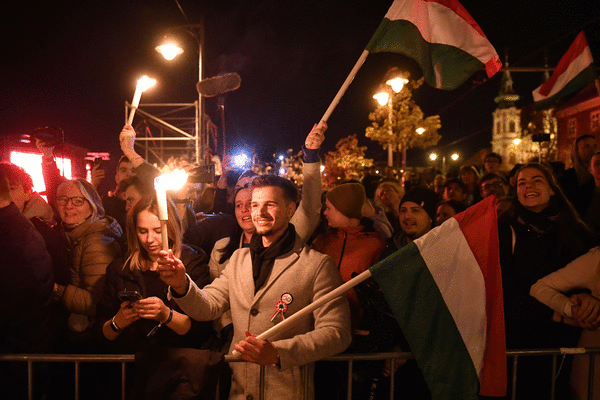
News cycles this year have been a relentless parade of hard knocks, and April has been no exception. But last weekend, the people of Hungary delivered good news. They came out in record numbers, with nearly 80% participation, to decisively vote out Viktor Orbán, the country’s long-standing illiberal prime minister. The opposition Tisza party secured more than two-thirds of the parliamentary seats, winning a powerful supermajority.
This would be a remarkable feat in any election, but in Orbán’s Hungary, it is stunning. He spent his 16 years in power painstakingly building a system of competitive authoritarianism, where the trappings of democracy — elections, opposition parties and news media — still existed, but the system was so rigged that the regime need not govern well to remain in power. Orbán’s allies in parliament redrew electoral districts and reworked election laws so strongly in his party’s favor that it secured a supermajority twice before, despite securing fewer than half the votes.
Opposition parties were locked out of television and radio coverage, prohibited from advertising on public stations and cut out by private media controlled by wealthy Orbán allies. In 2018, Orbán’s supermajority manipulated the judiciary by creating a parallel court system under the executive to rule on “public administration” cases, effectively insulating his allies from legal accountability. It’s no wonder corruption skyrocketed. That was how Orbán enriched his friends and allies, and they helped keep him in power in return.
The warped playing field meant Tisza had to win big to beat Orbán’s ruling Fidesz party at the ballot box, and that is exactly what it did. It won by such huge margins that Orbán quickly conceded rather than dispute the results with claims of fraud in an attempt to rally his supporters to “stop the steal.”
This achievement offers important lessons for those seeking to defend democracy from authoritarian creep around the world. First, in conditions short of absolute authoritarianism, as long as elections are still happening, ousting a wannabe dictator is possible. That path isn’t easy or certain, but Hungary has proved it can be done.
Second, an outcome big enough to succeed against a competitive authoritarian requires a bigger tent than just left or right. Policy disagreements alone are unlikely to mobilize enough of the population to beat such odds. Orbán’s fatal flaw was believing his system was fixed enough that it would keep him in power even as his corruption brought ruin upon his country and its people. But “It’s the economy, stupid” as an election explainer still generally reigns supreme.
Orbán’s leadership brought severe economic stagnation. Hungary has had far higher inflation than its peers and is much poorer. Unemployment is at a 10-year high.
Making matters worse, his illiberal actions so conflicted with European Union rule-of-law standards that it froze 18 billion euros in EU funding in 2022. Orbán frequently lambastes the EU, but its funding helped keep the country afloat despite his disastrous economic policies. Cutting off that financial lifeline undoubtedly played a role in revealing his leadership for what it really was. A government can only scapegoat foreigners for so long before the public realizes the ones in charge are to blame for their woes.
In stark contrast to Hungary’s economic decay, Orbán’s family and friends have become spectacularly wealthy through gifted government contracts and other grift. Many have become billionaires. For four years in a row, Transparency International has named Hungary the most corrupt state in the EU, and it shows.
Orbán wasn’t taken down by liberal democratic ideals but by his own excessive greed. He is being replaced not by the left but by an anti-corruption party on the center right. Peter Magyar, the opposition leader, originally came from Orbán’s own party and left Fidesz not for policy reasons but on account of the widespread kleptocracy. Though it is clearly pro-Europe (and anti-Vladimir Putin), Tisza will likely champion many of the same conservative policies as Fidesz, such as its harsh stance on immigration.
What it has promised, and what the people voted for, is to root out the corruption now embedded in the system. That message was well received across political divides. During the campaign, Tisza committed to amending the constitution to ensure such corruption could not continue. Magyar has called for all of Orbán’s cronies in the government to resign and has committed to holding to account those who plundered Hungary.
This will not be easy. If Magyar fails to fix the system and deliver results, a return to autocracy would be likely. This, too, is a lesson that pro-democracy movements around the world need to recognize. Magyar has declared, “Never again a country without consequences!” Let’s hope he can and does deliver.
____
Elizabeth Shackelford is a senior adviser with the Institute for Global Affairs at Eurasia Group and a foreign affairs columnist for the Chicago Tribune. She is also a lecturer with the Dickey Center at Dartmouth College. She was previously a U.S. diplomat and is the author of “The Dissent Channel: American Diplomacy in a Dishonest Age.”
___
©2026 Chicago Tribune. Visit at chicagotribune.com. Distributed by Tribune Content Agency, LLC.
















































Comments