Howard Chua-Eoan: Is the Pope American? No, he's Catholic
Published in Op Eds
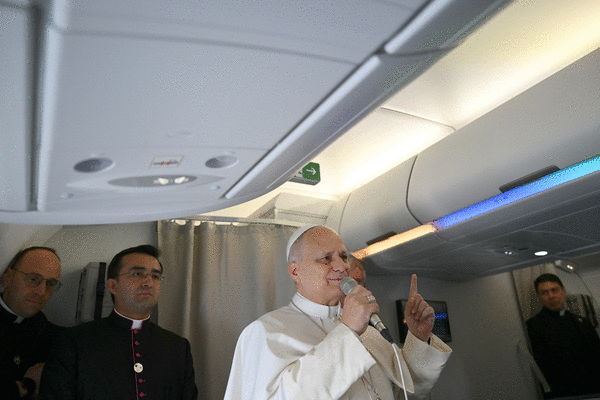
President Donald Trump has unleashed a diatribe against Pope Leo XIV on Truth Social that brings the simmering imbroglio between the two most powerful Americans in the world to a boil.
On one side, there’s the New York-born chief executive of the planet’s paramount military superpower. On the other, Chicago-born Robert Prevost, supreme pontiff of the Roman Catholic Church and chief spiritual advisor of nearly 1.4 billion believers. Their battlefield may seem global, but the ultimate goal is parochial: the hearts and minds and votes of U.S. Catholics.
Trump fired off his social media broadside in the early hours of his Monday morning. It called Leo “WEAK” on several fronts: Iran’s potential nuclear weapons, crime, immigration and politics. He said he prefers Louis Prevost, Leo’s brother, who is “all MAGA. Louis gets it, and Leo doesn’t!” He also implied that Leo owed him because he’d only been elected pope because the College of Cardinals “thought that would be the best way to deal with President Donald J. Trump. If I wasn’t in the White House, Leo wouldn’t be in the Vatican.”
That last bit of vitriol reminded me of how I got this pope wrong before his election. On May 3, 2025, just as the College of Cardinals prepared to vote, Trump and the White House circulated a portrait of the president as the new pope.
I brashly predicted that “The White House’s tasteless AI joke... may actually play into the politics of the conclave — making it harder for an actual American cardinal to ascend to the papal throne. The church still remembers the long-ago Avignon papacy as a time when the pontiffs enjoyed less power having come under the sway of French monarchs. Modern cardinals are unlikely to elect a pontiff who might be manipulated by Washington.”
Well, I proved to be no prophet, but Trump took Leo’s elevation personally. The friction between the pair proves that one question raised by that 14th-century drama remains valid: If believers had to choose, would they side with their king (or secular ruler) or their pope?
Coincidentally, the Avignon papacy was central to a Trump vs. Leo prequel that blew up on social media last week. The viral spasm — practically out of a Dan Brown novel — was inspired by a story in the Free Press, in which unnamed Vatican officials described a tense meeting between Pentagon officials and the papal nuncio — the pope’s ambassador in Washington D.C. (Both sides said the conversation had been cordial and the descriptions of it in the article were exaggerated and inaccurate.)
According to the Free Press, representatives of the Department of Defense warned the nuncio that “the United States has the military power to do whatever it wants — and that the Church had better take its side.” Amid the conversation, an unnamed Pentagon official cited the Avignon papacy, which took place 700 years ago. It would have been the kind of historic reference the 2,000-year-old institution would recognize as a threat.
This is what happened back in 1307: Philip IV, king of France, took umbrage at Pope Boniface VIII and sent his forces to abduct and depose the pontiff. The monarch then moved the papacy to Avignon in southern France where succeeding popes remained under the sway of his kingdom for more than six decades. Seven Frenchmen occupied the Throne of St. Peter, the longest stretch of non-Italian popes in history, unmatched even by Leo(1) and his three predecessors — Francis of Argentina, Benedict XVI of Germany and John Paul II of Poland.
Avignon occurred as the kingdoms of Europe began pushing back against an imperious papacy, which had been expanding in influence for about 250 years. It wasn’t a good time to be pope. In his Inferno, Dante destined Boniface VIII — who’d issued a decree declaring that the papacy was the ultimate authority in the world — to the eighth circle of hell. Look up Guelphs and Ghibellines if you want to fall into a rabbit hole.
All that would culminate in Martin Luther’s nailing of his indictment of the corruption and errors of Roman Catholicism on the doors of the Castle Church in Wittenberg, Germany, sparking the Protestant Reformation and spurring more of Western Europe to opt for their own nation-states instead of the overarching Christendom represented by the pope in Rome.
Today, the papacy is resurgent as a transnational authority that has been able to disrupt empires (John Paul II and the Soviet Union) as well as stir consciences. It is intriguing that the supposedly contentious meeting described in the Free Press involved the Department of Defense and the papal nuncio. The pope’s ambassador is more than a diplomat; he oversees the selection of new bishops and officials in the U.S. hierarchy — who, in their turn, help guide the American laity. Back in 2016, the Catholic hierarchy in the U.S. trended conservative: happy with the doctrinaire Benedict and cool to the relatively woke Francis. Their social and political opinions echoed among much of their congregations, which skewed Republican. Indeed, 56% of American Catholic voters cast their ballots for Trump in 2024.
The lineup of bishops has reached a different balance now because of Cardinal Christophe Pierre, the nuncio who met with the Pentagon officials. That’s probably what alarms Trump: A recent poll indicates that his Catholic support has now fallen below 50%, with 40% strongly disapproving of the president’s job performance.
Pierre retired last month after a decade in the Vatican’s Washington office. His successor Archbishop Gabriele Giordano Caccia, who’s been the Holy See’s permanent observer to the United Nations since 2019, will manage the choice of successors to a dozen U.S. bishops — and their stances on doctrine and how to propagate those teachings could well determine whether U.S.-Vatican relations are accommodating or confrontational.
The pope had been discreet about not citing Trump by name. But there was little doubt of his target given the timing of some of his public statements. In his Palm Sunday homily, delivered as U.S. attacks against Iran grew, Leo quoted the prophet Isaiah, “Even though you make many prayers, I will not listen: your hands are full of blood.” And Leo did not have to name the American president when he said, “There has also been this threat against the entire people of Iran. And this is truly unacceptable.”
We may yet see AI animation of U.S. Special Forces rappelling down St. Peter’s dome to bring regime change to the Holy See. The Trump administration and the MAGA movement have a fair share of Catholic representation, from First Lady Melania Trump to Vice President JD Vance to the controversial commentator Candace Owens. The rollout of the pontiff’s new battalion of bishops will force them to make difficult choices. If any MAGA believer has qualms, the White House posted an AI-generated image to steel their faith: Trump as a Jesus-figure healing the sick. (Update: The White House has apparently removed the image from its Truth Social account.)
So, nation or God? Leo made his preference clear early on, indeed soon after his election. In May 2025, Vance invited him to this year’s celebration of the 250th anniversary of U.S. independence. The first pope from the U.S. declined, choosing instead to spend that day on the Italian island of Lampedusa with refugees and migrants.
For now, Leo is off to visit several African nations. When asked by Italian journalists on his plane about Trump’s post, the pontiff reportedly said, “I’m not afraid of the Trump administration… and I will continue speaking with a loud voice against war.”
_____
(1) The pope also holds Peruvian citizenship, the result of his years as a missionary in the South American country. It is also a requirement that all ranking Catholic bishops in Peru be citizens, which Prevost became upon being elevated to Bishop of Chiclayo.
____
This column reflects the personal views of the author and does not necessarily reflect the opinion of the editorial board or Bloomberg LP and its owners.
Howard Chua-Eoan is a columnist for Bloomberg Opinion covering culture and business. He previously served as Bloomberg Opinion's international editor and is a former news director at Time magazine.
_____
©2026 Bloomberg L.P. Visit bloomberg.com/opinion. Distributed by Tribune Content Agency, LLC.


Comments