Mark Gongloff: Your expensive cheeseburger is a taste of what's to come
Published in Op Eds
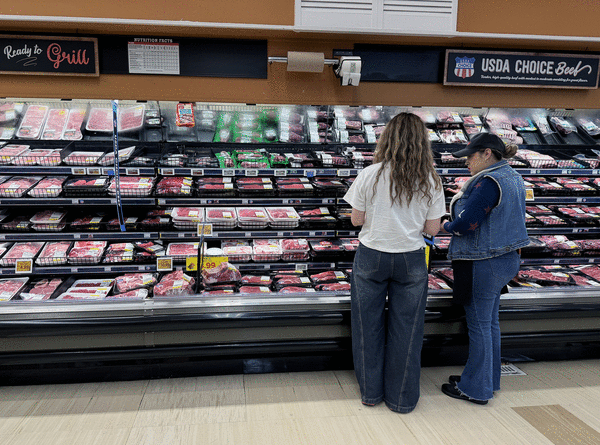
When I was in grade school back in the 1800s, they fed us cheeseburgers extended to the frontiers of human palatability by hefty amounts of what some call “textured vegetable protein” but all the kids knew was soy. Nobody liked them. But Americans might start considering soy burgers this summer when they see what happens to the price of beef.
President Donald Trump’s war and tariffs are playing a huge role in pushing ordinary ground chuck prices to Wagyu-like levels. But beneath those relatively short-term shocks are the long-term effects of a heating planet. Every trip we take to the grocery store offers a lesson about how climate extremes on the other side of the continent or planet can hit our wallets. And beef is only the start.
It’s also one of the most obvious pain points now. A pound of lean ground beef cost $8.20, on average, in the U.S. in March, according to the Bureau of Labor Statistics, up from $7.48 a year earlier and $5.68 in 2016. March’s consumer price index for beef was up 11% from a year earlier after recently threatening highs not seen since the pandemic and the post-pandemic inflation increase.
And the latest numbers have only just begun to price in the effects of the Iran war’s associated energy shock, which has sent gasoline and fertilizer prices soaring, hurting farmers across the country, cattle ranchers and soybean farmers included.
Before the war, Trump’s tariffs had already played a big role in raising food prices. But climate’s effects predate both the trade war and the war war. By sucking water from the land, higher temperatures make droughts more severe, widespread and longer lasting. Years of deep drought in cattle-rich states have reduced the amount of available forage, forcing U.S. herd sizes to shrink to their lowest levels since 1951. Kansas, Oklahoma and Texas alone lost nearly $24 billion in ruined crops, smaller herds and higher feed costs caused by drought between 2020 and 2024, according to a recent National Oceanic and Atmospheric Administration study.
This summer probably won’t bring relief. It was the warmest winter on record for much of the West, leaving mountain snowpack at historically low levels. That means there will be even less water this summer than usual for cows and crops, including the hays that cows eat. Drought was affecting 63% of the nation’s cattle-growing land as of this writing, according to the Department of Agriculture, along with 56% of hay acreage. Herds will likely grow even smaller and beef prices will rise even higher. It’s what some call “heatflation.”
This is probably going to make many of you very angry, but as a climate person, I’m glad to see beef prices rise. No other meat — no other food — has as much environmental impact. Ruminant meat, which is mostly cows, contributes a third of all the greenhouse-gas emissions generated by global food production, according to a 2023 study by researchers from the Environmental Defense Fund, a nonprofit research group. We should price things to reflect their costs to society, and beef’s externalities are dangerously high.
And Americans could really stand to eat much less red meat. Each American consumes, on average, nearly 82 pounds of beef every year, third in the world after Argentina and Brazil. By simply cutting back to, say, the 49 pounds the French eat annually, Americans could reduce their risk of heart disease, cancer and other illnesses, cut their food-related carbon emissions by 40% and still eat pretty well. The French are kind of famous for that. Chickens, meanwhile, exist, are far less harmful to the environment and are delicious.
All of this is just prologue to the far more dire food-supply disruptions that await if we let the planet get too much hotter. Even if we hold warming to just 2 degrees Celsius above preindustrial averages by 2050, global production of staples such as wheat, corn and those darn soybeans will still fall by 8%, according to a study in Nature last year. North American food production will be hit especially hard, falling nearly 17%. That will require importing more food, leading to even higher prices.
Climate change is often called a threat multiplier, meaning it makes standard miseries such as war, drought and famine even worse. I’d argue it’s also a threat creator. Either way, limiting it will help minimize the damage it does to our food security and wallets. That starts with burning less of the fossil fuels heating up the planet. But it can also include merely tweaking our diets today. In many different ways, we can’t afford not to.
____
This column reflects the personal views of the author and does not necessarily reflect the opinion of the editorial board or Bloomberg LP and its owners.
Mark Gongloff is a Bloomberg Opinion editor and columnist covering climate change. He previously worked for Fortune.com, the Huffington Post and the Wall Street Journal.
©2026 Bloomberg L.P. Visit bloomberg.com/opinion. Distributed by Tribune Content Agency, LLC.


















































Comments