Kaitlyn Buss: Trump got a ceasefire. At what cost?
Published in Op Eds
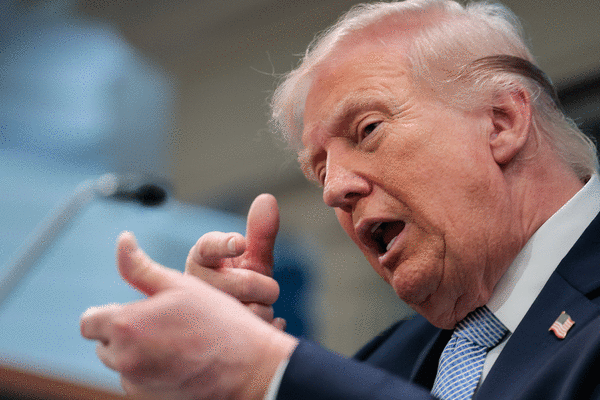
A ceasefire now appears to be holding between the United States and Iran, the result of President Donald Trump's repeated threats against the country to open the Strait of Hormuz and resume global commerce.
It's a significant development. It may even be the outcome Trump was aiming for.
But even if it holds — even if it becomes lasting peace — it won’t erase what Americans watched in real time: a president of the United States publicly taunting an adversary, invoking faith (on Easter morning) and threatening catastrophic destruction in language that sounded less like strategy and more like provocation.
"Open the F---in' Strait, you crazy b------s, or you’ll be living in Hell - JUST WATCH!" Trump added, concluding his message: "Praise be to Allah."
It may have worked. The U.S. has now received a 10-point Iranian proposal that led to the ceasefire. Although, as retired Army Gen. Barry McCaffrey noted, there is no indication of regime change, no confirmed access to Iran's nuclear program and the country remains a threat to the region. Control of commercial traffic through the Strait of Hormuz, he said, could still effectively sit with the Iranian military.
Regardless, it was crude, concerning — and revealing.
Presidents are always speaking to multiple audiences, including enemies, allies and global markets. But their primary audience is the American people.
Trump displayed escalation without discipline — rhetoric that rattled the public and introduced uncertainty at a moment when clarity was being demanded.
There is little evidence that this level of language was necessary to achieve the outcome. The closure of the strait was a predictable response to U.S. strikes. A strategy to reopen it should have existed well before the threats began.
Instead, Americans were left watching a president suggest that a “whole civilization will die tonight,” while markets, allies and civilians across the region tried to determine whether that was bluster or intent.
The distinction is important. When a U.S. president speaks, the world must take him seriously. The justification that this is just Trump’s “way of doing things” doesn’t hold up.
Even if the immediate objective is achieved, the longer-term consequences remain. Allies are forced to adjust, along with adversaries. Innocent civilians — including those already living under an oppressive regime — absorb the signal that things may escalate without warning.
The ceasefire won’t eliminate that instability.
Trump’s rhetoric also crossed lines that American leadership has historically been careful to keep distinct — invoking religious language in the middle of geopolitical threats.
Trump’s administration only heightens perceptions that the Iran mission is a crusade.
That suggests Trump is not just trying to get a successful outcome but shaping how the outcome is reached. His tactics reveal just how expansive he believes his power to be.
Trump may have secured a temporary pause, and that is a good thing.
But the way he did it left behind a different kind of damage. It won’t show up in the ceasefire agreements, but it will shape how Americans and the world view the next crisis — and to whom they will look to for leadership.
_____
©2026 www.detroitnews.com. Visit at detroitnews.com. Distributed by Tribune Content Agency, LLC.













































Comments