Commentary: Why Donald Trump's war could play into China's hands
Published in Op Eds
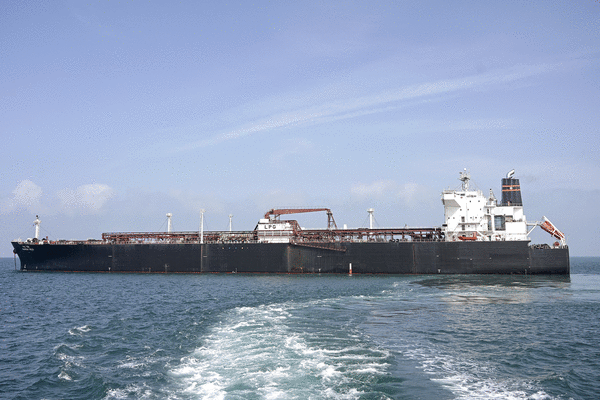
There are many plausible rationales for the U.S.-Israel war against Iran. Some proponents have even suggested that one goal is to deal a blow against China.
Former Secretary of State Mike Pompeo argues: “If this regime falls and gives way to a government that actually represents the will of the Iranian people, Beijing can say goodbye to the cheap shipments of crude oil that have helped power its economy.”
Pompeo added: “But more than that, it will lose a critical foothold from which to project power in the region and undermine U.S. interests.”
This is almost certainly untrue. Pompeo and those who agree with him fail to understand China-Iran relations and how Beijing might actually benefit from the current war.
Let’s first consider Pompeo’s claims about the Chinese economy. In fact, Moscow is a much bigger supplier of oil to Beijing than Tehran. Further, the war is well timed for both Russia and China. Because India has been reducing its imports of Russian oil to satisfy the demands of President Donald Trump’s administration, the spare oil on the market will most likely find its way to China instead.
Moscow has been eager to expand its energy relationship with Beijing, an act that will provide lifeblood to Russia’s economy. While major projects such as the Power of Siberia 2 pipeline have been on hold for some years, the Iran war will likely help Moscow’s case for this new energy linkage. Beijing has taken some prudent steps in the present crisis to adjust its energy policies, but one reason China has been tepid on a new major oil pipeline from Russia is that China’s thirst for oil has plateaued in recent years, and it even declined in 2024.
Problems in the Persian Gulf, moreover, are likely to give further impetus to China-Russia energy cooperation in the Arctic, since the Northern Sea Route has always been advertised in both countries as an alternative to the volatile route from the Middle East. It should also be kept in mind that China has developed a rail corridor that connects to Iran via Central Asia. There is additionally some limited evidence that Iran will permit Chinese shipping to pass through the Strait of Hormuz, while vessels of the U.S. and its allies will not be permitted to do so.
Pompeo also seems unaware that Beijing has spent the last couple of years topping off its large strategic petroleum reserves. The U.S. economy is likely to be hurt by quickly rising energy prices, and it’s not at all clear that China will be hit harder, especially given America’s inflation troubles.
Pompeo further claims that China will lose a strategic foothold for projecting power in the Middle East thanks to the Iran war, and this deserves close scrutiny.
Despite much speculation, China maintains no military bases in Iran or in the Persian Gulf area. True, there has been a series of joint naval exercises involving Iran, China and Russia, but these have been exceedingly small in scale with just a handful of warships. It’s also notable that Iran has, for several decades, not imported a single major weapons system from China. In short, China’s military relationship with Iran remains of minor significance.
In addition, China has decent relationships with many states that are rivals of Iran, for example Saudi Arabia, the United Arab Emirates and even Israel. There are thus very few signs that Beijing is on the verge of “projecting power” into the Middle East.
China may even stand to benefit militarily from the U.S-Iran war, contrary to what Pompeo supposes. At the soft power level, China will gain prestige and influence, since it will appear in the eyes of much of the world as a restrained great power upholding the status quo — quite the contrast to the U.S., which is increasingly viewed as having gone rogue.
From a narrowly military-strategic perspective, China will benefit from the fact that more U.S. forces may shift from the Asia-Pacific into the Middle East, and U.S. military munitions stocks are likely to be further denuded. Also, Chinese strategists will get yet another chance to closely study U.S. military technologies and doctrines — and any weaknesses that could become apparent.
This final point is disturbing and raises the troubling possibility that, should the U.S. dedicate serious effort to suppressing Chinese ambitions, Beijing may choose to participate more actively in proxy wars against the U.S. Already there are some concerns about intelligence sharing, for example, as Chinese satellite photos of U.S. military bases and deployments have been posted to the internet, and these photos are quite possibly aiding Iranian targeting.
China has traditionally sought to emphasize commerce and play peacemaker, avoiding risky involvement in regional conflicts. But if U.S. leaders continue to treat Beijing as an adversary, then soon it might start playing that role more actively.
____
Lyle Goldstein is director of the Asia Program at Defense Priorities.
___
©2026 Chicago Tribune. Visit at chicagotribune.com. Distributed by Tribune Content Agency, LLC.


















































Comments