Lynn Schmidt: Kentucky's Paul and Massie stand firm on principle over party
Published in Op Eds
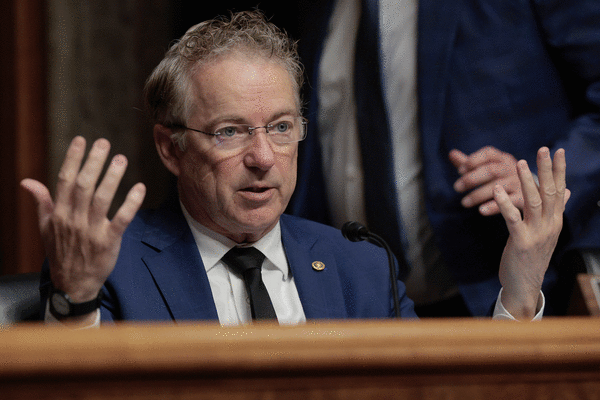
Two congressional Republicans from the Bluegrass State are serving as a model of how members of Congress can act with conviction over political convenience.
In an era when partisan loyalty often trumps individual conviction, Sen. Rand Paul of Kentucky and Rep. Thomas Massie of Kentucky stand out as lawmakers willing to break with their party when principle demands it.
While critics may dismiss their contrarian votes as obstruction, a closer examination reveals a consistent philosophy that places constitutional limits, fiscal responsibility, and protection of some of their most vulnerable constituents above political expediency.
Paul has built his career on a libertarian-conservative foundation that prioritizes individual liberty and limited government. Unlike many who campaign on these values only to abandon them once in office, Paul has maintained remarkable consistency.
He was one of the few Republicans willing to challenge defense spending increases under a Republican president, arguing that fiscal conservatism cannot be selective.
When both parties supported massive pandemic relief packages with minimal oversight, Paul stood virtually alone, demanding accountability for how trillions in taxpayer dollars would be spent. His filibuster against reauthorizing the Patriot Act demonstrated his willingness to stand for civil liberties even when it meant opposing his own party's leadership.
Paul's recent opposition to President Donald Trump's tariff policies further exemplifies his commitment. In April 2025, he introduced the “No Taxation Without Representation Act,” requiring Congressional approval before any new tariffs can be imposed by executive action.
He argued that tariffs are taxes, and that only Congress has constitutional authority to levy them. Paul co-sponsored resolutions with Democratic senators to block Trump's tariffs on Canada, which passed the Senate 51-48, and to terminate the national emergency declaration used to justify broad tariff implementation.
Despite facing intense criticism from Trump supporters, Paul has maintained that these tariffs harm American families economically and constitute executive overreach constitutionally. It shows, once again, his willingness to defend principle regardless of political cost.
Massie has earned a similar reputation for voting his conscience regardless of political pressure.
Recently, at a local GOP dinner, and before someone took the microphone away from him, Massie had the following to say: “I vote with the GOP in D.C. 91% of the time, because 9% of the time, they’re bankrupting our country, starting another war, or covering up for pedophiles.”
Also: “I am a congressman. I don’t work for the speaker of the House; I work for you.”
Massie's recent work on the Epstein files further exemplifies his commitment to transparency and accountability, regardless of political consequences. Massie was a co-sponsor of the “Epstein Files Transparency Act”, the legislation that forced the public release of documents related to Jeffrey Epstein.
After examining the unredacted files at the Justice Department alongside his co-sponsor, Democratic Representative Ro Khanna, Massie reported finding at least six men whose names were redacted but who appeared to be implicated in the documents.
More remarkably, Massie publicly called for Commerce Secretary Howard Lutnick's resignation after reviewing documents that included Lutnick's name, demonstrating a willingness to hold members of his own party's administration accountable.
None of this is without cost. Massie told a journalist that “Kash Patel's FBI” is threatening his staff with criminal investigations if he continues “speaking up about Israel and the Epstein files.”
Trump called Massie a “moron” at the National Prayer Breakfast, endorsed a primary challenger against Massie, and accused Massie's new wife of being part of the “radical left” and a “flamethrower.” Trump suggested Massie “became a Liberal” because of her, despite Massie’s noting she had voted for Trump three times.
What makes both men genuinely principled rather than merely contrarian is the consistency of their underlying philosophy. They don't oppose spending increases only when the other party is in power; they oppose them regardless of who occupies the White House. They don't defend civil liberties only for those they agree with; they defend them as universal principles.
Critics argue that their votes sometimes achieve nothing beyond making a statement, but this misunderstands the role of principle in politics. When everyone votes with their party, voters lose the ability to distinguish genuine conviction from political calculation — and in a Congress where most members calculate every vote to maximize their chances of reelection and advancement, Paul and Massie represent something increasingly rare: legislators who are willing to lose their seats than compromise their core beliefs.
Whether you agree with their ideology or not, their willingness to put constitutional duty above partisan pressure provides a model of what elected representation can be when divorced from pure political calculation. In that sense, they serve their country by demonstrating that conviction-driven governance is still possible, even if it's no longer fashionable.
____
©2026 STLtoday.com. Distributed by Tribune Content Agency, LLC.










































Comments