David Banks: On Jesse Jackson, and the never-ending pursuit of a better world
Published in Op Eds
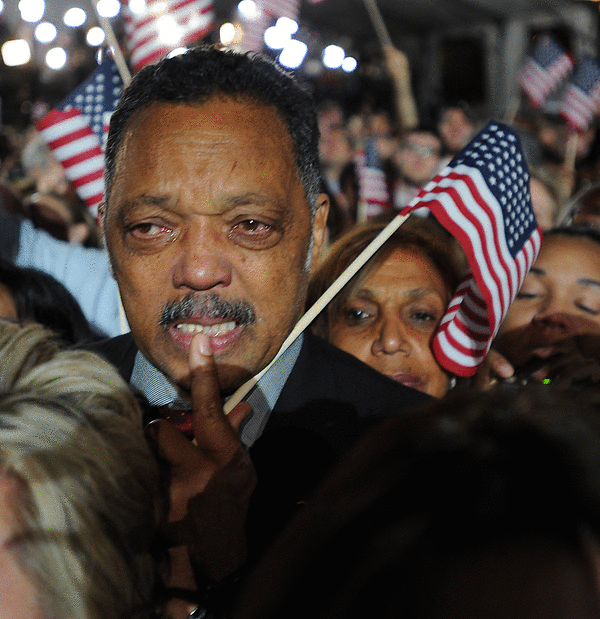
For those of us who grew up after the 1960s — at least those of us who are white and were raised in rural Minnesota — it seemed, perhaps, that the battle for civil rights had been fought and won, and that we, lucky us, didn’t have to inconvenience ourselves with it.
Of course we knew about the nation’s history, ranging from its original sin of slavery to its stubborn grip on inequality to the tumultuous era immediately preceding us that aimed, finally, to change all that. But it was abstract.
We knew Black people had suffered. We knew white people had caused it — and had perceived a right to cause it — but those people weren’t us. Maybe we felt superior because we lived in the North. Maybe in moments of real reflection we felt lucky that we didn’t have to truly know how we would have behaved in those situations ourselves. Maybe we felt we could be complacent.
We knew of the leaders. The Rev. Martin Luther King Jr., whose line of thinking felt reasonable to us. Malcolm X, whose didn’t. Even if we failed to properly understand either man.
But the leading civil rights figure of our era was Jesse Jackson. His face and his voice were prominent in news coverage, sometimes to the point of caricature. He ran for president, twice, under the aim of expanding the cause of civil rights into a coalition of poor and working-class people of all colors. A Rainbow Coalition.
Jackson died on Tuesday at 84. The cause was not immediately given, but in the last decade he’d struggled with a neurodegenerative condition. In this century he’d become much less broadly visible, but no less an advocate. A New York Times obituary noted that he’d tried to pick up King’s mantle but never achieved the commanding moral stature. Another man, perhaps, misunderstood.
I’ve been using the universal “we” throughout this column. There are people better able than I am to write about Jackson’s legacy. And even with regard to people who grew up with a distance to it as I did, I’m at risk of projecting. But I also now have the advantage of nearly six decades of existence, and in such an amount of time a person becomes painfully aware of human nature.
As it happens, just the other evening I finished watching “The Butler,” a 2013 film by Lee Daniels. This is the one critiqued in some corners as being the “Forrest Gump” of civil rights — in which the main character just happens to be in the middle of the significant events of his era. That assessment is not completely unfair. “The Butler” is based on a real person, Eugene Allen, who worked in the White House across several administrations. But it’s fictionalized.
But there’s more to the movie than that (and I liked “Gump” anyway). Despite its sweep, it’s a story on a human scale. It’s about relationships. About the roles we play and the faces we wear to survive. It’s about what we sacrifice, and how, in pursuit of a better world. It’s about the conflict between the various methods of that pursuit. It’s about the daftness and hypocrisy of those who don’t bear the brunt of the worse world.
I’d started streaming the movie three years ago and had to stop. It was too hard to watch. It wasn’t as if I didn’t know this material by then, but the knowledge of it only gets harder to endure.
Near the end, the main character has long since left his role in the White House but is watching on television as the U.S. elects its first Black president. He’s in tears. Everything he’s endured, everything he’s lost as he tried to navigate it all in the ways that seemed best to him, has come to this moment.
I’m a stoic, a cynic, but I felt it as well in real time. I was alone in the Star Tribune Editorial Board’s conference room in our old building on Portland Avenue in November 2008, waiting to produce a page with an editorial about Barack Obama’s election. My own tears were flowing. I wasn’t sure I’d earned them.
Nearly 20 years later I was viewing the recreation in the movie. The emotion was no less powerful. But it was even more complicated, tainted by anger.
Because all I could think was: And yet.
___
©2026 The Minnesota Star Tribune. Visit at startribune.com. Distributed by Tribune Content Agency, LLC.
















































Comments