Commentary: The danger isn't history repeating -- it's us ignoring the echoes
Published in Op Eds
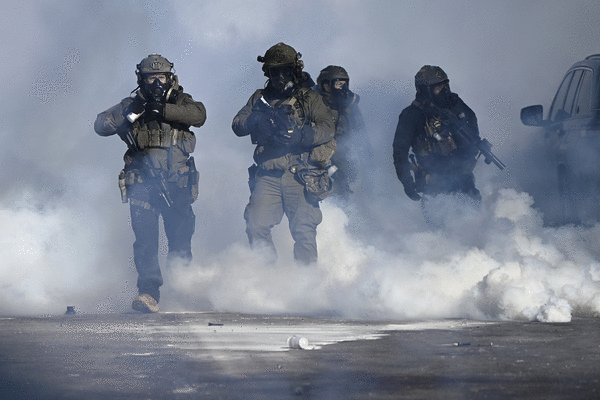
The instinct to look away is one of the most enduring patterns in democratic backsliding. History rarely announces itself with a single rupture; it accumulates through a series of choices—some deliberate, many passive—that allow state power to harden against the people it is meant to serve.
As federal immigration enforcement escalates across American cities today, historians are warning that the public reactions we are witnessing bear uncomfortable similarities to the way many Germans responded to Adolf Hitler’s early rise in the 1930s. The comparison is not about equating leaders or eras. It is about recognizing how societies normalize state violence when it is directed at those deemed “other.”
In Germany, the pattern is well documented. Hitler’s ascent was not inevitable; it was enabled by political elites who believed they could contain him and by a public conditioned to overlook the early targeting of Jews and other minorities. Historian Timothy Ryback, who has written extensively about Hitler’s early political development, told the Jewish Telegraphic Agency that Hitler’s rise was facilitated by rivals and allies who “underestimated him or thought they could ‘tame’ him once in power.”
Ryback is explicit that “Trump is not Hitler, by any means,” but he adds that “there are modalities that are very similar,” particularly in how institutions and the public respond to escalating abuses. The U.S. Holocaust Memorial Museum notes that Hitler’s worldview took shape in an environment where “antisemitism and ethnic nationalism flourished,” creating a social climate in which discriminatory policies could be introduced with little resistance. Facing History & Ourselves, an organization that studies the period, puts it more bluntly: “Choices made by individuals and groups contributed to the rise of the Nazi Party,” including the choice to ignore or excuse early acts of state violence.
The United States is not Weimar Germany, but the dynamics of public response deserve scrutiny. Nationwide, residents have documented aggressive ICE operations that include warrantless home entries, detentions of U.S. citizens, chemical agents deployed near schools, and masked federal agents questioning people in parking lots and outside gas stations.
Local officials have raised alarms about the scale of the federal presence and the absence of oversight. Amnesty International USA recently warned of “rising authoritarian practices and erosion of human rights in the United States,” with Executive Director Paul O’Brien stating, “We are witnessing a dangerous trajectory under President Trump that has already led to a human rights emergency.”
DHS maintains that operations target “the worst criminals,” yet federal data shows that 73 percent of people detained nationally have no criminal convictions, and only 5% have violent convictions. The gap between rhetoric and reality is widening, and the public response is following a familiar pattern: some protest, many look away, and others rationalize the abuses as necessary for security.
What historians find most striking is not the presence of state power—that exists in every nation—but the willingness of ordinary people to normalize its excesses. In early‑1930s Germany, many citizens viewed the targeting of Jews as a distant issue, something that affected “others.”
Today, civil rights groups report a similar distancing in the United States, where many Americans see ICE actions as justified or irrelevant to their own lives, even when U.S. citizens are detained or when local governments warn of legal violations. Political incentives reinforce this passivity. During the Weimar Republic’s collapse, parties across the spectrum tolerated Hitler for short‑term gain. In the U.S., some lawmakers have expressed concern about ICE operations but stopped short of challenging the administration directly, citing political risk.
Historians caution that democratic erosion rarely begins with dramatic gestures. It begins with the public learning to tolerate the intolerable. Frank McDonough, a leading historian of Nazi Germany, has said that dictators often rise because “people didn’t take them seriously enough.” Ryback echoes this point, noting that “there are lessons learned—and ignored—from Hitler’s rise to power.” The lesson is not that history repeats itself in identical form. It is that democracies falter when citizens and institutions decide that the suffering of targeted groups is an acceptable cost of political order.
The question facing the United States today is not whether it is 1933. It is whether we recognize the warning signs that historians have spent decades documenting. When federal agents operate with minimal oversight, when marginalized communities are treated as expendable, and when the public grows accustomed to scenes that would once have been unthinkable, the issue is not only the actions of the state. It is the silence that meets them.
Democracies are not only defended at the ballot box or in the courts. They are defended in the everyday choices people make about what they are willing to see, to question, and to refuse. The danger is not that America will repeat Germany’s past. The danger is that we will ignore the echoes long enough to discover that the guardrails we assumed would hold have already been worn down by our own indifference.
______
_____
©2026 The Fulcrum. Visit at thefulcrum.us. Distributed by Tribune Content Agency, LLC.













































Comments