Commentary: Why James Forman still matters
Published in Op Eds
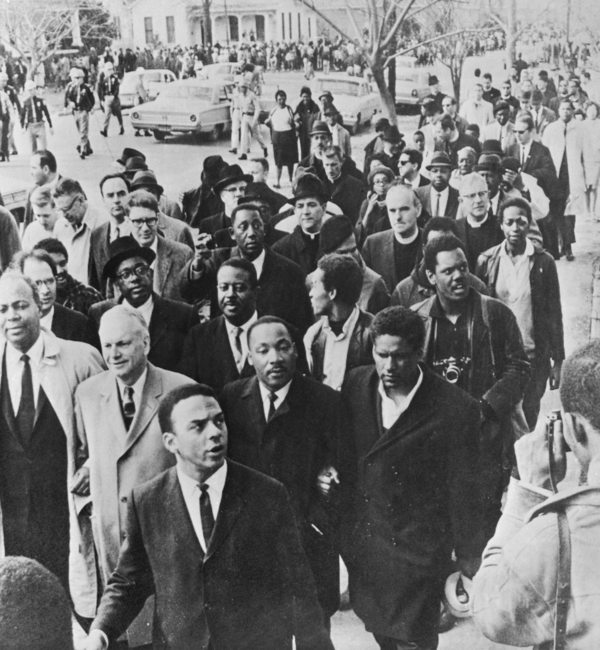
Movements rarely collapse because the enemy is too strong. More often, they rot from within — through the loss of discipline, morale and political clarity. The civil rights leader James Forman warned us about this decades ago. We ignored him.
James Forman was a revolutionary organizer, strategist and movement builder who helped shape the Black freedom struggle into something more militant, internationalist, democratic and explicitly revolutionary.
As executive secretary of the Student Nonviolent Coordinating Committee (SNCC), Forman was a behind-the-scenes organizer who was deeply embedded in the work of the Civil Rights Movement. He helped organize sharecroppers, students and poor Black communities across the Jim Crow South under constant threat of violence.
Cut from the same radical cloth as activist and leader Ella Baker, Forman embraced a democratic organizing tradition rooted in building local, indigenous power from the ground up.
Forman’s career, as recounted in his 1997 book, “The Making of Black Revolutionaries,” centered on his insistence on political education, discipline and reflection. He believed that struggle alone was not enough — organizers also had to actively study racism, white supremacy, capitalism and the state while engaging in daily struggle against them.
But just as importantly, he believed organizers had a responsibility to reflect honestly on their experiences, mistakes and contradictions, and to write them down so future generations could learn from them. That kind of intentional reflection is something we too often neglect today.
As the head of an organization committed to improving the lives of boys and men of color by creating and supporting legislation, I have seen over the past five years how decades of progress can be swiftly undone. That means the struggle is never over.
I’ve read the academic texts. I’ve heard the moral arguments for racial justice. I’ve studied abstract theories of revolution. And I am determined to remember, above all, that we have been here before, and will be again. What we need now are the reflections of people who actually went out and tried to make revolution — people like James Forman, who organized under pressure, made mistakes, learned hard lessons and kept going. We can study the past to make way for the future, collectively adding on to our theoretical narrative, not writing a new one.
Forman’s short but powerful 1970 manual, “Twenty Enemy Forces Within a Revolutionary Organization That Must Be Combatted,” was written as a tool for movement self-criticism. It offered a clear-eyed assessment of the internal habits, liberal illusions, ego and organizational weaknesses that quietly undermine revolutionary movements from the inside. The book, Forman wrote, was meant “to consolidate the thoughts of many people who have had negative experiences with the tendencies listed as enemy forces within a revolutionary organization.”
In the introduction, Forman makes his purpose unmistakably clear: “Individuals who belong to revolutionary organizations that are seeking and working toward the seizure of state power must not only study the theory and practice of other revolutionaries, but must carefully study our own experiences and draw conclusions from those experiences that will help others.”
We often spend all our energy diagnosing external enemies, while ignoring the internal forces that limit our capacity to build real power. “Twenty Enemy Forces” offers a starting point for that work, as a guide for action, discussion and collective learning. I believe many of our current organizations — and the people within them — are constrained by the limits of liberalism, and those limits are actively undermining our ability to win tangible gains for our communities.
Forman died of colon cancer in 2005, at age 76. Yet his life’s work continues in its invitation to build organizations capable of challenging imperialism, capitalism and white supremacy.
Movements don’t usually collapse because the enemy is too strong, but because we refuse to confront the internal habits that make us undisciplined, incoherent and easy to defeat. This Black History Month, let us reflect on how James Forman showed us the way.
____
Eric Morrison-Smith is executive director of the Alliance for Boys and Men of Color, a nonprofit group focused on enacting legislative work and policies to improve the lives of boys and men of color in California. This column was produced for Progressive Perspectives, a project of The Progressive magazine, and distributed by Tribune News Service.
_____
©2026 Tribune Content Agency, LLC.


















































Comments