Commentary: Why medication abortion is the top target for anti-abortion groups in 2026
Published in Op Eds
January would have marked the 53rd anniversary of Roe v. Wade, the 1973 Supreme Court decision that legalized abortion nationwide — that is, until 2022, when the court overturned it. Since then, abortion has been banned in 13 states and severely limited in 10 others.
Yet anti-abortion activists remain frustrated, in some cases even more so than before Roe was overturned.
Why? Because despite the new legal restrictions, abortions have not stopped taking place, not even in states with complete bans. In fact, the number of abortions has not dropped at all, according to the latest statistics.
“Indeed, abortions have tragically increased in Louisiana and other pro-life states,” Liz Murrill, Louisiana’s attorney general, said at a Senate Health, Education, Labor, and Pensions Committee hearing this month.
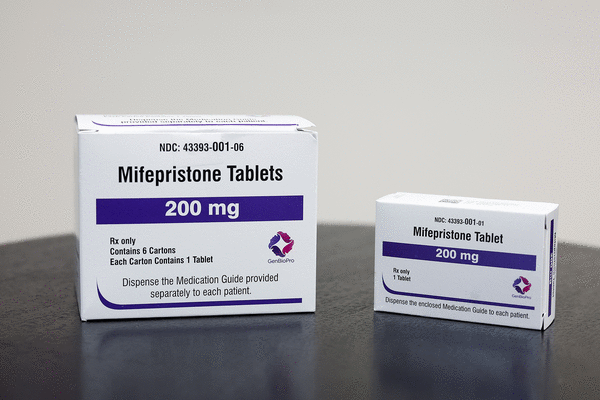
That’s due in large part to the easier availability of medication abortion, which uses a combination of the drugs mifepristone and misoprostol, and particularly to the pills’ availability via mail after a telehealth visit with a licensed health professional.
Allowing telehealth access was a major change originally made on a temporary basis during the COVID pandemic, when visits to a doctor’s office were largely unavailable. Before that, unlike most medications, mifepristone could be dispensed only directly, and only by a medical professional individually certified by the Food and Drug Administration.
The Biden administration later permanently eliminated the requirement for an in-person visit — a change the second Trump administration has not undone.
While the percentage of abortions using medication had been growing every year since 2000, when the FDA first approved mifepristone for pregnancy termination, the Biden administration’s decision to drop the in-person dispensing requirement supercharged its use. More than 60% of all abortions were done using medication rather than a procedure in 2023, the most recent year for which statistics are available. More than a quarter of all abortions that year were managed via telehealth.
Separately, President Donald Trump’s FDA in October approved a second generic version of mifepristone, angering abortion opponents. FDA officials said at the time that they had no choice — that as long as the original drug remains approved, federal law requires them to OK copies that are “bioequivalent” to the approved drug.
It’s clear that reining in, if not canceling, the approval of pregnancy-terminating medication is a top priority for abortion opponents. This month, Susan B. Anthony Pro-Life America called abortion drugs “America’s New Public Health Crisis,” referencing their growing use in ending pregnancies as well as claims of safety concerns — such as the risk a woman could be given the drugs unknowingly or suffer serious complications. Decades of research and experience show medication abortion is safe and complications are rare.
Another group, Students for Life, has been trying to make the case that the biological waste from the use of mifepristone is contaminating the nation’s water supply, though environmental scientists refute that claim.
Yet the groups are most frustrated not with supporters of abortion rights but with the Trump administration. The object of most of their ire is the FDA, which they say is dragging its feet on a promised review of the abortion pill and the Biden administration’s loosened requirements around its availability.
President Joe Biden’s COVID-era policy allowing abortion drugs to be sent via mail "should’ve been rescinded on day one of the administration,” SBA Pro-Life America’s president, Marjorie Dannenfelser, said in a recent statement. Instead, almost a year later, she continued, “pro-life states are being completely undermined in their ability to enforce the laws that they passed.”
Lawmakers who oppose abortion access are also pressing the administration. “At an absolute minimum, the previous in-person safeguards must be restored immediately,” Senate HELP Committee Chairman Bill Cassidy said during the hearing with Murrill and other witnesses who want to see abortion pill availability curtailed.
Sen. Jim Banks, R-Ind., said at the hearing that he hoped “the rumors are false” that “the agency is intentionally slow-walking its study on mifepristone’s health risks.”
The White House and spokespeople at the Department of Health and Human Services have denied the review is being purposely delayed.
“The FDA’s scientific review process is thorough and takes the time necessary to ensure decisions are grounded in gold-standard science,” HHS spokesperson Emily Hilliard said in an emailed response to KFF Health News. “Dr. Makary is upholding that standard as part of the Department’s commitment to rigorous, evidence-based review.” That’s a reference to Marty Makary, the FDA commissioner.
Revoking abortion pill access may not be as easy as advocates hoped when Trump moved back into the White House. While the president delivered on many of the goals of his anti-abortion backers during his first term, especially the confirmation of Supreme Court justices who made overturning Roe possible, he has been far less doctrinaire in his second go-round.
Earlier this month, Trump unnerved some of his supporters by advising House Republicans that lawmakers “have to be a little flexible” on the Hyde Amendment to appeal to voters, referring to a decades-old appropriations rule that bans most federal abortion funding and that some Republicans have been pushing to enforce more broadly.
And while the anniversary of Trump’s inauguration has many analysts noting how much of the Heritage Foundation’s Project 2025 blueprint has been realized, the most headline-grabbing portions on reproductive health have yet to be enacted. The Trump administration has not, for example, revoked the approval of mifepristone for pregnancy termination, nor has it invoked the 1873 Comstock Act, which could effectively ban abortion nationwide by stopping not just the mailing of abortion pills but also anything else used in providing abortions.
Still, abortion opponents have decades of practice at remaining hopeful — and playing a long game.
____
HealthBent, a regular feature of KFF Health News, offers insight into and analysis of policies and politics from KFF Health News chief Washington correspondent Julie Rovner, who has covered health care for more than 30 years.
_____
©2026 KFF Health News. Distributed by Tribune Content Agency, LLC.


















































Comments